Ponds in the Sava floodplain
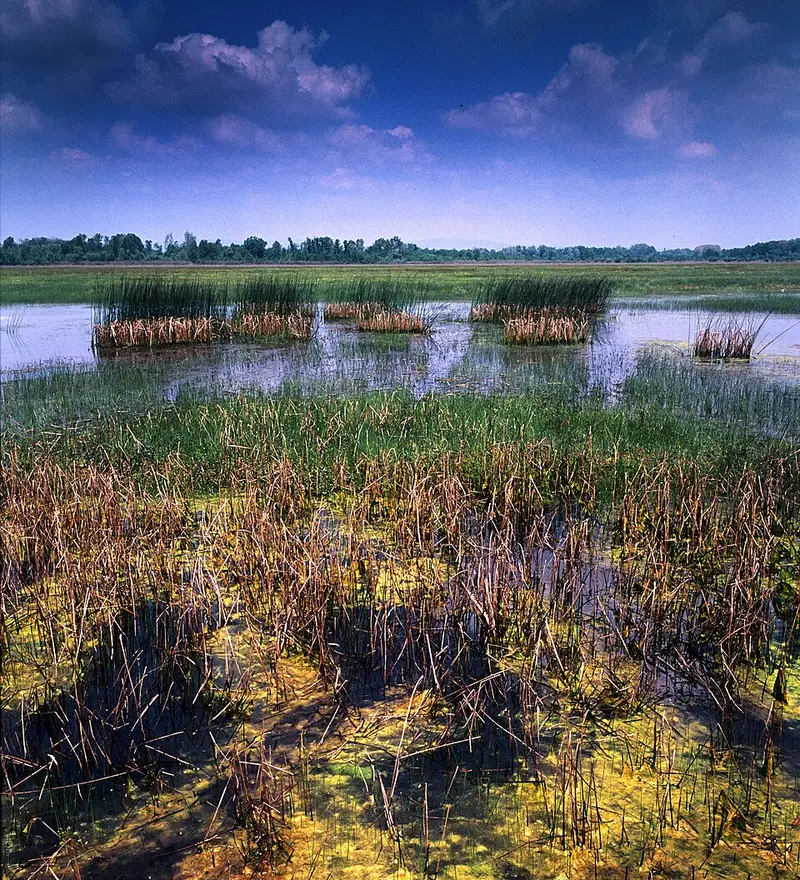
Bardača lies in the north of Republika Srpska between the right bank of the Sava and the left bank of the Vrbas, in the north-eastern part of Lijevče polje, at around 100 metres above sea level. About half of the Ramsar site consisted of fishponds, built from the early 20th century and enlarged in the 1960s for irrigation. The lakes were fed by three small streams, the Matura, Stublaja and Brzaja.
The village of Bardača grew up around 1901 in the area of the Jovača forest, when the Sava embankment and the fishponds were built. The driving forces were Artur and Viktor Burda from Galicia; Viktor Burda was a well-known fisheries expert. The name Bardača comes from the word “bara”, a pond or marsh.
Habitat for waterbirds
As early as 1969 all breeding colonies of waterbirds at Bardača were placed under protection, and in 1973 the researcher Svjetoslav Obratil described the area as a special habitat for marsh birds. After new surveys in 2001 recorded 185 bird species, conservationists began working to have the area protected. On 2 February 2007 Bardača was designated a Ramsar site covering 3500 hectares. Ponds, floodplain forest, meadows and swamps offered breeding and resting places for endangered species, along with a rich fish fauna, amphibians such as the fire salamander and the agile frog, and the European pond turtle.
Drainage and the present situation
Between 2010 and 2012 the wetland suffered heavy destruction, partly due to the extremely dry summer of 2011, but mainly because the owner had the fishponds converted into farmland. According to the Center for Environment in Banja Luka, only three of the eleven lakes still held water, Rakitovac, Sinjak and Mali Dajkovac; at the Dugo Polje I, Dugo Polje II and Lug lakes, trees that served many birds as nesting sites were cut down. A procedure by Republika Srpska for preliminary protection ended at the end of 2017 with its suspension.
In 2016 staff of the Center reported that only a few bird species could still be seen and that species such as the glossy ibis, coot, whiskered tern, black-headed gull and great crested grebe no longer nested there. According to the Center in 2018, of the three Ramsar sites in Bosnia and Herzegovina only Hutovo blato had protected area status. Anyone visiting Bardača should therefore not expect an intact lake landscape.
The art and ecology colony
In 1984 the Likovno-ekološka kolonija, a colony for art and environmental protection, was founded at Bardača. The idea arose in 1983 at a painters’ colony on the island of Iž; its initiator was the painter Rajko Petković, who came from Srbac. Its declared aim was to protect the nature of Srbac municipality, above all the Bardača reserve, from pollution. The colony continued even during the war, and its collection includes more than 600 works of art.