A railway village on the Una
Dobrljin lies 15 kilometres from Novi Grad on the right bank of the Una and is first mentioned in the 13th century. Its history is closely tied to the railway. After a journey to Europe, Sultan Abdülaziz decided to build a line that would link Constantinople with Vienna. Work on the section from Dobrljin to Banja Luka began in spring 1871, and it opened at the end of December 1872: a standard-gauge line 101.6 kilometres long with 13 bridges, two of them made of iron.
Today Dobrljin has a station on the network of the Railways of Republika Srpska. Locals say that people used to claim you could travel from here by train all the way to Berlin, and that over time ‘Doberlin’ turned into Dobrljin.
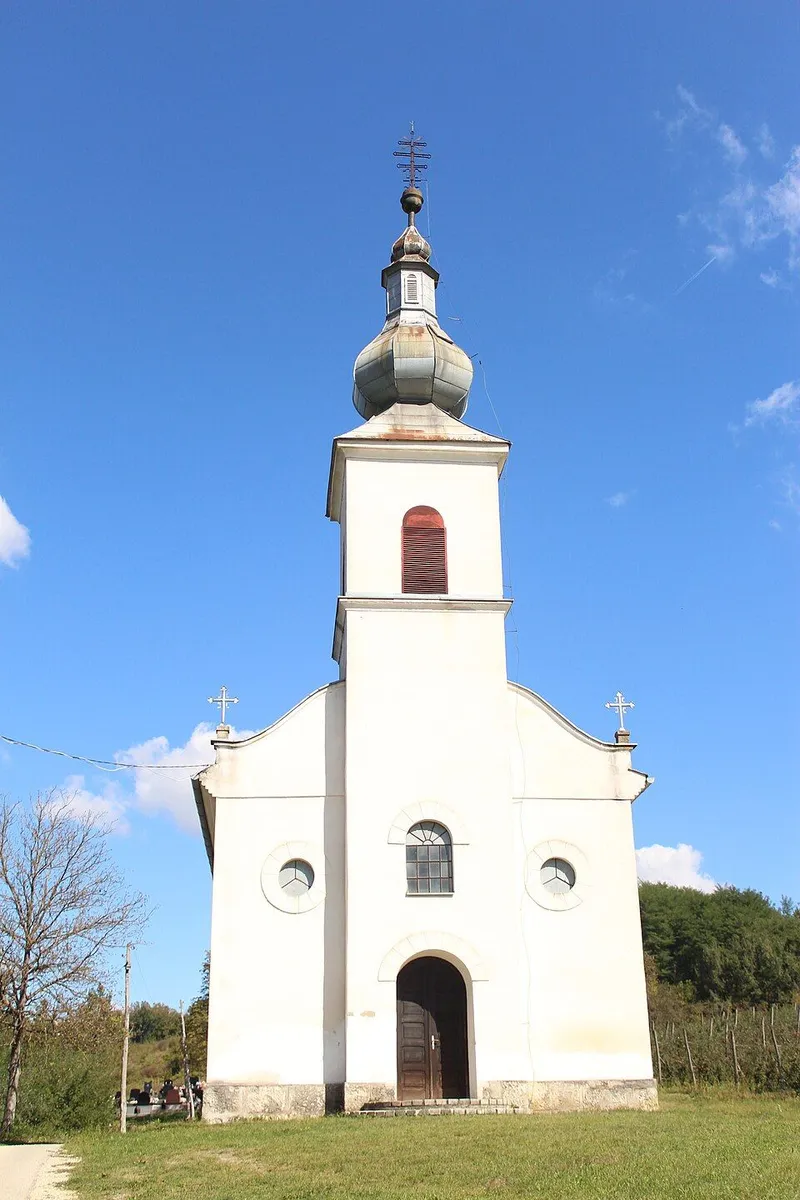
The parish church of St Nicholas
According to the parish priest, Dobrljin is an old parish in the municipality of Novi Grad, and church life here goes back a long way. A wooden church previously stood on the site of today's church; the present building was put up to replace that old log church. It is dedicated to the Translation of the Relics of St Nicholas. The church bell was hung in 1920 and later fell during an earthquake.
Besides Dobrljin, the parish includes the villages of Gornje and Donje Vodičevo, Kuljani, Prusci and Velika Žuljevica.
War and a new beginning
The Second World War hit the parish hard, and a large part of the population was killed. Particularly well known is Archpriest Aleksa Popović, a priest of the village who was tortured by the Ustaše. They forced him to tear down the monument to King Peter I that he had put up together with his parishioners. He was then held in Kostajnica for a time, sent to forced labour in Koprivnica and from there to the police prison in Zagreb. After his deportation he died in Belgrade on 6 December 1944.
For a long time afterwards the parish had no priest of its own, and priests from Kostajnica looked after the area. Parish life only revived in 1996. The bust of King Peter I from 1924, destroyed by the Ustaše in April 1941, now stands restored in the courtyard of the parish house.