A lake in a glacial cirque
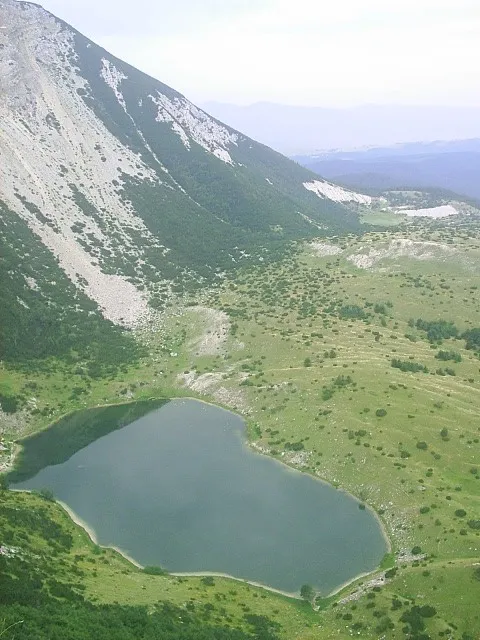
Šator rises to 1872 metres on the northern edge of the Livanjsko polje, and its conical summit can be seen from far away. The mountain owes its unusual name – šator means tent – to this shape; close up, however, it turns out to be an irregular tangle of ridges and peaks. Among the summits lies a huge stone cirque carved by glaciers, with the lake at its bottom.
The slopes of Šator are densely forested up to about 1700 metres. Above them rise peaks that are gentle on the outside but drop into the lake basin in cliffs and scree. The rock walls of Mali Šator, Veliki Šator and Babina greda enclose the lake to the north, east and south and tower more than 400 metres above the shore. The slopes are covered in dwarf pine, and the so-called Vražji vrtovi, the Devil's Gardens, on Babina greda make a striking sight.
Water, plants and animals
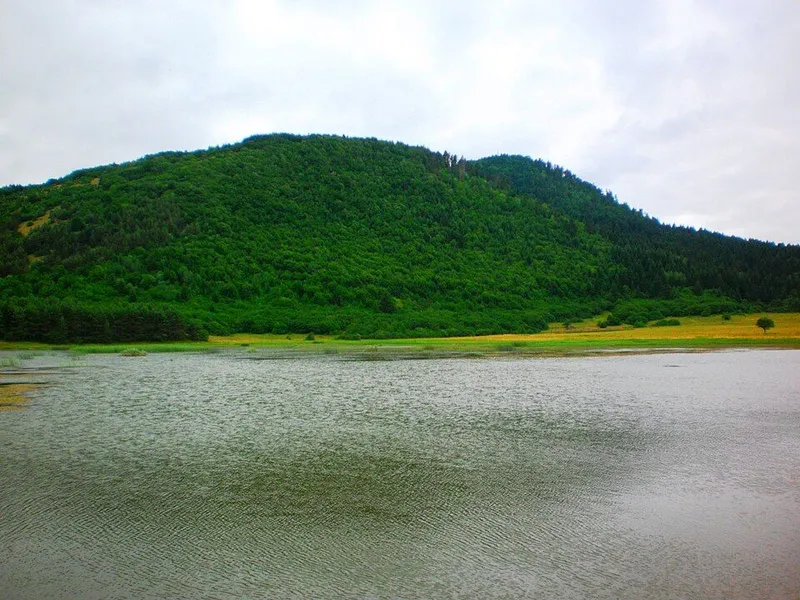
The municipality gives the lake's size as 337 metres long, 127 metres wide and up to 8 metres deep; other sources give smaller figures. It is fed by a spring a few metres from the south-west shore, while water drains away on the opposite, north-eastern side, so the level always stays the same. The Mlinski potok flows out of the lake and later joins the Šatorski potok to form the Unac river.
The water looks dark green because pondweed (Potamogeton) grows on the bottom. It is clear down to 4 metres, so much of the lake bed is visible. In summer the water reaches around 17 °C, while the spring on the shore stays at just 6 °C. From December to April the lake is frozen, with ice up to 70 centimetres thick.
An endemic amphibian, a newt referred to by the municipality as the triton, lives in the lake, and the protected edelweiss grows just above the shore.
Ilindan at the lake
On Ilindan, St Elijah's Day, people from the area gather at the lake to show themselves and the younger generation, through song and dance, who they are and where they come from. In the morning they go to the Bulino vrelo spring near the lake to wash. The long-standing custom is linked to an oral tradition about a blind bula, a Muslim woman, who is said to have regained her sight after washing at the spring – hence the name. The spring lies a few hundred metres north of the lake, and locals believe it has healing powers. Later in the day everyone gathers around the lake, which becomes the meeting place.
At other times, visitors can walk along the shore, swim in the lake or climb to the summit of Šator.
Protection and Ledenica cave
The Assembly of Canton 10 has declared Ledenica cave and Šatorsko jezero eco-zones of special interest, and the municipality of Bosansko Grahovo has adopted an expert study on their protection. A European Union project supported the protection of both sites as rare geological phenomena.
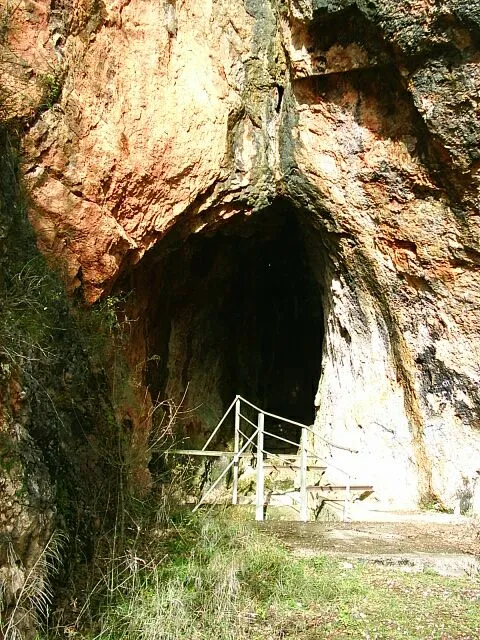
Ledenica is an open sinkhole cave on the north-western edge of the Resanovačko polje, on the slopes of Stražbenica near the village of Resanovci. It takes its name from the ice that forms in the entrance hall in winter and lasts until July or August. The entrance lies at 878 metres, and the explored section is 697.5 metres long. The cave contains formations such as stalactites, stalagmites and columns, and it has been protected as a natural rarity and geological phenomenon since 5 June 1959.
The lake is reached from the Bosansko Grahovo–Livno road via Gornje Peulje; it is 37 kilometres from the centre of Grahovo.