Motorhome in Bosnia: tolls and documents
Insurance, speed limits, winter rules and motorway tolls: what you need to know when driving a motorhome or towing in Bosnia and Herzegovina. As of 10/2026.
As of October 2026. Rules can change. Check your foreign ministry's travel advice before you set off.
Planning to take a motorhome, caravan or trailer to Bosnia and Herzegovina? Here you will find what authorities and motoring clubs say about it. ID, registration and health insurance are covered in Camping in Bosnia: tips before you travel.
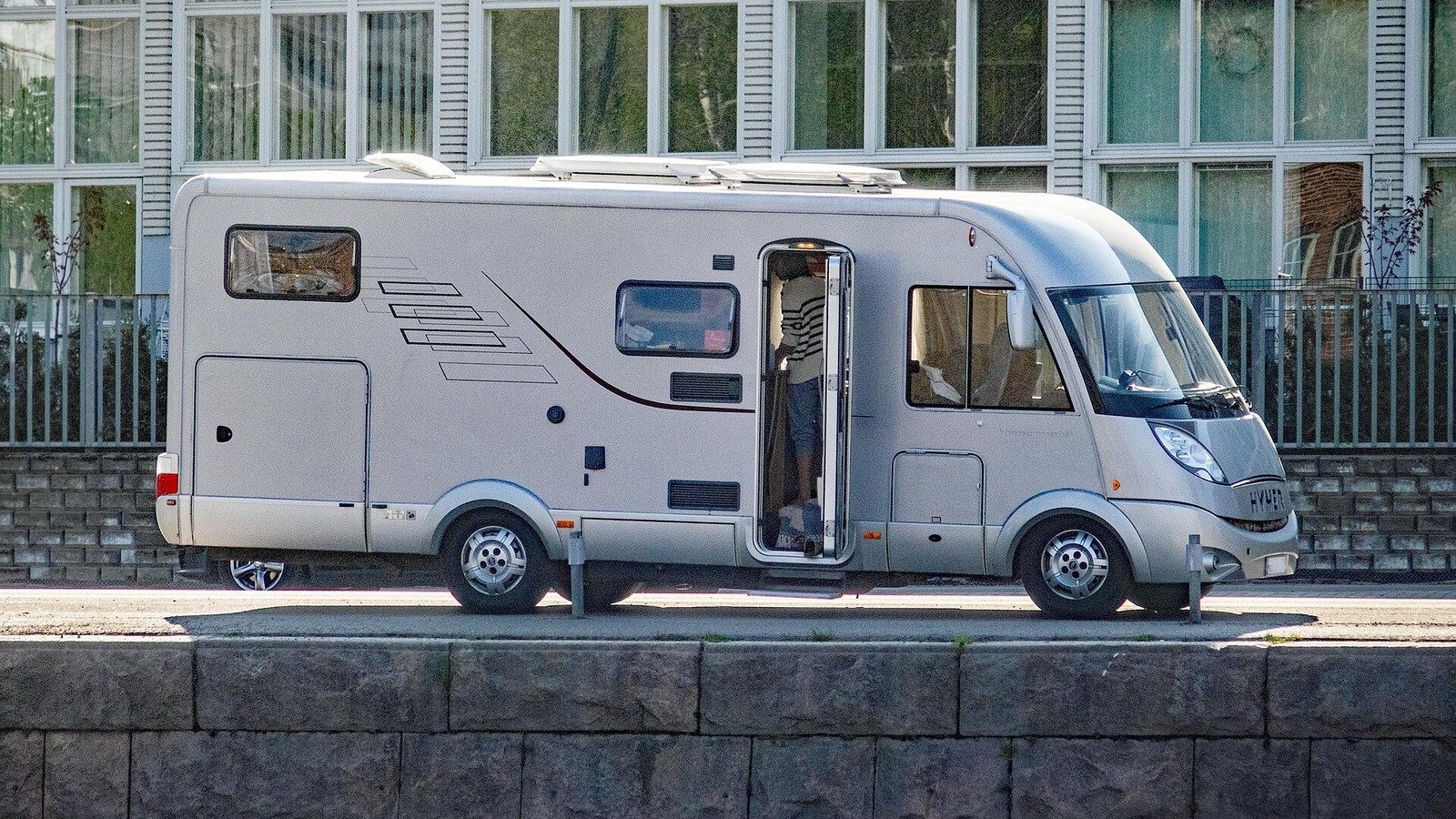 Illustrative photo: a motorhome on a trip.
Vehicle documents and insurance
For the vehicle, the German motoring club ADAC lists the registration certificate Part I. According to the German Federal Foreign Office, the country recognises your German driving licence. According to ADAC, you do not need an international driving permit. The Swiss TCS strongly recommends the international driving permit for Swiss drivers.
Vehicles with German, Austrian or Swiss number plates count as insured in Bosnia and Herzegovina. The number plate is sufficient proof. That is what the country's Green Card Bureau (Biro zelene karte BiH) says. So a Green Card is not mandatory. ADAC and ÖAMTC recommend one anyway. If you bring one, the country code "BIH" must be on it. The Austrian Foreign Ministry writes that the insurance card may be requested during checks. If you are towing, according to ÖAMTC you also need the insurance card for the trailer.
If you do not have valid third-party liability insurance, you take out border insurance with a Bosnian insurer at the border. This cannot be done online. The price depends on the vehicle type and the duration. According to ADAC, the statutory minimum cover is well below the German level.
For the country identifier, ADAC mentions the oval D sticker. The TCS lists the CH sticker as mandatory for Swiss drivers. None of the sources say whether a Euro number plate with a country code replaces it.
Mandatory equipment and lights
For cars, the ÖAMTC lists this mandatory equipment:
- tow rope (3 to 5 metres)
- spare wheel or repair kit
- first-aid kit, no more than five years old
- warning triangle and high-visibility vest
- spare bulb kit, except for xenon, LED or neon lights
The TCS list is shorter: CH sticker, warning triangle, spare wheel, tow rope and first-aid kit.
According to ADAC, you put on the high-visibility vest as soon as you get out on a country road or motorway. According to ADAC, dipped headlights are mandatory all year round, even during the day; according to ÖAMTC, daytime running lights are also enough. According to ADAC, you may only use your phone at the wheel with a hands-free kit.
Speed limits for motorhomes and towing
For cars and motorhomes up to 3.5 tonnes, ADAC and ÖAMTC give these values:
| Road | Speed limit |
|---|---|
| in built-up areas | 50 km/h |
| outside built-up areas | 80 km/h |
| expressway | 100 km/h |
| motorway | 130 km/h |
With a caravan or light trailer, 80 km/h applies on the motorway. That is what the motorway company JP Autoceste says, and the same goes for lorries from 3.5 to 7.5 tonnes.
For vehicles towing a trailer and motorhomes over 3.5 tonnes, ADAC, ÖAMTC and TCS give slightly different values. What they all have in common: a maximum of 80 km/h outside built-up areas, including on expressways and motorways. In built-up areas, ADAC and TCS give 50 km/h.
Alcohol limit and winter rules
The blood alcohol limit is 0.3 per mille. Novice drivers and drivers under 21 must have no alcohol in their blood at all. According to ADAC, a novice driver is anyone who has held a licence for less than three years.
From 1 November to 1 April, winter equipment is mandatory. The clubs differ on exactly what that includes. According to ADAC, you need winter tyres. As an alternative, ADAC mentions two winter tyres on the drive axle or summer tyres with at least 4 mm of tread, but then with snow chains on board. According to ADAC, studded tyres are prohibited. The ÖAMTC mentions four M+S tyres; according to the TCS, snow socks are also allowed.
Motorway tolls: how they work
The motorways in the Federation are operated by JP Autoceste FBiH. Tolls there are a closed system. When you enter, you get a magnetic card, and at the exit you pay according to distance and vehicle class. You pay in cash, by card or with the ACC subscription device. According to ÖAMTC, the device costs 33 KM and gives a discount of around 20 per cent.
The toll stations accept euros. Change is given only in KM, calculated at 1 euro = 1.80 KM according to the JP Autoceste price lists (2025 and 2026). That is less than the fixed rate of 1.95583 KM. According to ÖAMTC, euros are only accepted as notes. Card-only lanes ("ONLY CARD") for classes I and II are open around the clock in Svilaj, Ljubuški, Zenica jug and Tarčin.
Look after the card. If you lose it, you pay double the toll for the longest route. The same applies if you are on the motorway for more than 14 hours. Or if you exit at the same point where you entered, more than 15 minutes later.
According to JP Autoceste, these sections are tolled:
- Svilaj to Odžak
- Doboj jug to Medakovo
- Sarajevo sjever to Zenica sjever
- Sarajevo zapad to Bradina
- Čapljina (Međugorje) to Ljubuški
JP Autoceste answers questions on 080 02 03 06.
Which toll class applies to your motorhome
The vehicle classification has applied since 12 August 2024. Class I covers vehicles with two axles, no more than 1.3 metres high at the first axle, with up to seven seats and up to 3.5 tonnes.
Under the JP Autoceste classification, a class I car with a caravan falls into class II. Your motorhome up to 3.5 tonnes also ends up there if it is higher than 1.3 metres at the first axle. If you hitch a trailer to this motorhome, it falls into class III. A motorhome over 3.5 tonnes that is higher than 1.3 metres at the first axle also ends up there. A motorhome over 3.5 tonnes with a trailer falls into class IV.
Sample prices in KM per toll class from the JP Autoceste price lists (as of 2025 and 2026):
| Route | I | II | III | IV |
|---|---|---|---|---|
| Sarajevo sjever to Zenica sjever | 7.00 | 14.00 | 21.00 | 28.00 |
| Sarajevo zapad to Bradina | 3.50 | 7.00 | 10.50 | 14.00 |
| Ljubuški to Čapljina | 2.20 | 4.50 | 6.50 | 9.00 |
| Doboj jug to Medakovo | 0.80 | 1.60 | 2.40 | 3.20 |
Republika Srpska has its own toll system. It is best to check current prices and payment methods there before you travel.
Roads and police
The German Federal Foreign Office describes the roads like this: markings are often inadequate and the condition is often poor. Not every route from your satnav is passable. The EDA points out how few kilometres of motorway there are and advises caution, especially at night.
Police checks are always carried out by two officers. You can pay fines on the spot. Otherwise the police may temporarily keep your driving licence.
After an accident involving injury, foreigners who are not resident in the country may face pre-trial detention. The EDA advises against moving the vehicle after an accident until the police arrive. The ÖAMTC recommends carrying the European Accident Statement. Breakdown assistance is provided by the automobile club BIHAMK. The Austrian Foreign Ministry gives 1282, 1285 or 1288 for this.
Do not pick up hitchhikers. According to the German Federal Foreign Office, anyone who does so may come under suspicion of people smuggling.
Fuel and gas
LPG is called "Autoplin", "Plin" or "UNP" locally and, according to ADAC, is available. According to ADAC, you need the Dish adapter. According to ADAC, CNG is hard to find. For a spare fuel can, ADAC recommends a maximum of 5 litres.
We have not found a reliable source on service points for motorhomes. Ask your host where you can get fresh water and get rid of your waste water.
Parking safely
According to the German Federal Foreign Office, cars with foreign number plates are a favoured target. Do not leave any valuables or documents in the vehicle, not even in the boot. In larger cities the EDA recommends guarded car parks. What is known about parking up overnight in the open is in Wild camping in Bosnia: rules and landmines.
With hosts on Camplix
With hosts on Camplix, you send your request through us, in English. Ask at the same time whether your motorhome fits on the site and whether the host will register you. You can find an overview of the whole country here. If you are only driving via Neum to Dubrovnik, read Neum corridor and Pelješac Bridge explained.
Sources
- ADAC: Bosnia-Herzegovina, vehicle information, undated, accessed October 2026
- ÖAMTC: country information for Bosnia and Herzegovina, undated, accessed October 2026
- TCS: country information for Bosnia and Herzegovina, undated, accessed October 2026
- Biro zelene karte BiH (Green Card Bureau): information for drivers of foreign vehicles, copyright 2021
- JP Autoceste FBiH: Cestarina (tolls), undated, accessed October 2026
- JP Autoceste FBiH: vehicle classification, valid since 12 August 2024
- JP Autoceste FBiH: ONLY CARD, undated, accessed October 2026
- JP Autoceste FBiH: speeds on the motorway, undated, accessed October 2026
- JP Autoceste FBiH: price list Doboj jug to Medakovo (PDF), 2026
- German Federal Foreign Office (Auswärtiges Amt): Bosnia and Herzegovina, travel and safety advice, as of 19 October 2026
- Austrian Foreign Ministry (BMEIA): travel information for Bosnia and Herzegovina, as of 19 October 2026
- EDA: travel advice for Bosnia and Herzegovina, on site, updated 30 April 2026
- Central Bank of Bosnia and Herzegovina: KM exchange rate, 2021