Camping in Bosnia: tips before you travel
ID, registration, money and health insurance: what to sort out before your camping holiday in Bosnia and Herzegovina. As of October 2026.
As of October 2026. Rules can change. Check your foreign ministry's travel advice before you set off.
Before you head to Bosnia and Herzegovina with a tent or a motorhome, it is worth looking at a few rules. Here you will find what authorities and motoring clubs say about them. The sources are listed at the end. There is a separate post on driving with a motorhome or towing a caravan or trailer: Motorhome in Bosnia: tolls and documents.
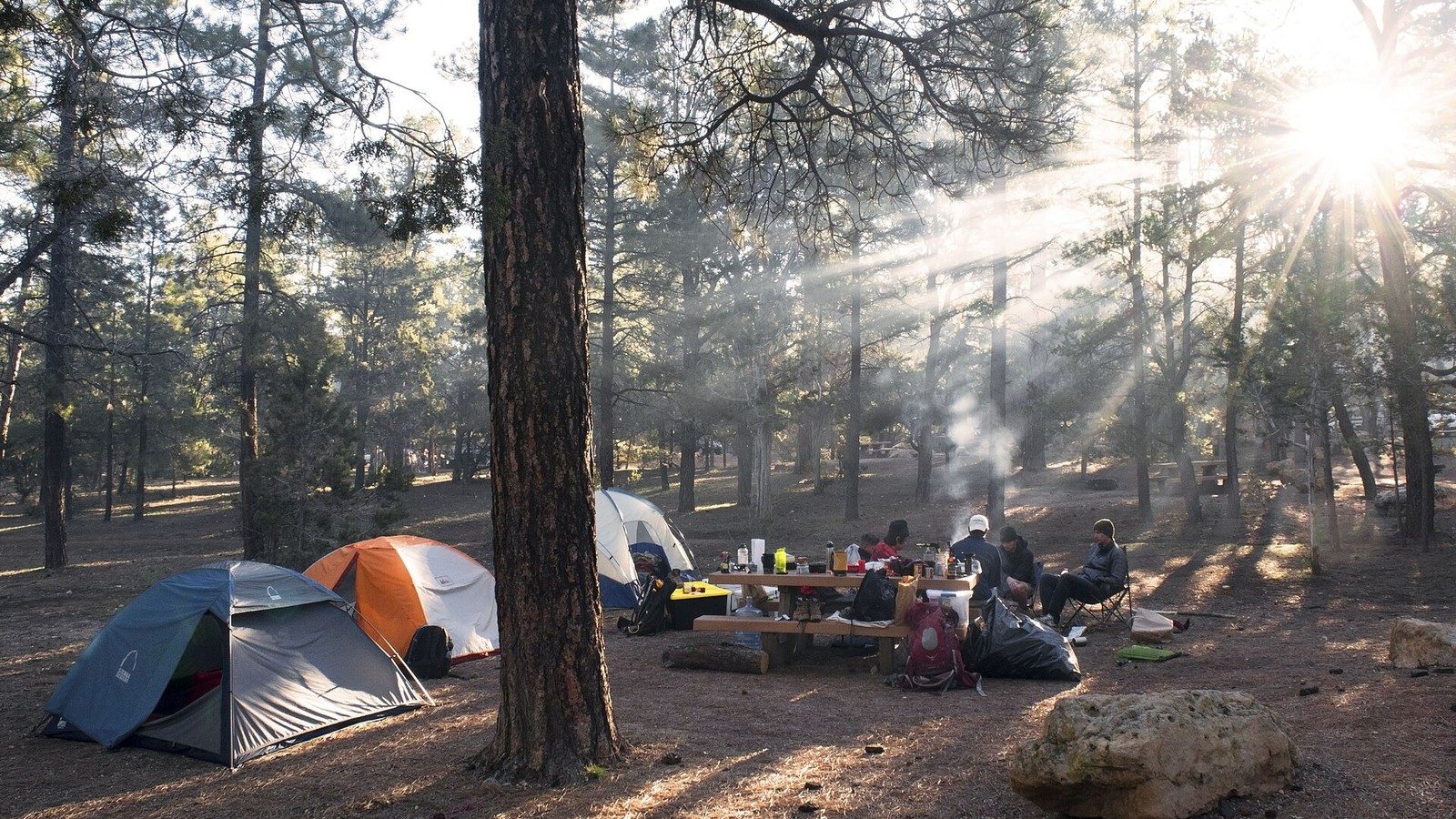 Illustrative photo: tents on a forest campsite.
Which ID documents you need
From Germany you can enter with a passport, a temporary passport, an ID card or a child passport. Bosnia and Herzegovina does not accept the temporary ID card. According to the German Federal Foreign Office, your document must be valid for at least three months beyond your departure.
From Austria you can enter with a passport or a valid ID card, and an emergency passport is accepted as well. The Austrian Foreign Ministry also states three months of validity beyond departure for the passport.
From Switzerland, it is best to bring your passport. The Swiss Federal Department of Foreign Affairs (EDA) writes that you should carry your passport or ID at all times. It does not explicitly confirm whether the identity card is enough for entry. If in doubt, ask the diplomatic mission of Bosnia and Herzegovina in Switzerland.
You do not need a visa for short stays. You may stay up to 90 days within 180 days. According to the Service for Foreigners' Affairs, anyone who stays longer risks a fine of 300 to 1,500 KM. This can be followed by expulsion and an entry ban of one to five years.
On entry you may be asked to show that you have enough money for your stay: 150 BAM per person per day, which is about 75 euros. You can prove this in cash or by non-cash means.
Travelling with children
If a child travels alone, the German Federal Foreign Office recommends written consent from the parents. It should be translated (into Bosnian, Croatian or Serbian) and certified. If the child travels with only one parent, consent from the other parent is advisable.
For minors who are not travelling with both parents, the Austrian Foreign Ministry lists a declaration of consent. On top of that come copies of the birth certificate and of the passports of the persons with parental authority. The Swiss motoring club TCS writes that children under 14 travelling without their parents need a certified declaration from both parents.
Registration: what your host does and what you do yourself
If you enter visa-free, your stay must be registered within 48 hours of entry. This does not apply to short stays. The sources differ slightly on exactly where the cut-off lies. This rule keeps you on the safe side: if you stay three days or longer, you should be registered.
If you stay in registered commercial accommodation, the operator must register you. They have at most twelve hours from the start of your stay to do so. In that case you do not have to register yourself. It is best to ask in advance whether your campsite is such a provider.
If you stay with private individuals or not in commercial accommodation, you register yourself. You must do this within 48 hours of entry, at the Service for Foreigners' Affairs or at the police. The Austrian Foreign Ministry advises taking your passport with you. According to the German Federal Foreign Office, self-registration costs about 10 BAM. Keep the proof of registration with you. Under the Law on Foreigners, anyone who does not register risks a fine of 100 to 500 KM.
When you send your request, ask your host whether they will register you.
Money: marks, euros and cards
You pay in convertible marks (KM, internationally BAM). The rate has been fixed since 2001: 1 euro is 1.95583 KM.
According to the German Federal Foreign Office, Visa and Mastercard are increasingly accepted, American Express rarely. Markets and small shops are often cash-only, and small notes help. The Austrian Foreign Ministry writes that credit cards are only accepted in cities. You can withdraw money with your credit card at cash machines. According to the Austrian Foreign Ministry, there are cash machines in larger towns.
No official source says whether shops, restaurants or campsites take euros. This is documented only for the JP Autoceste toll stations in the Federation. Change is given there only in KM. More on this in the post Motorhome in Bosnia: tolls and documents.
You must declare cash of more than 10,000 euros.
Health insurance and emergencies
From Germany: According to the German health insurer DAK, the European Health Insurance Card is not valid in Bosnia and Herzegovina. Instead you need an Auslandskrankenschein, a certificate for treatment abroad. With DAK you print it yourself after logging in, and every family member insured with you needs their own. Ask your own insurer how it works there.
From Austria: Two official sources contradict each other here. According to oesterreich.gv.at you can use the e-card: you present it in advance to the insurance institution in Bosnia and Herzegovina and receive a treatment voucher there. Alternatively, an Auslandskrankenschein works. Benefits are only provided under the law of the country, and you pay the rest yourself. The Austrian Foreign Ministry, by contrast, writes that the e-card is only valid in the EU, the EEA and Switzerland, and recommends additional insurance.
From Switzerland: According to the EDA, hospitals require a financial guarantee, meaning a credit card or advance payment.
For everyone: medical care does not meet EU standards. The German Federal Foreign Office strongly recommends travel health insurance that is valid worldwide and includes repatriation. There are no mandatory vaccinations. The German Federal Foreign Office recommends vaccinations against hepatitis A and polio, and depending on the trip also against hepatitis B, rabies and tick-borne encephalitis (TBE).
These are the emergency numbers you should know:
- Police: 122
- Fire brigade: 123
- Ambulance: 124
Do not rely on 112. According to the legal portal paragraf.ba, it had not yet been introduced in September 2024. Whether that has changed since is not documented.
Sources describe the number 121 differently. The Austrian Foreign Ministry lists it as mountain rescue, the mine action centre BHMAC as civil protection. According to the German Federal Foreign Office, you can reach the GSS mountain rescue service at +387 63 11 22 33. For Swiss citizens, the EDA has the crisis numbers +41 800 24-7-365 and +41 58 465 33 33.
Mobile phone and roaming
Bosnia and Herzegovina is not covered by the EU's "Roam like at Home" rule. On 25 February 2026, the European Commission proposed negotiating on this with the six Western Balkan countries. However, the surcharges only disappear once an agreement is in place and the country has fully adopted the EU rules. For your trip in 2026 this means: check your tariff before you go.
Safety and landmines
According to the German Federal Foreign Office, crime is low overall, though there is pickpocketing in tourist spots. Cars with foreign number plates are a favoured target. So do not leave any valuables or documents in the car, not even in the boot. In larger cities the EDA recommends guarded car parks. The German Federal Foreign Office describes the domestic political situation as stable in principle.
Mines and unexploded ordnance lie mainly away from the main routes. The German Federal Foreign Office advises against leaving paved roads, including near Sarajevo, and against entering fallow land or ruins. How to recognise danger zones is explained in Wild camping in Bosnia: rules and landmines. If your dog is coming along, also read With your dog to Bosnia and back into the EU.
With hosts on Camplix
With hosts on Camplix, you send your request through us, in English. Ask straight away whether the host will register you. You can find an overview of the whole country here.
Sources
- German Federal Foreign Office (Auswärtiges Amt): Bosnia and Herzegovina, travel and safety advice, as of 19 October 2026
- Austrian Foreign Ministry (BMEIA): travel information for Bosnia and Herzegovina, as of 19 October 2026
- EDA: travel advice for Bosnia and Herzegovina, on site, updated 30 April 2026
- EDA: country page Bosnia and Herzegovina, accessed October 2026
- Služba za poslove sa strancima (Service for Foreigners' Affairs BiH): Boravak stranaca u BiH, undated, accessed October 2026
- Služba za poslove sa strancima: Najčešća pitanja (FAQ), undated, accessed October 2026
- Zakon o strancima BiH (Law on Foreigners) on paragraf.ba, 2023 version
- TCS: country information for Bosnia and Herzegovina, undated, accessed October 2026
- ÖAMTC: country information for Bosnia and Herzegovina, undated, accessed October 2026
- Central Bank of Bosnia and Herzegovina: KM exchange rate, 2021
- JP Autoceste FBiH: Cestarina (tolls), undated, accessed October 2026
- DAK: printing your Auslandskrankenschein yourself, as of 1 October 2026
- oesterreich.gv.at: health insurance when travelling, as of 3 August 2026
- paragraf.ba: report on the emergency number 112, 17 September 2024
- BHMAC: short guide to mine risk (draft), 06/2024
- European Commission: roaming, negotiations with the Western Balkans, 25 February 2026