Protected area and location
Protection is based on the Law on Drina National Park and a designation study adopted by the National Assembly of Republika Srpska in 2017. It ranks as the country's fourth national park and Republika Srpska's third, after Sutjeska and Kozara. The park authority, a public institution, was established on 22 February 2018 and is based in Skelani.
The park lies on the middle course of the Drina in the east of the country, in the Stari Vlah region, and belongs to the inner belt of the Dinaric Alps. The terrain ranges from 291 to 1,265 metres in altitude.
The canyon and Lake Perućac
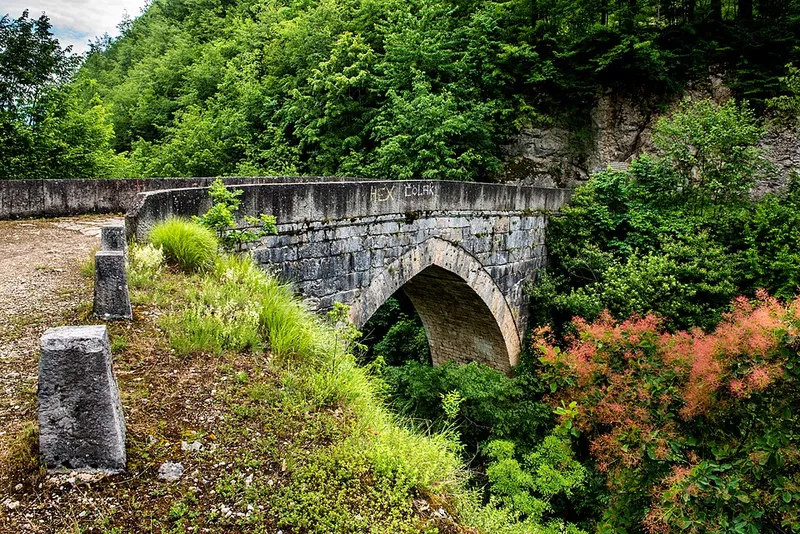
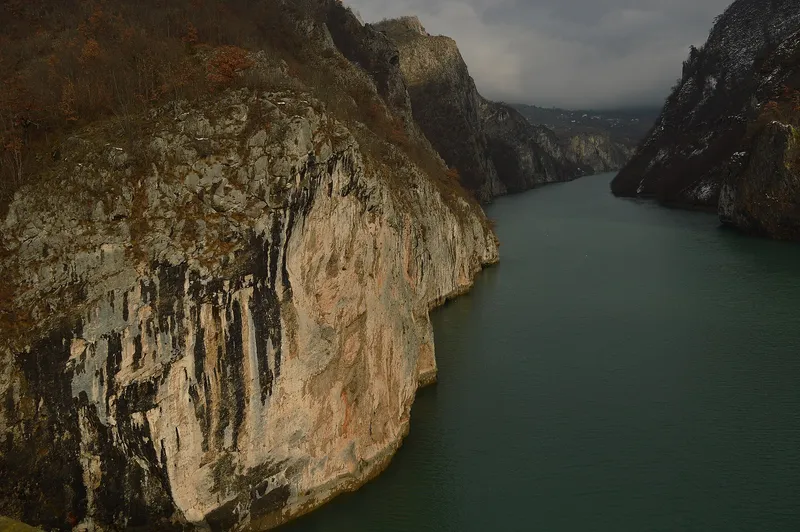
The park mainly protects the rocky gorges and canyons of the Drina and its tributaries, with their steep, vertical walls. At the mouth of the Crni Potok the canyon reaches a depth of 976 metres. The Crni Potok itself rises at over 1,100 metres and drops more than 800 metres in just 6 kilometres before joining the Drina.
Lake Perućac was created in 1966, when the Drina was dammed for the Bajina Bašta hydroelectric plant. The lake lies 30 km southeast of Srebrenica and is navigable, with boat trips running between Tara National Park and the Sušica hunting reserve. The Drina and Pančić regattas are held on the lake.
Serbian spruce and wildlife
Among the key features the park protects is the Serbian spruce (Picea omorika), an endemic species and a relic of the Tertiary. It once grew across much of the continent; today it grows only around the middle course of the Drina, in Bosnia and Herzegovina in the municipalities of Rogatica, Srebrenica, Foča, Čajniče and Višegrad, and in Serbia on Mount Tara. Many endemic and relict species grow in the crevices of the limestone cliffs in the canyon.
About 635 taxa of vascular plants have been recorded in total. Edraianthus jugoslavicus, Daphne malyana and Sesleria tenuifolia are part of plant communities of endemic character. Among the animals, the brown bear, chamois and golden eagle stand out.
Forts, stećci and Roman remains
The medieval fort of Klotjevac stands on a height overlooking the Drina canyon. It measures 100 by 20 metres, with surviving towers and walls and the remains of stables; about ten stećci stand on Jatara hill. 7 kilometres downstream, Đurđevac fort sits on a ridge above the left bank, with a square tower up to 3 metres high and an outer wall about 25 metres long. It is recorded in 1444 together with its settlement.
Necropolises such as Greben, with 70 tombstones, and Babajići, with 35, preserve many stećci, and there are Roman tombstones at Mataruzi. The Skelani archaeological site, with a Roman settlement and two early Christian basilicas, is a National Monument; finds are shown at the "Roman Municipium" museum in Skelani.
The area belongs to the historic region of Osat, which in the last century was known for its excellent builders.