Founded by Župan Pribil
The monastery goes back to Župan Pribil and his sons Stefan and Petar; 1343 is given as its founding year. Dating of the frescoes places its construction between 1340 and 1343, under King and later Tsar Stefan Dušan. Pribil was lord of Dobrun at the time and also built his court inside the fortress. Reliable records of the founding are scarce, though, and scholars disagree considerably on the dates.
Pribil's son Petar later added a painted outer narthex on the west side and a treasury on the north side next to the altar area. In the records of the Dubrovnik archives, Dobrun appears in 1407 as a fief of the Pavlović noble family.
Destruction and rebuilding
When the Ottomans pushed into the area in 1393, Dobrun was hit hard and the monastery was devastated; Despot Stefan Lazarević and Princess Milica had it restored. In 1462 the Ottomans took Dobrun, destroyed the town and damaged the monastery, which was then abandoned. It was rebuilt in the 16th century, destroyed again at the end of the 17th century and only restored a century later.
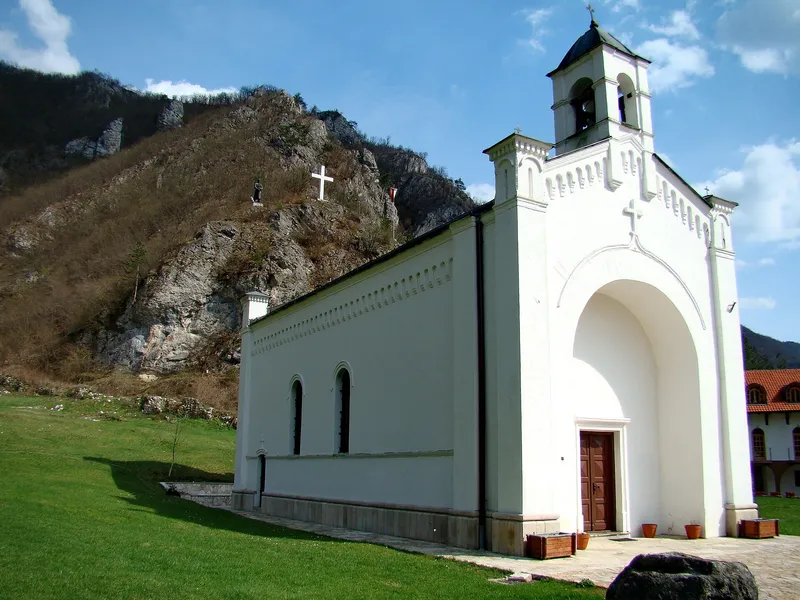
After the Herzegovina uprising of 1875, the altar area, the roof and part of the naos lay in ruins; the west wall of the narthex with its frescoes survived. Metropolitan Sava Kosanović visited Dobrun in 1884 and set the renewal in motion. Funded by his collections, local contributions and Baroness Vilhelmina Nikolić, the church was renewed in 1886 to plans by architect Josip Vancaš. Only Pribil's original church was restored, not Petar's narthex and treasury, which is how it stands today.
After damage in the First World War, the monastery was renewed in 1921. On 20 January 1945, retreating German troops set off an ammunition store in the naos. The eastern part was razed to its foundations, but a partition wall saved the western part with its 14th-century frescoes. Rebuilt with local donations, the church was reconsecrated in November 1946.
The church and its frescoes
The church is a single-nave, vaulted stone building. Its naos is divided into three unequal bays, 7 metres long in total and 5 metres wide inside; to the east it ends in a low apse that is semicircular both inside and out.
Originally the entire interior was painted, down to the niche of the entrance portal. The scheme includes Christ enthroned, the Mother of God and saints such as Sava, Petka and Clement of Ohrid, along with eight portraits of historical figures. The images of King Dušan with Queen Jelena and the young Uroš have survived to this day, as has the donor portrait: Pribil holds a model of the church, with his sons Petar and Stefan beside him. The protovestiarios Stan is depicted too. The frescoes were painted by skilled masters from southern Serbia.
The monastery is still active today. The complex includes a Museum of the First Serbian Uprising, a picture gallery and a museum of the Metropolitanate of Dabar-Bosnia.
Dobrun fortress, hermits' cave and railway
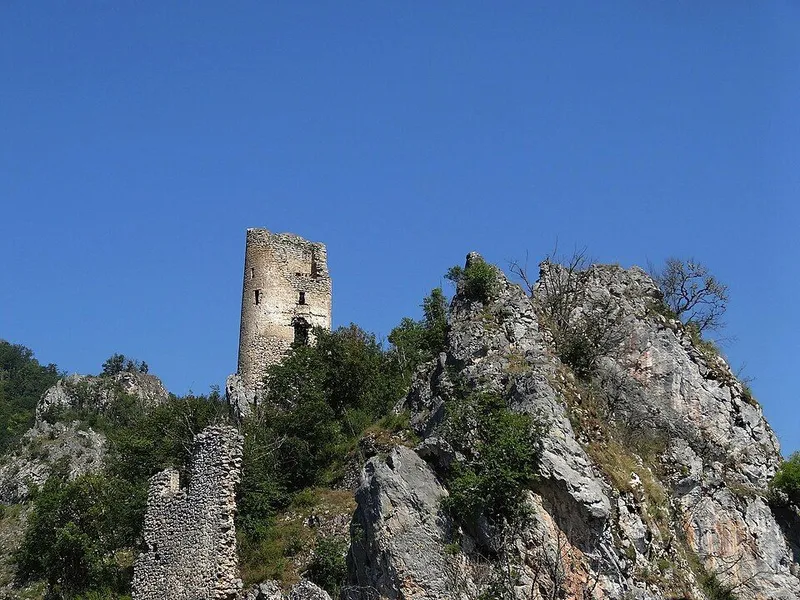
Not far from the monastery, 150 metres up in the rocks, stand the remains of the medieval fortress of Dobrun. It comprised the fortress itself, a court and three guard posts, and was then the seat of church and civil authority in the area. Merchants from Dubrovnik lived in its suburb. According to local tradition, the “cursed Jerina”, wife of the Serbian despot Đurađ Branković, built the fortress in the 1440s, but there is no firm evidence for this. Only remains of the towers survive, visible from the regional road.
In the cliffs above the monastery is a cave whose entrance was once walled up with stone blocks. Monks lived there as hermits and came down to the monastery only for the great church feasts.
From 1906 a 760-millimetre narrow-gauge railway ran right past the monastery complex: the section from Sarajevo to Dobrun opened on 4 July, and the line from Dobrun to Vardište on 1 August 1906.