A seat of the Kosača family
Samobor lay in the medieval district of Pribud in the upper Drina region, which passed to the Bosnian state in 1373. By the end of the 14th century the area belonged to the Kosača family. According to tradition, its name comes from a lone pine (bor) that once stood on the cliff.
Samobor appears in the records mainly in connection with envoys from Dubrovnik visiting Sandalj Hranić. In 1423 they met him in the settlement below the castle, Sottosamobor. Trade caravans rarely headed there: up to 1435 only three caravans bound for Samobor are recorded. In 1435 Stjepan Vukčić Kosača succeeded his uncle Sandalj; for him, too, Samobor was one of the principal towns of his lands. In 1444 King Alfonso V of Aragon and Naples confirmed his possessions, naming Samobor explicitly.
In late spring 1465 an Ottoman army under the Bosnian sanjak-bey Isa-beg Ishaković invaded the Herceg's lands. Samobor was the first of his fortresses in the upper Drina valley to fall. In March 1466 Herceg Stjepan wrote to Dubrovnik that Samobor had been lost.
Ottoman stronghold
According to an Ottoman register of 1469, Samobor belonged to the Hersek vilayet within the Sanjak of Bosnia and became the seat of the nahiye of Pribud or Samobor. Until 1832 a permanent garrison under a dizdar was stationed in the fortress; around 1800 it numbered 20 fortress guards, 18 armourers and an unknown number of gunners. The fortress was abandoned in 1832, though a few years before the Austro-Hungarian occupation part of it still served as a prison.
One of the cannons remained at Samobor until 1872 and was then taken to Čajniče, where it was filled with dynamite and burst. Stipe Delić handed one half to the National Museum in Sarajevo in 1890.
A walk through the ruins
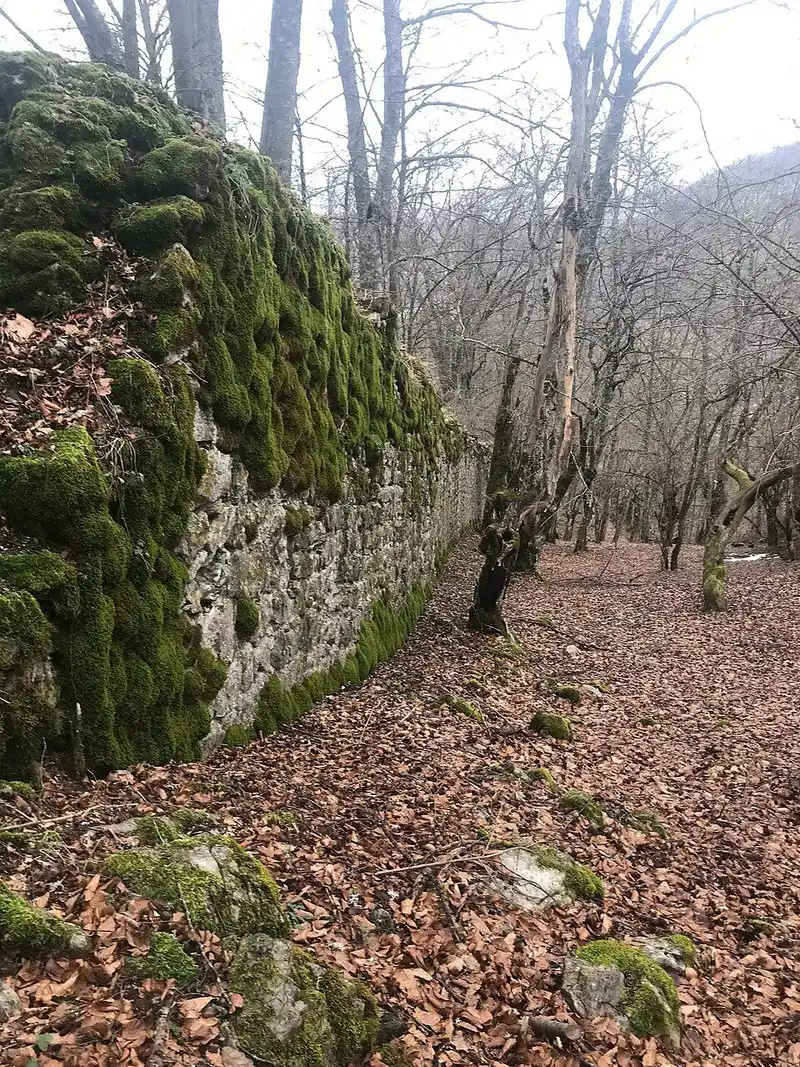
Samobor covers more than a hectare and in places is 350 to 400 metres wide. The layout follows the sloping, rocky ground with its narrow passages and small plateaus; to the south, north and east it was only partly walled, as the cliffs offered enough protection.
The main entrance was guarded by a tall tower with a roughly equilateral triangular plan, a very unusual form in Bosnia and Herzegovina. From there a path of about 400 metres leads east through natural rock cuttings. In the central part stood a mosque, probably converted from a church of Sandalj's time; today its site is covered with stones and earth. Along the path to the upper town, four benches are carved into the living rock.
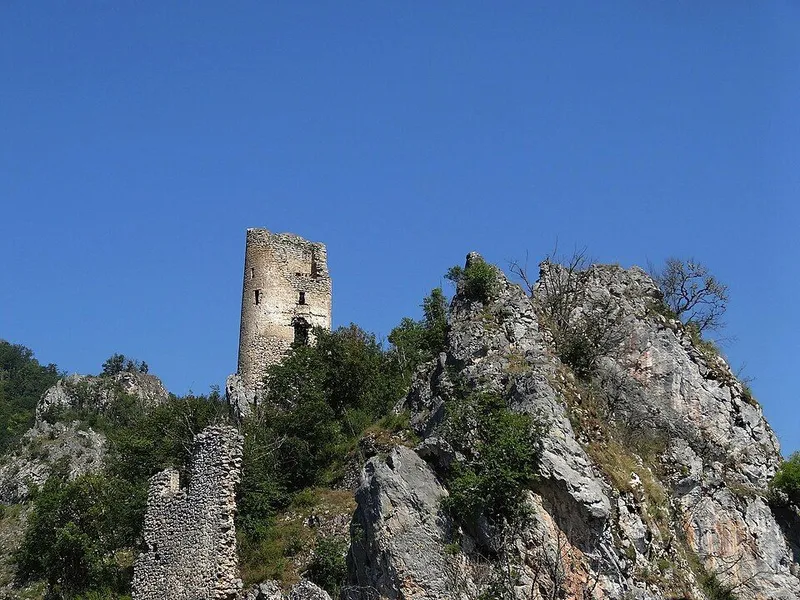
On a projecting rock at the north-western tip rises the main tower, which still stands at a little over half its original height, about 11 metres. Its plan is an irregular ellipse, and it was entered by a bridge through an opening 5 metres above the ground. Its fallen stones lie in the Janjina gorge, which is more than 200 metres deep here.
The way up
Samobor can be reached from the road in the Janjina valley by a relatively steep climb on foot. Roughly halfway up lies a plateau with a spring where the village of Vinje once stood; from there the medieval track leads to the fortress gate. A strenuous ascent also leads up from Međurječje via Vinje, probably the medieval route. The fortress can only be approached from the south-west, as ravines and cliffs drop away on every other side.
During its site visit in 2005, the Commission to Preserve National Monuments described the walls as badly ruined. The main tower also showed cracks, and the arch over the western entrance was close to collapse. It described the way up, especially from the foot of the hill to the Vinje plateau, as difficult.