Tombstones in a hornbeam wood
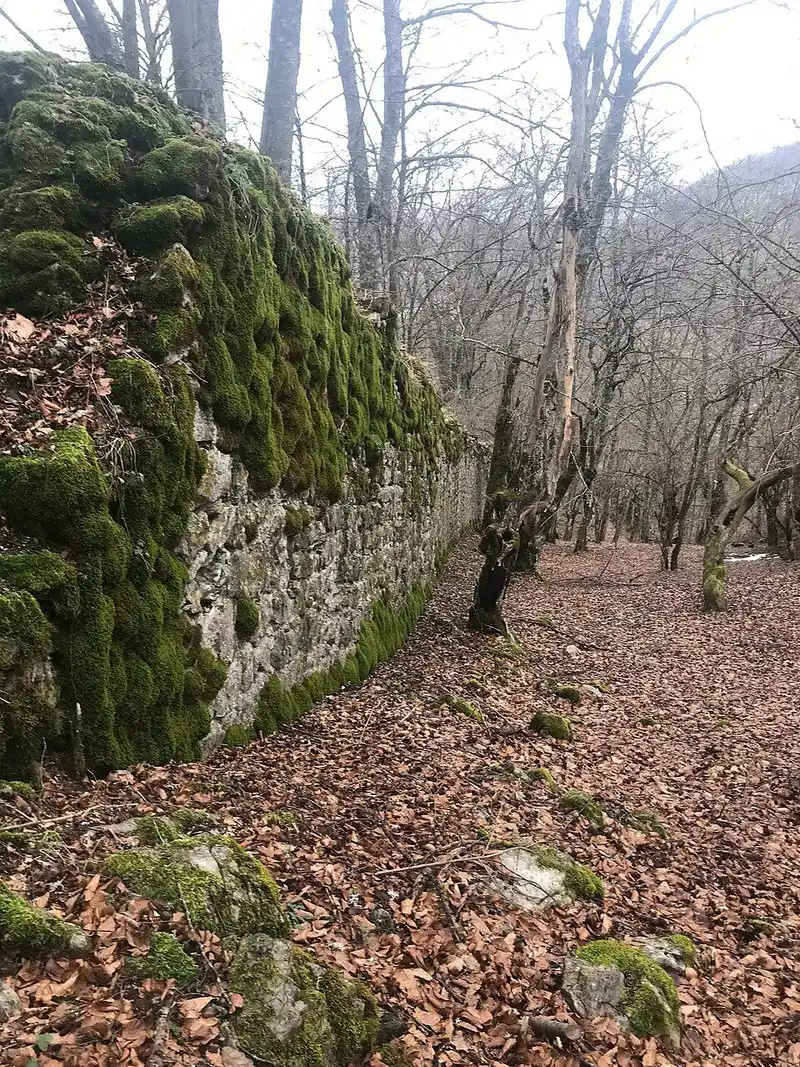
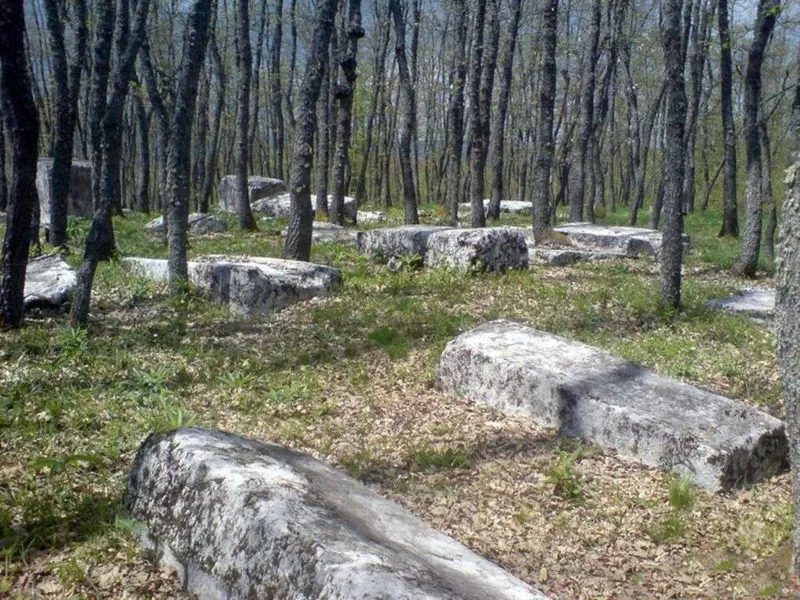
The village of Hrančići lies about 15 kilometres west of Goražde. The Kučarin necropolis lies at an altitude of 730 metres. Most of the tombstones stand on a rise above the local road in a hornbeam wood; 30 stećci lie some 40 metres away, south of the road.
325 visible stones have been recorded. Most are slabs or chests, some are gabled, and most are aligned east to west. Many stones in the northern part have sunk into the ground and are covered with soil, leaves and dry branches, so the real number is certainly somewhat higher.
A deer, a sickle, a lily and an inscription
Decoration can be seen on only a few stones. A trough-shaped stone has fluted edges, a cross with rounded ends inside a circle on its western end and a deer on its southern side. Another stone has a sickle carved in high relief on its top, and a chest has a lily, also in high relief, on its western face; this decoration has been coated with red paint.
Another stone bears an inscription that was still unpublished when the site was protected. In transliteration it begins ‘Se leži Njegoš (?) Vidojević, zemlja mu na Obrju’. Freely translated, this might mean: ‘Here lies Njegoš (?) Vidojević, his land is at Obrje.’ The question mark marks an uncertain reading, and the translation is only an interpretation.
In the land of the Kosača
The upper Drina valley is mentioned by the Priest of Duklja as early as the mid-12th century, and in 1373 it passed to the Bosnian state. In the Middle Ages Goražde was a well-known market town in the domain of the noble Hranić-Kosača family. The župa of Osanica included the village of Kosače, which some scholars believe to be the family's place of origin. Voivode Sandalj Hranić, who ruled from 1392 to 1435, lived at his court of Samobor near Goražde, on the right bank of the Drina. His successor Stjepan Vukčić Kosača took the title of herceg in 1448, from which the name Herzegovina was later derived.
National monument and World Heritage
In October 2010 the Commission to Preserve National Monuments declared the necropolis with its 325 stećci a national monument of Bosnia and Herzegovina. In 2016 UNESCO inscribed the stećci graveyards on the World Heritage List; Kučarin is one of 28 sites in Bosnia and Herzegovina, Croatia, Montenegro and Serbia. The stećci of this World Heritage site date from the 12th to the 16th century, are mostly carved from limestone and show a wide variety of motifs and inscriptions.
According to the decision, the site is open to the public and may be used for educational and cultural purposes. Without an approved plan, however, it is not permitted to remove vegetation or to clean lichen and moss off the stones.