The Herceg's foundation
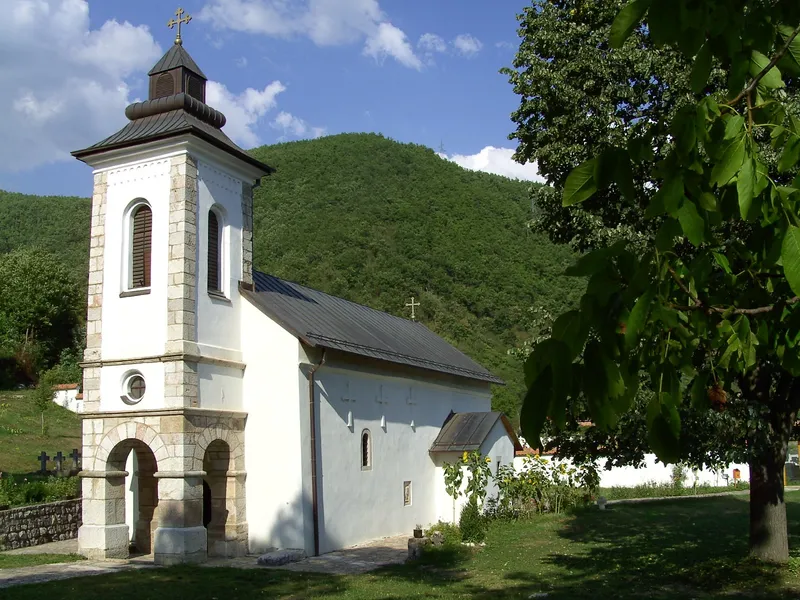
After the death of his uncle Sandalj Hranić, who had resided on the opposite bank of the Drina at his court of Samobor near Goražde, Stjepan Vukčić Kosača took power. From 1437 until his death in 1466 he ruled as an independent lord. In 1448 he took the title of herceg (duke), from which the whole region later came to be called Herzegovina. In 1454 Herceg Stjepan built the Orthodox Church of St George in Sopotnica.
The founder's inscription, on a dark marble slab, is still set above the portal: Herceg Stefan, servant of Christ, built the church of St George the Great Martyr and asks for his intercession. The core of the complex is a small cruciform single-nave building with a semicircular apse, two side choirs and a pointed vault; excluding the apse and choirs it measures 8.50 × 4.50 metres inside, and the vault is 7 metres high. Đoko Mazalić, who studied the church in the 1940s, attributed the building to masons from the coast because of its tall, Gothic pointed vault. As early as 1455 a small chapel was added on the north side at the Herceg's request. Some scholars believe it was intended for his second wife Barbara, who was a Catholic, to pray in.
Monastery and printing press
A monastery stood beside the church. An inscription on the window of the south choir, from the 15th or 16th century, records the ordination of the monk Isaija, and the first Ottoman registers of 1468/69 and 1477 list extensive landholdings belonging to the church. In the churchyard, the foundations of the monastery building were found about 20 metres north of the church. As the nave soon became too small, the monks extended it by 6 metres to the west, probably in the second half of the 16th century.
In the early 16th century the printing press of Božidar Goraždanin operated in the monastery, providing churches and monasteries under Ottoman rule with service books. Three books are linked to it: a Služabnik in 1519, typeset by the brothers Đurađ and Teodor Ljubavić, then, typeset by Teodor alone after Đurađ's early death, a Psalter with Horologion in 1521 and a Trebnik in 1523. After the press had been taken to Wallachia, the monastery served as a scriptorium; a Gospel book was copied here in 1550.
Destruction and rebuilding
From the mid-16th century until 1869 the church received no major repairs beyond new roofing and whitewashing. Repairs followed in 1869, when Jovan Andrić Ćebenika of Sarajevo donated the metal entrance door. The present bell tower was added in 1894. In 1987/88 the reservoir of the Višegrad hydroelectric plant raised the water table, and the church floor had to be sealed against damp.
During the 1992–1995 war the church was shelled and set on fire in September 1992, and the roof frame and cladding burned. In October 1994 it received a temporary roof; between 2000 and 2002 it was restored, mostly with donations, and reconsecrated on 7 September 2002. The carved walnut iconostasis dates from 2001.
Roman stones and stećci
Three Roman stones are built into the church walls: two votive inscriptions in the altar area and, on the south façade, a relief of the god Mercury, whom the Romans revered as protector of travellers and merchants. According to scholars, a Roman settlement lay very close by, either a way station or a small military camp on the road from Epidaurum through the Drina valley.
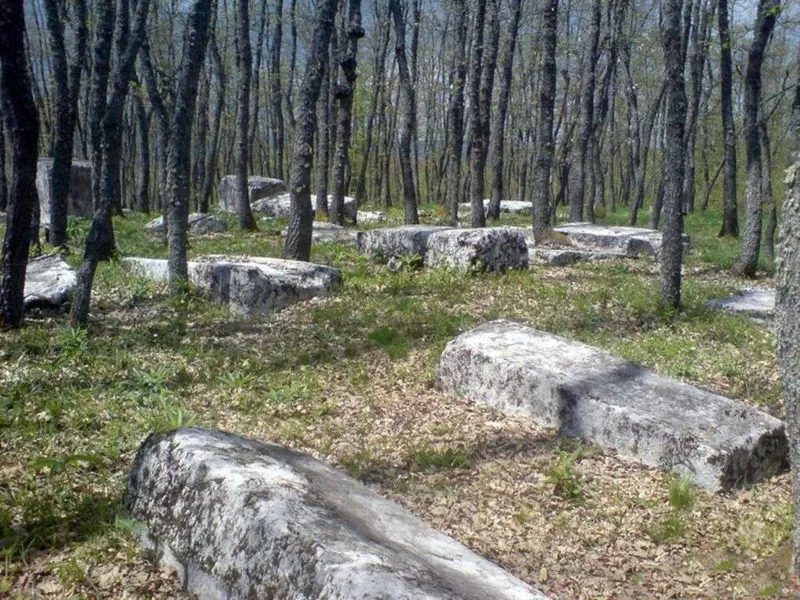
The church stands on a medieval burial ground with stećci, where burials continued after it was built. Only two of these tombstones survive, along with some fragments. To the right of the portal stands the stećak of knez Radoslav Širinić, whose epitaph reads, in translation, "In God's name: here rests God's servant, knez Radoslav Širinič". The frescoes that once decorated the church were removed and buried; fragments were found 25 metres west of the church at a depth of about 2 metres.