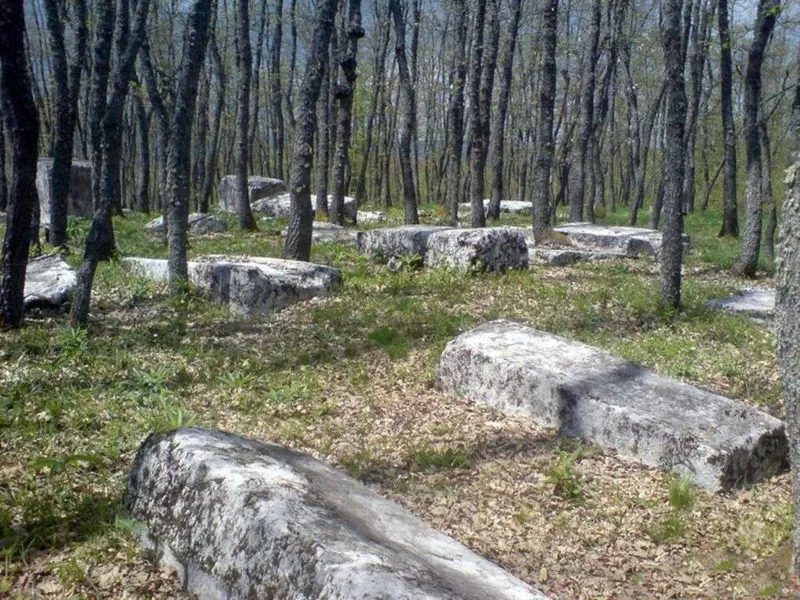
The tombstones
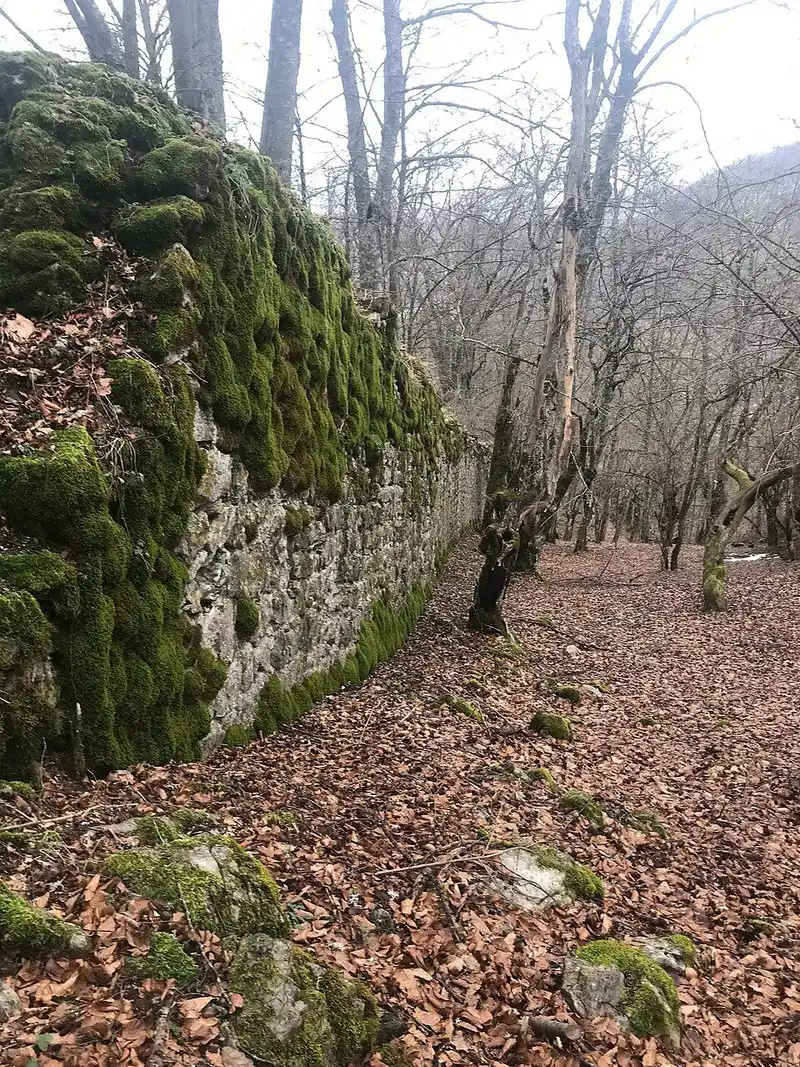
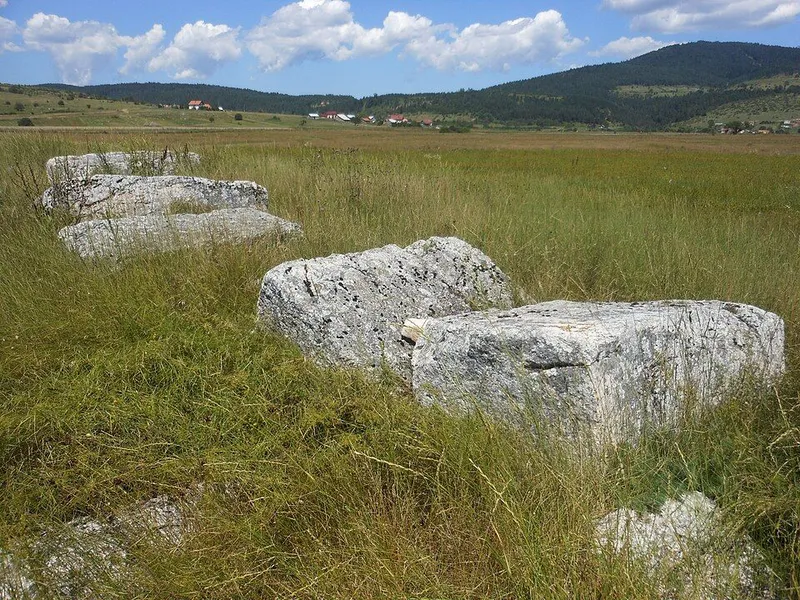
The tombstones lie on the height of Borak in dense oak woodland, close to the medieval road from Dubrovnik to Srebrenica; the protected area extends to the foot of the hill. Most are aligned east to west, a smaller number north to south. According to the records of the Commission to Preserve National Monuments there are 212 stones: 136 slabs, 67 chests, 7 gabled stones, a hollowed stone with a trough and one of uncertain shape. The heritage institute of Republika Srpska counted 213 in 2012, fragments included. In the 1950s the National Museum in Sarajevo had recorded about 150.
Only five stones are decorated, one slab, two chests and two gabled stones. They show a double spiral, a half-sphere, a cross, a crescent, a rosette, a lily and a hand holding a sword. One stone shows a hunting scene: a hunter on foot carrying a spear, with a dog, a deer and a bear. There are no inscriptions.
Rogatica, Borač and the road to Dubrovnik
Traces of human life in the Rogatica area go back to the centuries before Christ, when the Illyrian tribe of the Autariatae lived here; hillforts and burial mounds survive. In the Middle Ages Rogatica had a settlement, as shown by the old road from Dubrovnik to Srebrenica, which ran through the town, and by remains of a fortification nearby.
According to records in the Dubrovnik archives, Rogatica was the hub of a rich cattle-raising district in the 14th and 15th centuries, and Dubrovnik bought its cattle here. The town was closely tied to the fort of Borač and its lords, the Radinović and Pavlović, who in the 15th century ruled the land from the source of the Bosna to the Drina. Their ruined fort stands above the left bank of the Prača near the village of Varošište. When Srebrenica passed to the Serbian state in 1411, Borač became a border town, and Dubrovnik told its merchants to unload goods bound for Srebrenica and Zvornik there. Between 1417 and 1436 Borač was a major caravan destination. The Ottomans took the fort before 1466 and soon abandoned it; in the first years of their rule the Rogatica market was still called Borač.
Protection and condition
In November 2008 the Commission to Preserve National Monuments declared the Borak necropolis on the Han-stjenički plato a national monument. In 2016 it became one of 28 sites of the stećci World Heritage property; the inscribed area covers 3 hectares, the buffer zone 4.6 hectares. No excavation has ever taken place here, but further necropolises with stećci lie in the surroundings.
The 2017 description calls the condition satisfactory and the necropolis preserved in its original state. Most stones are coated with lichen and moss and covered in leaves, and many have partly or wholly sunk, so their dimensions cannot be measured. Holes probably dug by wild animals were found under many stones, which puts them at further risk. In 2011 the site was surveyed and photographed stone by stone.