Discovery and development
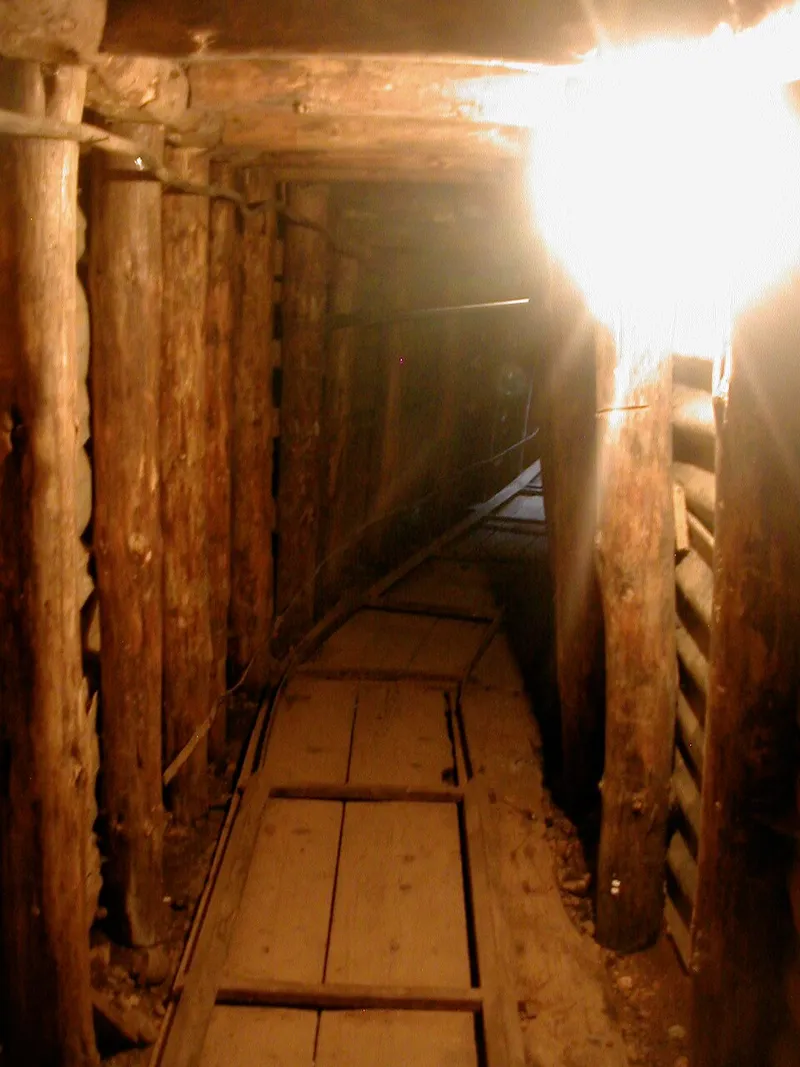
The cave owes its second name to Savo Minić. At his invitation, Muhamed Hadžiabdić, the Kurtović brothers and Momčilo Piljević set out on the first exploration of the cave on 13 September 1975. Originally the main passage could only be reached by crawling through a narrow, low tunnel 206 metres long. At its end the first cavers widened a tight opening. As nobody had got that far before, formations and bones were completely intact.
By 1992 the caving society “Bosansko-hercegovački krš” from Sarajevo had built 220 metres of visitor trail, put up a reception building and brought in electricity; the war halted further work. In 2002 the cave was made accessible to visitors again. A new access path and a staircase over the scree slope to the entrance were built, lighting was installed, and the trail was extended to 560 metres.
What you see inside
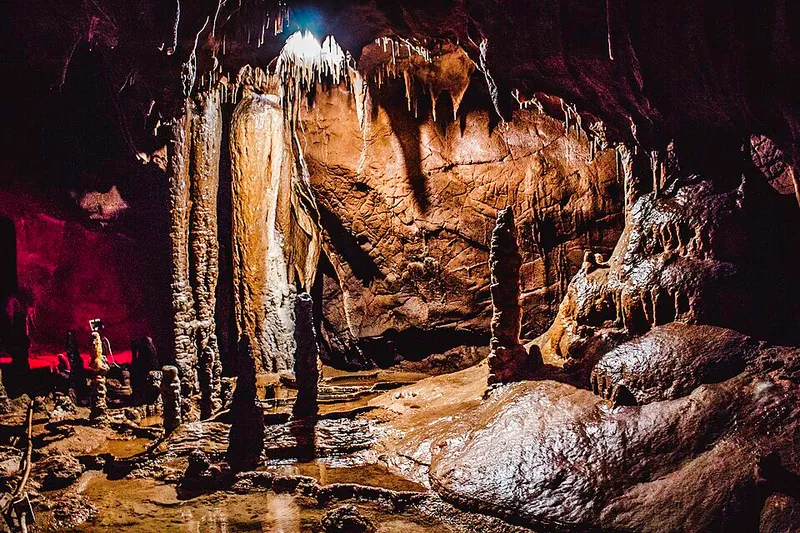
The trail passes through several named spaces: the Entrance Hall (Ulazna dvorana), the Dragon's Den (Zmajeva jazbina), the Ermitaž hall, the Lighthouse Passage (Prolaz svjetionika), the Slonovo oko hall (“Elephant's Eye”), the Thermopylae Passage and the Romanija hall. Along the way you see stalagmites and stalactites, flowstone, draperies and rimstone pools. A white flowstone shaped like an upturned torch is regarded as the emblem of Orlovača.
The stalagmites are mostly white or tinted in various shades of red by dissolved iron oxides. There are also a few small helictites, moonmilk and cave pearls. Bats live in the cave. The temperature stays at 8.8 °C all year round, with humidity above 90 per cent.
Cave bears and other finds
Most of the finds are bones of the cave bear (Ursus spelaeus). They lay in several places in the main passage and in the uppermost passage, where the animals also had their dens. Their age is estimated at more than 16,000 years. So-called bear nests have survived: dish-shaped hollows 2 to 3 metres across, mostly in the cave clay. There are also smoothly polished rock walls and blocks where the bears rubbed themselves, mainly because of the parasites in their fur.
Of other Pleistocene animals, only isolated remains of dhole and ibex have been found. Near the bear bones lay the remains of an axe and prehistoric pottery fragments. A cave beetle named after the cave is also known from here. The small Orlovača Museum at the entrance displays a longitudinal section through stalagmites and remains of the cave bear.
How the cave formed
Orlovača formed in Middle Triassic limestone at the edge of the ridge of Orlovača hill. Beneath it lie older Werfen beds of sandstone, sandy shale and marl. Where the limestone meets the Werfen beds, several springs emerge, among them that of the Sinjeva, a tributary of the Mokranjska Miljacka. The stream's course can also be traced in the rear part of the main passage.
The passage system extends over four interconnected levels. At the bottom the Sinjeva flows underground. Slightly higher lies the entrance passage, which carries water at times of flooding. Above it comes the spacious, easily walkable main passage with its rich decoration. The top level is only 14 metres long and consists of three small chambers.
Protection and visiting
Since 2011 Orlovača has been protected as a natural monument and is assigned to Category III under international criteria. It is managed by the Pale Cultural and Sports Centre (Kulturno sportski centar Pale). An asphalt road leads to a small building at the entrance with a souvenir shop and museum; the main Sarajevo–Sokolac road is 1 kilometre away. Because it stays cool inside even in high summer, bring a jacket. The surroundings suit walks and a picnic by the small stream nearby.