The bridge
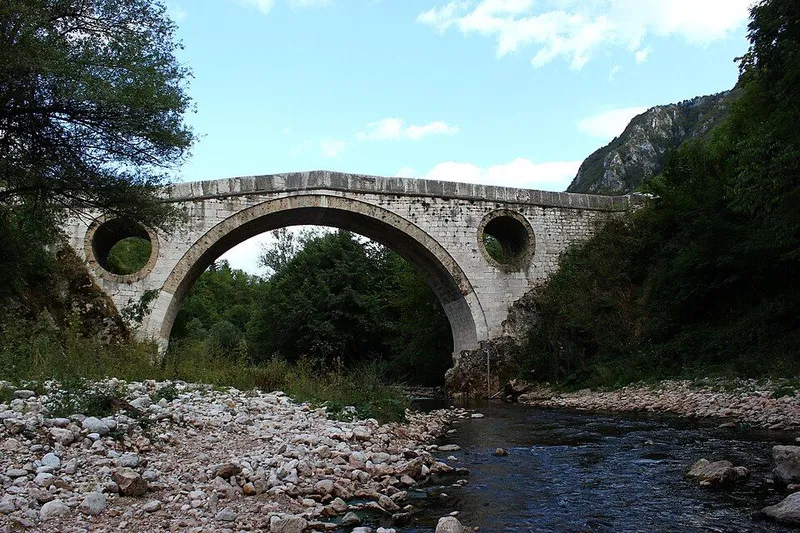
The bridge stands in the Babića Bašća neighbourhood of the Stari Grad municipality. At this point the riverbed is narrow and set firmly in the rock, and on the left bank the structure rests on the bedrock. A single arch with a span of 17.5 metres carries the crossing, 42 metres long and 4.75 metres wide, flanked by two round openings. It is built of limestone and tufa.
Four old bridges survive within the city of Sarajevo. Besides Kozija ćuprija they are the Šeher-Ćehaja Bridge, the Latin Bridge and the Roman Bridge near Blažuj.
History
The bridge lay on the old trade route to Constantinople, which followed the valleys of the Miljacka, Prača and Drina and was known as the Carigradski drum, the Constantinople road. It is believed to have been built during the great overhaul of the road network under Mehmed Pasha Sokolović, grand vizier from 1565 to 1579, probably in the second half of the 1570s. The bridge over the Drina at Višegrad dates from the same era. The bridge is first mentioned in writing only in 1771, when the chronicler Mula Mustafa Bašeskija recorded a stone wall from Kozija ćuprija to Alifakovac.
In Ottoman times the bridge marked the eastern entrance to the city. New viziers were welcomed here and pilgrims seen off. In honour of a vizier, daring young men would jump from the bridge into the shallow Miljacka, and he would reward them with money. Kozija ćuprija has been a national monument of Bosnia and Herzegovina since 2004.
Name and legends
Where the name comes from is uncertain. A folk legend tells of a poor shepherd whose goats lingered unusually long by a bush on the river. Beneath it he found a pot full of gold coins, paid for his education with it and later, as a rich and respected man, had the bridge built at that very spot. According to another tradition, the name goes back to a large livestock market nearby where goats were also sold. The nearby settlement of Jarčedoli probably also owes its name to residents who herded goats here.
The walk via Dariva
The bridge no longer plays any part as a road link. A cycling and walking path leads to it from the Vijećnica in the centre along the Miljacka via Dariva, and the people of Sarajevo like to use it for outings. The stretch between Bentbaša and Kozija ćuprija is closed to traffic. It follows the once wild canyon, whose charm Sarajevans only noticed after Austria-Hungary built a railway line here.
Along the way more than 150 linden trees line the Ambassadors' Alley, planted by diplomats living in Bosnia. The Dariva rock has marked climbing routes, and not far away is Babin Zub, where the history of mountaineering in Sarajevo began. The name Dariva recalls Josef Da Riva, who lived at the confluence of the Mošćanica and the Miljacka.