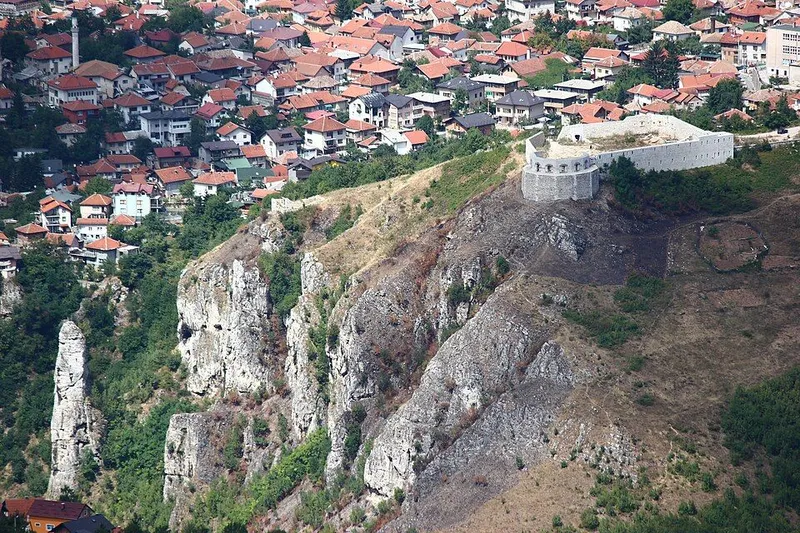
Location and structure
Bijela Tabija juts out from the wall of the old quarter of Vratnik and commands the eastern, natural approach to Sarajevo. It stands on the road from Dariva to Mošćanica, on the eastern height of the Sarajevo basin. The fortress is built of stone, and its thick walls are pierced by openings for cannon. It housed a gun crew and an ammunition store, and the bastion also served as quarters for soldiers.
History
Opinions differ on its age. One view holds that the fortress was built around 1550, another that a castle already stood here in the late Middle Ages, probably the small Hodidjed, the main stronghold of the Vrhbosna county. It had a rectangular plan of about 75 by 50 metres with four square corner towers and a fifth above the gate, which places it in the late 14th or early 15th century. Under the Ottomans a garrison of timar-holders was stationed in the castle, and a mosque was built for them. In 1660 Evliya Çelebi describes, besides the mosque, houses for the imam, muezzins and military musicians, and a granary.
Until the campaign of Prince Eugene of Savoy, Sarajevo was an open city with only this small fortress, which held 150 to 200 soldiers. In 1697 Eugene sacked and burned the city. Governor Ahmed Pasha Rustempašić then ordered Vratnik to be fortified, and in the 18th century walls, three gate towers and five bastions were built, one of them Bijela Tabija. When Austro-Hungarian troops took Sarajevo on 19 August 1878, the fortifications gradually lost their purpose. The upper part of large stone blocks dates from the Austro-Hungarian period, when the fortress was rebuilt as an intermediate fort.
Protection and restoration
As part of the fortified town of Vratnik, Bijela Tabija has been under legal protection since 1971. Since 2005 it has been part of the national monument Stari grad Vratnik. Before the war the site decayed through poor maintenance, stone was stolen and illegal building destroyed parts of the ramparts. During the war the fortress was under direct shelling for years.
In 1991 small archaeological test excavations began, and after 2000 the repair of the walls. In May 2026 the site reopened after restoration work, prepared for open-air cultural events.
Around the bastion
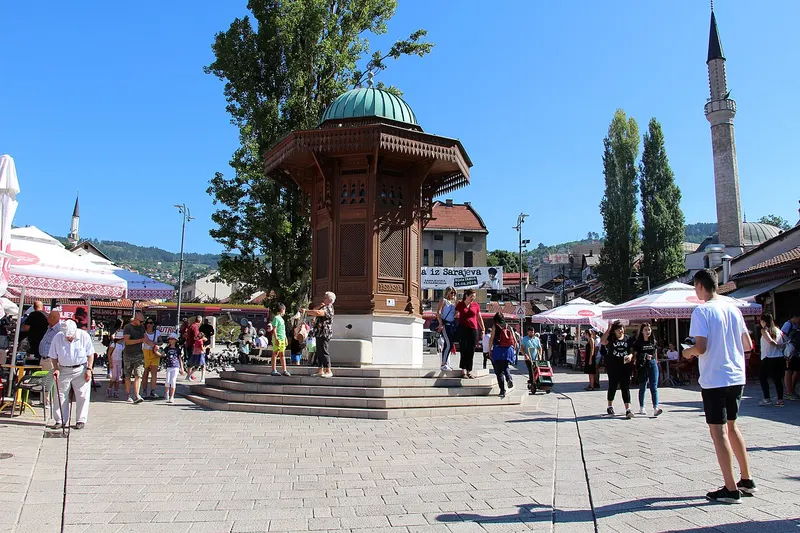
From Bijela Tabija you overlook the eastern entrance to Sarajevo, the Miljacka canyon and the city. The bastion is part of the Vratnik walls, so a walk through the quarter suggests itself. Through the Višegrad Gate the Imperial Road once led via Višegrad to Istanbul. The Ploča Gate houses the Alija Izetbegović Museum, and from Žuta Tabija, the Yellow Bastion, a cannon is fired during Ramadan to mark the end of the daily fast.