History
Baščaršija lies on the north bank of the Miljacka in the municipality of Stari Grad. It began in 1462, when Isa-beg Ishaković, the founder of Sarajevo, had the Kolobara han built here, and many shops opened around it. The čaršija reached its peak in the second half of the 16th century, with 80 different crafts organised in guilds.
After an earthquake in 1640 and fires in 1644 and 1656, troops of Prince Eugene of Savoy burned the town in 1697. A great fire in the 19th century destroyed much of the old town; since then Baščaršija has been only half its former size and ends at Ferhadija street. Plans to demolish the bazaar step by step after 1945 were dropped.
The Beg's Mosque, madrasa and clock tower
The čaršija was shaped by Gazi Husrev-beg, the Ottoman governor of Bosnia. In 1530 he paid for his mosque on the right bank of the Miljacka, the Begova džamija. Badly damaged during the siege of Sarajevo, the mosque was restored from 1996 onwards.
Next to the mosque stands the clock tower, the Sahat kula, about 30 metres high. Because few people owned a watch at the time, it helped the faithful keep track of the five daily prayers. Opposite the mosque, Gazi Husrev-beg had a madrasa with a library built in 1537 and dedicated it to his mother Seldžuka. Because of its lead roof it is also called the Kuršumli madrasa, after the Turkish word for lead. The neighbouring hanikah, once a higher school of Sufism, is now a gallery space.
Craft streets and the Sebilj
Like many towns of the Levant, Sarajevo was divided in two: trade happened in the čaršija, laid out on the model of the Arab souk, while people lived in the mahalas on the surrounding slopes. The streets of the čaršija were named after crafts, such as Kazazi, Kujundžiluk, Kazandžiluk, Kovači, Sarači and Aščiluk. In Bravadžiluk, craftsmen once specialised in locks and padlocks; today the street is lined with ćevabdžinicas, buregdžinicas and aščinicas. Two covered markets survive, the Gazi Husrev-beg Bezistan and the Brusa Bezistan.
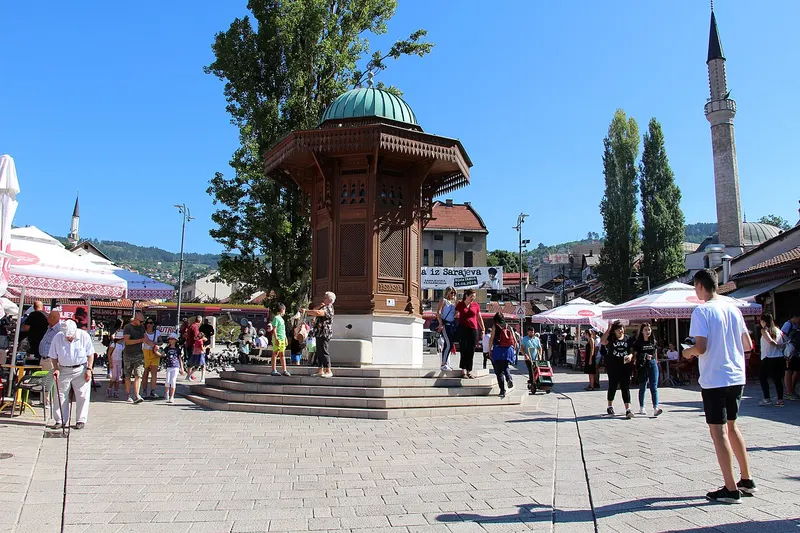
In the middle of the square stands the Sebilj, a wooden fountain in Ottoman style. The first was built by Mehmed-paša Kukavica in 1753 and burned down in 1852. The present one was built by the Austrian architect Alexander Wittek. According to the chronicler Mula Mustafa Bašeskija, the town once had more than 100 sebilj fountains.
Four faiths in a small space
Right next to the Beg's Mosque stands the Old Orthodox Church, first mentioned in Ottoman sources in 1539. In the mid-16th century, Jews expelled from Spain arrived in Sarajevo. In 1581 a han was built for them in the Velika avlija, and the first Sephardic synagogue went up there. Today it houses the Jewish Museum of Bosnia and Herzegovina, while the neighbouring New Synagogue is home to the Novi Hram gallery. A mosque, a Catholic and an Orthodox church and a synagogue all lie within a circle 200 metres across.
Not far from the Old Orthodox Church, Svrzina kuća shows how an urban Muslim family lived from the late 18th century and through the 19th century.
Tips for your visit
The square around the Sebilj is closed to traffic. On its northern edge, on Telali street, trams stop at the Baščaršija stop; from there they only run westwards. For a break there are plenty of kafanas, and coffee is still drunk here at leisure. According to legend, anyone who drinks from the Sebilj will return to Sarajevo.