Why the tunnel was built
At the start of the war, the airport controlled by UNPROFOR was the only link between the encircled city and the territory on Mount Igman outside the siege lines. Anyone who wanted to get out had to run across the runway, fully exposed to sniper fire. In line with its neutrality mandate, UNPROFOR put up barriers to prevent such crossings.
After months of this, the Army of the Republic of Bosnia and Herzegovina planned a tunnel under the airport. It was to connect Dobrinja inside the siege lines with Butmir outside them, hence the name Tunnel D-B. It is also known as the Tunel spasa, the Tunnel of Salvation, or the Tunnel of Hope.
Construction
Digging took place in the spring and summer of 1993 from both ends at once, from Dobrinja and from the yard and ground floor of the Kolar family house in Butmir. Skilled workers, tools and materials were all in short supply. The men dug by hand with shovels and picks, around the clock in 8-hour shifts, and were paid one packet of cigarettes a day. Groundwater kept seeping in and had to be bailed out by hand.
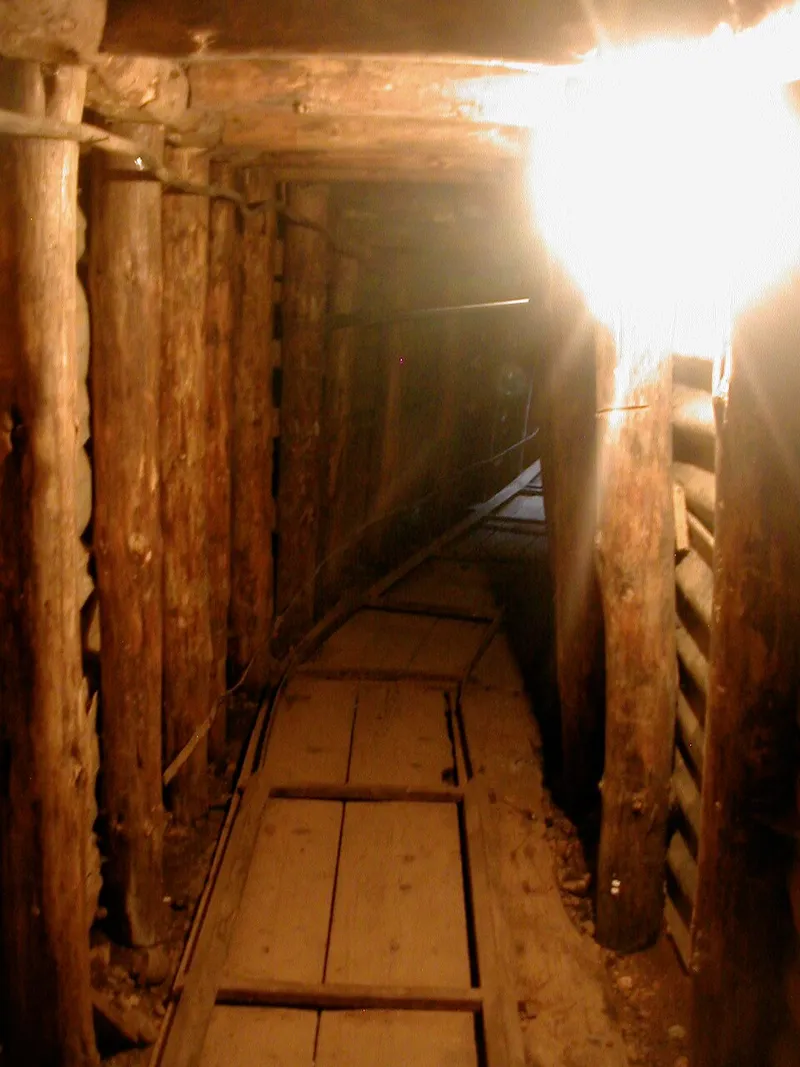
The finished tunnel was about 800 metres long, roughly one metre wide and 1.60 metres high. It ran up to 5 metres below the runway.
The link to the outside world
At first the tunnel was a muddy passage through which everything had to be carried. Within a year small rails and carts were added, and later a power cable, pumps for the groundwater, an oil pipeline, permanent lighting and telephone lines. Food, fuel, newspapers and weapons came into the city through the tunnel, and people were able to leave. Every day between 3,000 and 4,000 soldiers and civilians and some 30 tonnes of goods passed through. A permit was required to use it.
The tunnel had no ventilation, so everyone entering had to wear a mask, and the groundwater could rise to waist height. Alija Izetbegović, President of the Presidency of the Republic of Bosnia and Herzegovina, also used it regularly on his way to peace talks.
The museum today
Since April 2012 the Tunnel D-B memorial complex has been managed by the Memorijalni centar Sarajevo. The Butmir side, where the damaged Kolar family house stands, is open to visitors. Part of the exhibition explains the siege with a map drawn onto a plan of Olympic Sarajevo from 1984. Photos and videos show daily life inside the siege lines, along with objects residents made for themselves and food from aid deliveries. Another part takes visitors through the first plans and orders for the construction and shows rare footage from the time, photos of those involved and the tools they used.
From the original entrance on the Butmir side, 25 metres of the authentic tunnel are accessible, plus 100 metres of the original tube, restored to show its interior as it was in use from 1993 to 1995. The museum is in Butmir, on Tuneli Street; from the centre, take the tram to the Ilidža terminus and then the bus towards Butmir.