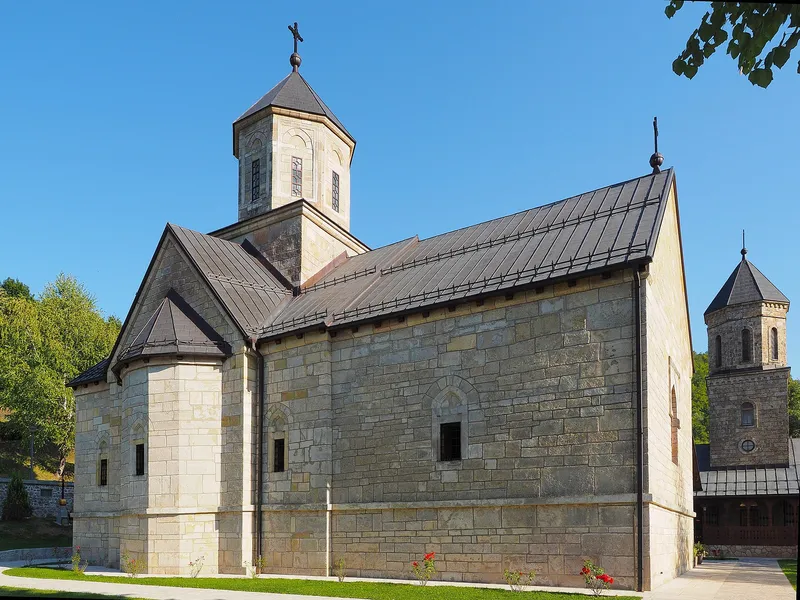
In the Moštanica valley
The monastery stands at 202 metres above sea level on the slope of Mala Gradina, on a sheltered stretch of level ground where fragrant lime trees grow. An asphalt road leads to the monastery.
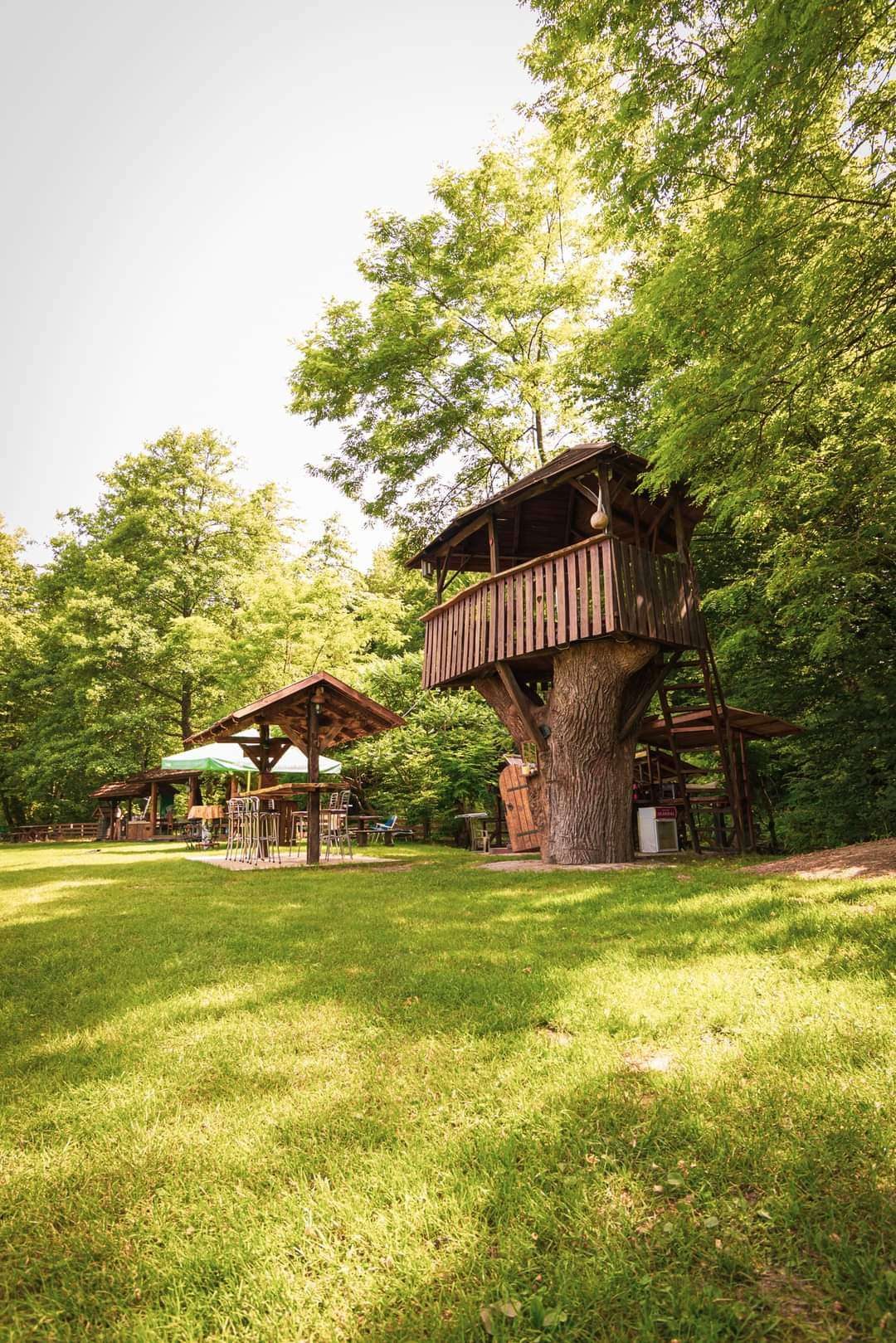
According to tradition, 44 footbridges made of felled beech trunks once crossed the stream. The name Mostanica is said to come from the word most, bridge, and became Moštanica, first for the stream and then for the monastery. One such footbridge still crosses the water by the monastery today. Beside the complex, wide meadows stretch along the stream, and locals and visitors like to use them for picnics.
Legends and history
When and by whom the monastery was founded is not recorded. Legends attribute it to the Nemanjić dynasty or place its founding in the early 12th century; another story names Hasan-paša Predojević as its builder in the 16th century. The first written record dates from 1579, in the book “Otočnik”; by then books were already being copied in the monastery. It had probably been restored shortly before, in the time of Patriarch Makarije.
In an area long fought over by the Ottomans and Austria, Moštanica was destroyed and rebuilt again and again; sources speak of seven to nine destructions. After the Ottomans had once again set the monastery on fire, two monks who had fled Moštanica founded Komogovina monastery. In 1941 the Ustaše burned the monastery, and in July 1942 German forces bombed it during the offensive on Kozara. It was rebuilt in 1947.
The monastery church
The church is built of neatly cut stone and, according to the Tourist Organisation of Republika Srpska, is 23.4 metres long and 10.5 metres wide. It has a trefoil plan and a single dome resting on freestanding columns; unusually, the entrance portal is in the south wall of the narthex. The white stone came from the village of Vojskova on Kozara, and the walls are a metre thick. As with other churches of the Bosanska Krajina, the door is small and low so that the Turks could not ride in on horseback. No wall paintings have survived inside the church.
The monastery keeps wax that sealed the tomb of Christ, a stone from the tomb of Christ and a shoe from the relics of St Basil of Ostrog. The complex includes the konak, a monastery building put up in 1972 and renovated and extended in 2005, and a small chapel with a bell tower built in 2002 and dedicated to St Basil of Ostrog.
Avakum, Pećija and the feast of the Transfiguration
Avakum, a deacon later venerated as a saint, was born close to the monastery towards the end of the 18th century and became a monk here. Captured after the Hadži-Prodan uprising of 1814, he was brought to Belgrade, where he was told he could escape death if he accepted Islam. Epic folk songs still recall how he refused, and the song he sang as he was led to his death. Since 2006 the municipality of Kozarska Dubica has marked his feast day, 30 December, as its patron saint's day.
The grave and monument of Petar Popović Pećija (1830–1875), a hajduk and rebel commander who lost his life in the Bosnian-Herzegovinian uprising, lie close to the monastery. Every 19 August the monastery keeps the feast of the Transfiguration, and by tradition this includes the “Veče ojkače”, a contest of traditional folk singing.