Legends and first records
With no documents to go on, the church cannot be dated precisely; archaeological finds suggest that its fabric may go back to the 14th century. A legend in the chronicles of Peć and Tronoša credits its foundation to Vladislav and Urošić, sons of King Dragutin. Another tradition holds that Tavna is younger than Papraća and was endowed by the hajduk Grujo Novaković.
The church is first mentioned in an Ottoman census of the Zvornik sanjak in 1533, and the census of 1548 lists it as a monastery. A note in a Gospel book kept at Cetinje Monastery records that Gavrilo, bishop of Zvornik, died at Tavna in 1627. In 1697, shortly after the Austro-Turkish war, Metropolitan Jevtimije of Buda stayed here, a sign that the church survived the war intact. The Jesuit Rudolf Bzenski, who lived in Zvornik from 1688 to 1699, described Tavna as a very fine Orthodox church adorned with frescoes.
Building phases and later history
The first archaeological investigation inside the church was led by Mirko Babić in 1994. Two transverse foundations led him to conclude that the building went up in three phases: one in the 14th century, another in the 16th and a final one in 1884, the year the bell tower was added. On this reading the church originally had an apse, its entrance lay roughly in the middle of today's building, and the narthex dates from the second phase.
Its style suggests that the present church may date from the second half of the 16th century. It resembles the church of Tronoša in Serbia, built in 1559 across the Drina; Tavna is not far from the river. After the Peć patriarchate was restored in 1557 many Orthodox churches were renewed or rebuilt, possibly this one too. According to Abbess Marta, the konak burned down in 1943 during the Second World War and had been rebuilt by 1954; in 2005 it was fully renovated.
The Church of the Holy Trinity
The church has one nave under a barrel vault running its length, with a dome above the middle bay and choirs on either side that make the plan look cruciform from outside. Externally it measures about 18.95 by 6.15 metres. Related churches stand at Ozren, Vozuća and Lomnica; Tavna differs from them in being low-built, with a low, wide dome. The dome rests on an octagonal drum, and its apex is 12.75 metres above the floor. The walls are of local limestone and sandstone. Since the latest renovation stripped the render, the big ashlar blocks in their even courses show on the outside. Fifteen windows light the interior, eight of them in the drum.
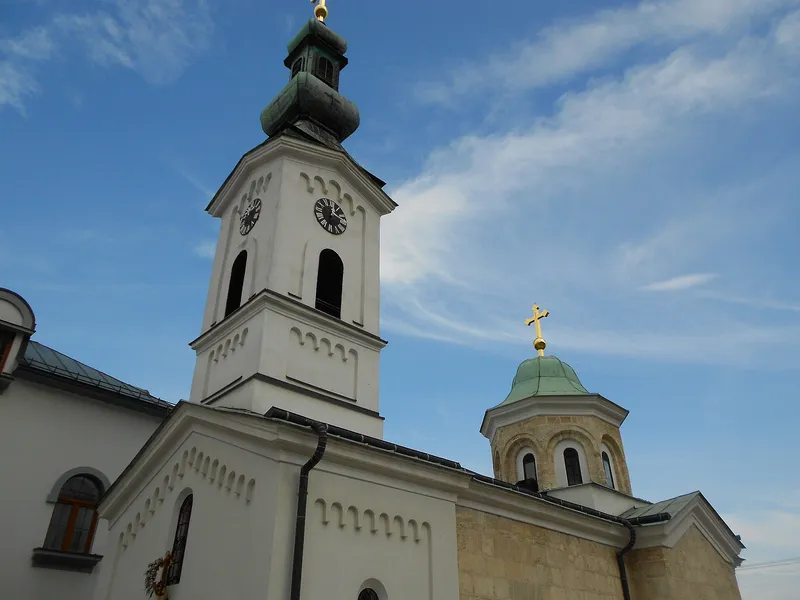
At the west end stands the bell tower from the late 19th century, about 21.32 metres high, rendered white, with a clock face and a copper-clad onion dome. Apart from this tower the church has kept its original appearance. A high stone wall of recent date encloses almost the whole site.
The wall paintings
Little remains of the old paintings. Because the monastery was badly damaged several times, including in 1943, only two cherubim in the pendentives survive; in the 1970s Zdravko Kajmaković counted Tavna among the churches whose murals had been lost. Restoration of the interior, including the iconostasis, thrones and icon stands, began in 1984, and the church was painted anew in 1995. An inscription to the right of the entrance in the narthex names the painters, Deacon Marko Ilić, Dragan Marunić and Nikola Lubardić, and the monastery's sisterhood.
The paintings cover every free wall surface in three registers. Christ Pantocrator fills the dome, with eight Old Testament prophets below. In the apse the Virgin spreads her cloak over six hierarchs, among them John Chrysostom and Basil the Great. The Annunciation appears high on the east wall of the nave, and the Dormition of the Virgin, following the Byzantine scheme, on the west wall opposite the apse.