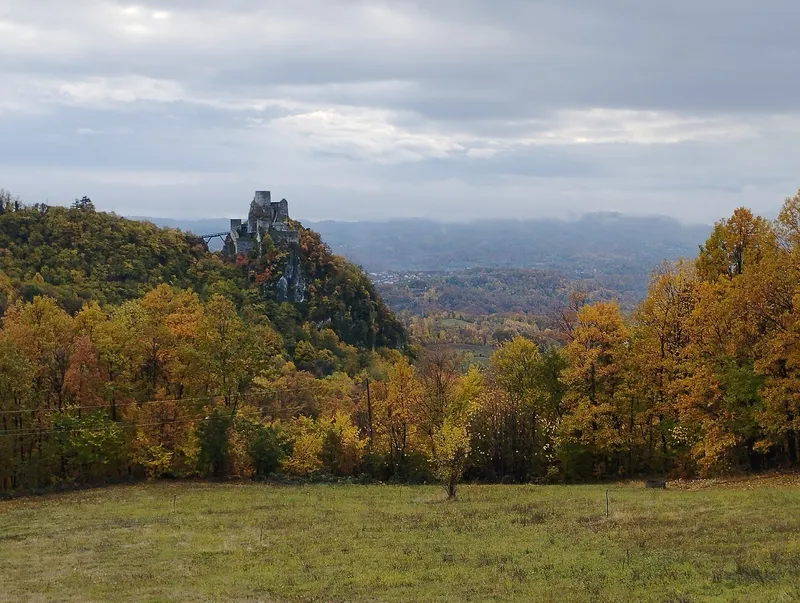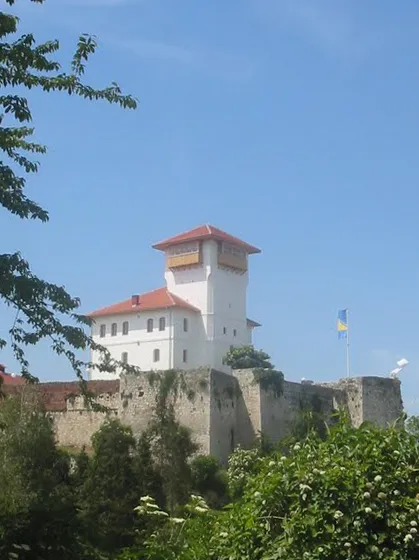
The fortress above the town
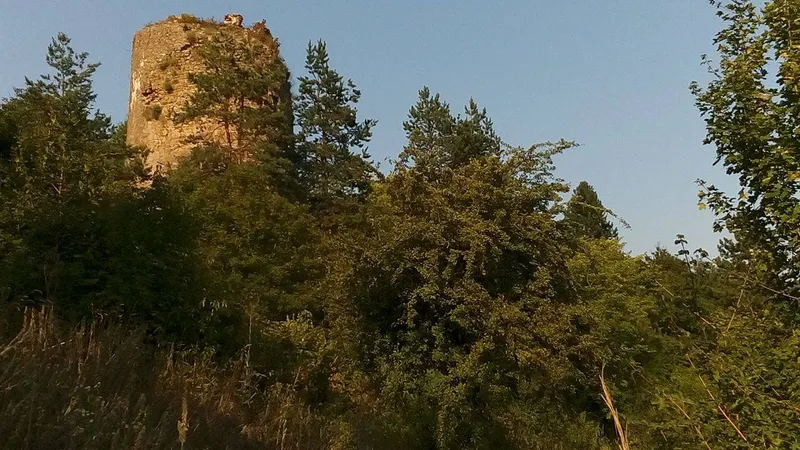
Set on a hill overlooking the town centre, in the Majevica foothills, the fortress marks the point where the flat Posavina gives way to the Bosnian hills. From the tower you can see five towns: Odžak, Bosanski Šamac, Orašje, Brčko and Modriča.
In 2004 the Commission to Preserve National Monuments declared the old town of Gradačac a national monument. It comprises the walls, the upper town with the tower of Husein-kapetan Gradaščević, and the lower town with the clock tower, the building housing the town library, radio station and museum, the grammar school and the catalogued items of the museum collection.
From Gračac to the captaincy
In the Middle Ages the area belonged to the Bosnian župa of Nenavište. In the late Middle Ages a district of the same name formed around the fortress of Gračac, and in 1461 King Stjepan Tomašević gave Gračac to Radivoj Kotromanić. The Ottomans finally took the area before 1519, and a register of 1533 lists the settlement below the fort with 19 houses.
Gradačac only gained importance in the 18th century, when the Ottoman frontier ran along the Sava. Around 1710, and certainly before 1730, a captaincy with 300 paid soldiers was established here, which also included the forts of Soko near Gračanica and Srebrenik. The fortress took on its present form between 1765 and 1824; inscriptions on two of the gate towers name Osman-kapetan as benefactor in 1808. After the captaincy was abolished in 1832, the tower housed the administration until 1895, and from 1878 to 1940 it served as a gendarmerie barracks.
Husein-kapetan Gradaščević, the Dragon of Bosnia
Husein-kapetan Gradaščević was born in Gradačac in 1802 and took over the captaincy from his relatives in the early 1820s. In 1831, known as Zmaj od Bosne, the ‘Dragon of Bosnia’, he led an uprising of the Bosnian ayans against the sultan's centralising reforms and demanded autonomy for Bosnia and Herzegovina. As the seat of his captaincy, the fortress was one of the centres of the movement. The uprising failed; Gradaščević was not allowed back into Bosnia and died in 1834.
The tower was never the family residence; it served only military and administrative purposes, and Husein-kapetan was born in the Gradaščević family house not far from the fortress.
What to see
The walls enclose 35 ares and 91 square metres in the shape of an irregular quadrilateral with sides of about 180 to 200 metres. Parts of the walls and towers are built of more carefully dressed stone than many other Bosnian fortresses of the period. The complex is entered through three gate towers, the kapi-kule: from the čaršija through the main north gate, and through the south and west gates. Above the arch of the north gate a stone panel shows a horseman among plant motifs.
In the north-west, on the highest point, lies the upper town, a fortress within the fortress, with the tower of Husein-kapetan. It consists of a three-storey main block measuring 12.50 by 15.50 metres and a tower that rises three storeys higher to 18.20 metres. Originally the top floor had wooden oriels on all four sides. Husein-kapetan built the 22-metre clock tower in the lower town in 1824. Because of inadequate foundations it leans noticeably.