Settled since the Stone Age
The low rise where the small Crkvena river flows into the Vrbas has always been a good place to settle. Flint tools from the Gravettian, a phase of the late Old Stone Age, have been found on the site, and systematic excavations in 1974 uncovered the remains of a Copper Age settlement of the Baden culture.
In Roman times the settlement of Castra stood here, with a station for travellers, a military camp, a civilian settlement beside the camp and a beneficiarii post. It lay on the route from Salona, the political centre of the province of Dalmatia, to Servitium, today's Gradiška, then a port on the Sava. Excavations in the north-east of the fortress in 1972 revealed the remains of an early medieval Slavic settlement which, judging by the pottery, existed between the 8th and 12th centuries.
From cannon workshop to bastion fortress
Under Ottoman rule Banja Luka became the seat of the Bosnian sanjak-bey in 1554, and in 1580 the capital of the newly founded Bosnian Pashalik. Its first beylerbey, Ferhad Pasha Sokolović, had 216 buildings put up in Donji Šeher, today's city centre, among them a tophana, a workshop for casting cannon, built before 1587. Under Sultan Mehmed III (1595–1603) it was turned into a fortress, called Novi grad to set it apart from the older castle in Gornji Šeher.
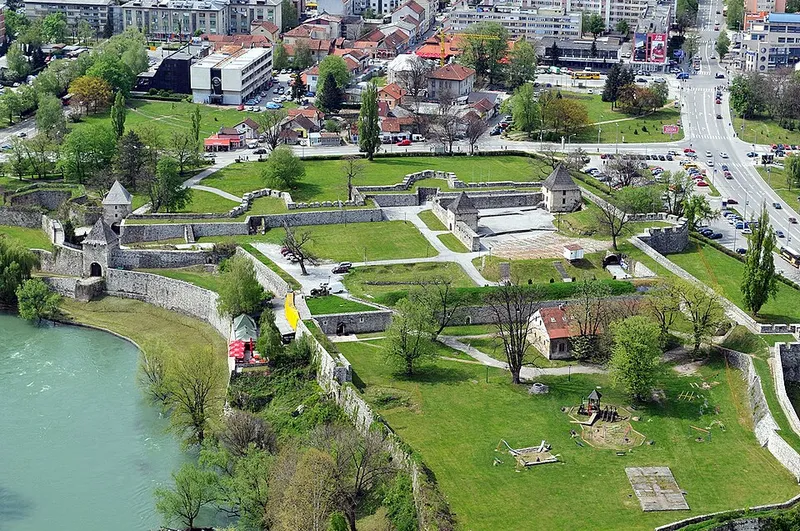
The fortress reached its final size during the rebuilding under Numan Pasha Köprülü between 1712 and 1714. Modelled on the lowland fortresses of Slavonia, it became a bastioned enclosure in the shape of an elongated trapezoid, with massive walls, towers and underground passages. On 4 August 1737 the Battle of Banja Luka ended in an Ottoman victory over the Austrian army. Around 1785 the fortress held 50 cannon; a military bathhouse was added in 1826 and artillery barracks around 1865, and the last repairs were carried out in 1868.
From military site to events venue
After the Austro-Hungarian occupation of 1878 the fortress kept some of its military functions. During the Second World War Kastel was a German stronghold, housed Ustaše and Nazi forces as well as a prison for communists and opponents of the regime, and was bombed several times by the Allies. The army used the site until 1959; from the 1960s it served many different purposes, and the 1969 earthquake damaged it.
Since July 2004 the historic area of the fortress has been a National Monument of Bosnia and Herzegovina. Restoration work with EU support began in 2013. In May 2026 the city reported that work on two more towers had been completed.
What you see today
Kastel is a lowland artillery fortress with a polygonal plan in the shape of an elongated trapezoid. Inside the walls the site covers 26,610 square metres. Seven projecting bastions are set into the walls, along with three square towers, and three arsenals lean against the inner side, where the walls are 6.5 metres thick. The main casemate is about 80 metres long and 15 metres wide.
A moat 20 to 30 metres wide once surrounded the fortress on every side except towards the Vrbas, so that it stood almost like an island; it has since been filled in. On the sandy riverbank two concealed wells were dug, holding river water filtered through layers of sand.
Behind the thick stone walls there is now a restaurant, a summer stage and children's playgrounds, and the open spaces are used for concerts, festivals and theatre. A Roman sarcophagus found near the city is also kept in the fortress.