A monastery older than 1536
When and by whom the monastery was founded cannot be said with certainty. Folk traditions name Grand Župan Stefan Nemanja and Saint Sava, or an Empress Mara, as its founders. The name comes from the Gomionica river, which may itself be named after mining spoil heaps: slag heaps, pits and tunnels line its upper and middle course.
The monastery first appears in writing in an Ottoman census register (defter) of 1540/41 that mentions a monastery of Zalužje in the nahiye of Zmijanje. In 1560 a pasha wrote to Istanbul that Abbot Andrija had headed the Zalužje monastery, also called Gomionica, for 24 years. The monastery therefore existed before 1536.
In the first half of the 17th century many monks lived here, with links across the Orthodox world. In 1599 a Typikon was copied at Gomionica, and in 1612 a monk from Mount Athos completed the copying of a Psalter here. In 1640 the goldsmith Stefan Ivanović Sarajevac made a silver-gilt cross for the monastery; it now belongs to the University of London.
Flight, fires and new beginnings
In the wars between Austria and the Ottomans from 1683 to 1699 the monastery was laid waste; the monks probably fled with its valuables to the monastery of Hodoš in the Banat. A later war drove them out again: in 1738 monks under Abbot Pahomije Knežević were granted permission to settle in the abandoned monastery of Pakra. The church was renovated in 1747, and around 1770 the monastery underwent a further renovation. During or shortly after the Knežopolje revolt of 1858 Gomionica was apparently set on fire and looted, and renovations followed in 1861, 1865 and 1868.
Abbot Partenije Davidović, later the hero of Petar Kočić's prose, had the residential building (konak) lengthened and given an extra floor, built a wooden bell tower and, from 1882 to 1884, a monastery school. In 1887 Petar Kočić attended this school.
During the Second World War the Ustaša killed Abbot Serafim Štrkić in 1941, and in December the Germans bombed the monastery. After the war Gomionica became a convent; the first nuns were Orthodox Ukrainians from the Prnjavor area. In 1953 the monastery was listed as a cultural monument. Repairs followed the earthquake of 1969, old frescoes were discovered in the dome beneath a 19th-century layer of paint in 1982, and between 1994 and 1997 the church was structurally secured and its old murals restored.
Church and frescoes
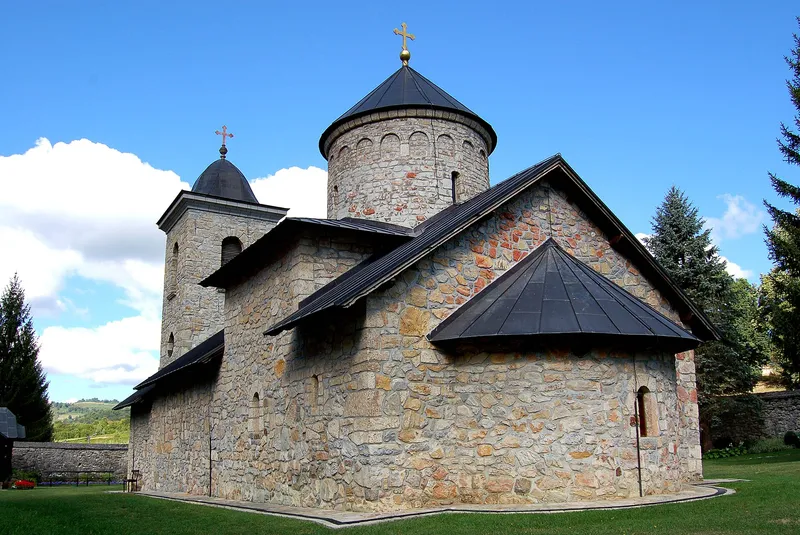
The church is a single-nave domed building with a semicircular apse and has largely kept its original appearance. Excluding the apse, the old building was about 16.50 metres long on the outside and 8.37 metres wide; the central vault is 8 metres high and the dome 12 metres.
The dome frescoes are dated to between 1560 and 1580 and associated with the painters then working in the circle of the Patriarchate of Peć. At the apex Christ Pantocrator appears in a medallion, below him the Heavenly Liturgy with ten angels, and in the drum twelve standing prophets. In the altar apse an image of the Mother of God alludes to the Burning Bush, a motif that is uncommon in the apses of 16th-century Serbian churches.
Around the church
Besides the church, the monument comprises the old konak, an old fountain, parts of the old wall, the village cemetery and a collection of icons, manuscripts and early printed books. According to local residents the bell tower was built in 1900; its baroque roof contrasts sharply with the old church. The old konak, a building with a rectangular plan measuring 19.70 × 9 metres, preserves a 17th-century fresco of the enthroned Mother of God with the Christ Child and two cherubim. Between the church and the konak stands a tufa fountain bearing the date 1700. The cemetery holds several dozen tufa grave crosses from the 18th and 19th centuries, without inscriptions.