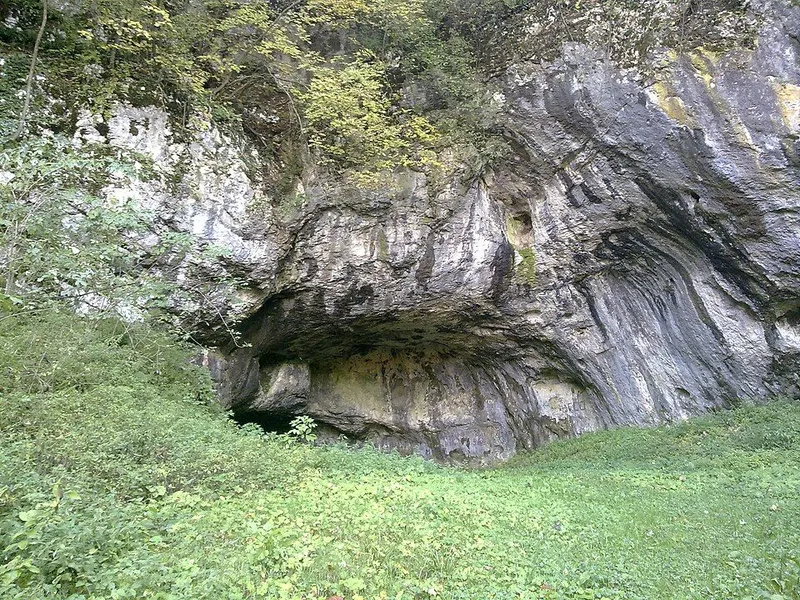
Setting and formation
The cave opens about halfway up the hill of Strane, above the spring of the Glibaja stream. From the village of Hrustovo it is around 700 metres, first along a village track and finally a short stretch on a footpath. The surrounding rock is Triassic and Cretaceous limestone.
The cave lies at the head of a dry valley whose floor holds the source of the Glibaja. It was carved out by a watercourse that over time sank to deeper levels, leaving its former underground bed behind.
Passages, lake and the totem room
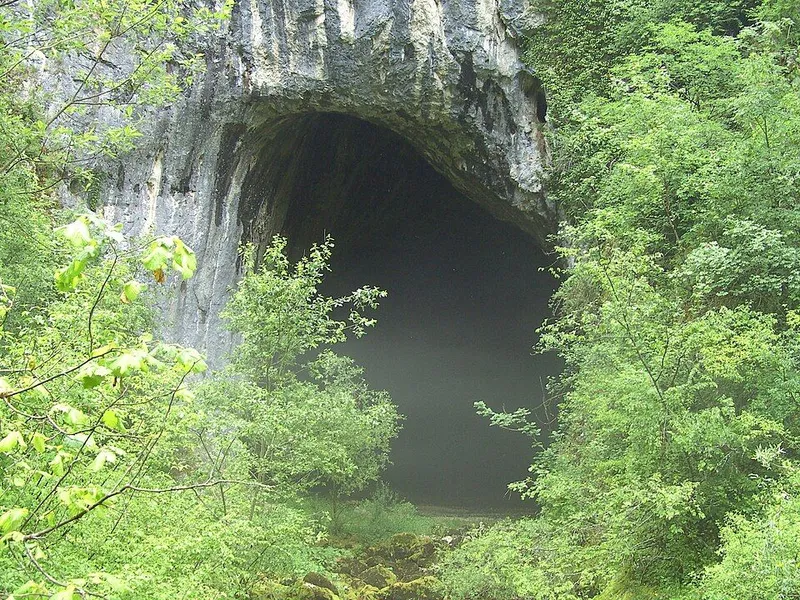
The entrance is a large opening in the rock, behind which a very high ceiling arches over spacious chambers. The cave is several hundred metres long and branches in two directions. One roomy, easily walkable passage runs about 480 metres west, towards an old Catholic church, and in places its cross-section reaches 7 to 8 square metres. The second passage is much narrower and heads south-east, towards the upper part of a neighbouring village. After around 760 metres it reaches a small lake of about 5 square metres whose size varies with the season and the inflow of water. As the water is about 2 metres deep, you cannot go further without equipment.
Roughly in the middle lies the so-called totem room. Over thousands of years water has shaped stalactites and stalagmites here; some resemble a lion or an elephant, and columns linking ceiling and floor recall totem poles. The floor is mostly level and consists of reddish-brown to black clay.
Traces of prehistory
Archaeological investigations showed that the entrance area was inhabited in the Copper Age. They uncovered eight large prehistoric hearths that were not used for metalworking, as well as animal bones. Specialists from the National Museum in Sarajevo recovered pottery, including bellied amphorae and biconical bowls, decorated mainly with triangles, quadrilaterals and zigzag bands. The finds belong to the Vučedol culture, whose regional variant in Bosnia and Herzegovina is called the “Hrustovački tip”. Among those who studied the cave was the archaeologist Alojz Benac; the finds are kept in the National Museum in Sarajevo. Test pits also produced bones of the Ice Age cave bear.
During the wars in the Balkans, people from the surrounding villages repeatedly took refuge in the cave, and in the Second World War Yugoslav Partisans used it as a hideout. As early as the beginning of the 20th century it featured in travel guides.
Wildlife and bats
The cave has a rich cave flora and fauna. Surveys in 2019 recorded four bat species: 95 lesser horseshoe bats, 248 greater horseshoe bats, 5 Mediterranean horseshoe bats and 500 common bent-winged bats.
Tips for your visit
The cave is largely undeveloped for tourism. It runs horizontally and no climbing is needed. You will need sturdy shoes and several lamps, and a helmet with a headlamp is recommended. As in any cave, do not go in alone, and tell someone where you are and when you expect to be back. Visits without a knowledgeable guide repeatedly lead to damage in the cave.