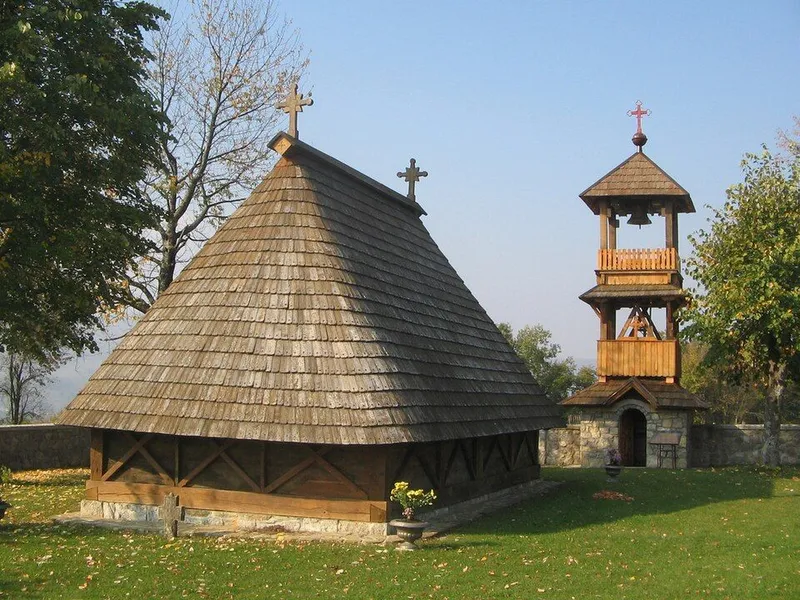
A log church from the 18th century
The Church of St Nicholas belongs to the Eparchy of Banja Luka of the Serbian Orthodox Church and is a cultural property of Republika Srpska. The parish gives 1756 as the year it was built, while other accounts say 1757. The tourist organisation of Republika Srpska counts it among the four Serbian Orthodox churches regarded as a special national treasure in Kneževo municipality; like the church in Imljani, it dates from Ottoman times and is protected as a historical monument.
It is built of oak on a rectangular plan, with no apse for the altar. It is 9.46 metres long, 4.92 metres wide and 5.50 metres high. That makes it an exception: according to the Commission to Preserve National Monuments, most wooden churches of the 18th century are no longer than 7 metres and no wider than 4.
Construction and interior
The walls are made of massive oak beams lapped at the corners, and on each long side five posts reinforce the wall. There is no ceiling, so from inside you look straight up into the open roof timbers. The floor is laid with stone slabs, and a choir gallery sits above the narthex.
An inscription about a repair in 1824 is carved into the wood. The church held a large number of icons from 1757 and 1758, whose inscriptions state that they were meant for Javorani. The icon of St Nicholas bears a note saying that the hieromonk Nikodim Gomioničanin from Kostajnica brought it in 1787. A prayer book kept in the church also records the monk Neofit of Gomionica Monastery, who was hanged by the Ottoman authorities in Banja Luka on a charge of defamation.
The wandering church
The church did not originally stand where it is now. In Ottoman times it was taken apart several times, carried to another hill and reassembled there to protect it from destruction. This gave rise to the legend that the church moved from hill to hill by itself; one night, it is said, it wandered from Grabež to Cvišić hill.
Another story concerns the sultan's permission: only a church as large as an ox hide could cover was allowed to be built. This rule is said to have been got round by a trick, by cutting up the hide.
A new parish church and restoration
In 1931 Javorani received a new parish church, also dedicated to St Nicholas, and the parish lists the wooden church as a chapel of ease. According to the Commission to Preserve National Monuments, building the new church right next to the old one contributed to the latter's decay.
In 2003 and 2004 the church was restored in a project run by the Republic Institute for the Protection of Cultural and Natural Heritage of Republika Srpska. In 2005 it was renewed and consecrated again.