Salt water in the city centre
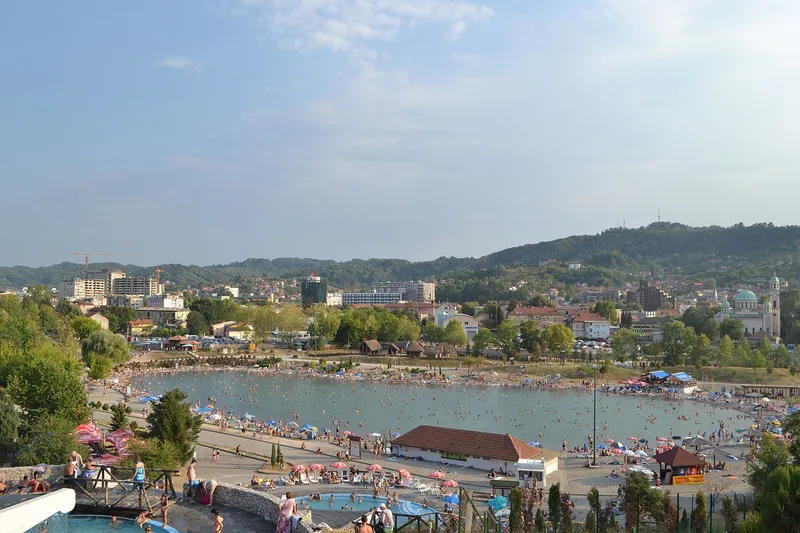
The complex consists of three lakes of different size and depth plus the salt waterfalls. All three lakes are in the centre of Tuzla and are run by the municipal company Pannonica. The grounds cover 75,000 square metres, the shoreline is 1000 metres long and the gravel beach measures 22,000 square metres.
The lake water is a blend: process water is piped in from the Modrac reservoir, and brine comes from the salt wells at Tetima just outside the city. Salt water makes up about 30 per cent of the volume, and salinity is 30 to 35 grams per litre. The water contains calcium, sodium, sulphur, iodine and bromine among other minerals, and according to the city it has almost all the properties of seawater; the city also credits it with healing effects, especially for rheumatic and respiratory conditions. It circulates constantly and is cleaned through sand filters. During the summer bathing season the Public Health Institute of Tuzla Canton tests the water three times a week.
A piece of the Pannonian Sea
When the Pannonian Sea withdrew from large parts of the continent millions of years ago, it left millions of tonnes of rock salt beneath Tuzla. With the help of local experts, salt water from these deposits was brought to the surface. The first, large lake was built in July 2003, and the archaeological park with its reconstructed pile-dwelling village followed in 2006. From 2008 the second lake and the salt waterfalls on the north side were built, and in 2012 the third, smaller lake opened.
The idea is older: as early as 2000 the book “Tuzland” proposed turning an existing body of water into artificial lakes with catering and sports facilities. At the 2012 Ulysses Awards of the United Nations World Tourism Organization, the project was named a runner-up in the category for innovation in public policy and governance.
What there is by the water
On the north side are the salt waterfalls, with five cascades and two swimming pools. The tourist board describes them as an open-air inhalation spot where you breathe in the salty mist and can let the falling water massage you. The third lake has two water slides, a blue spiral one and a red one shaped like a wave.
The archaeological park holds a reconstruction of a Neolithic pile-dwelling village. It shows how people lived here 7000 years ago; excavations have shown that a large settlement of pile dwellings stood in what is now the city centre. The Pannonica museum on the site opened in October 2012 and displays 100 minerals and 120 fossils, including tuzlaite, a mineral named after the city and found in its salt deposits. There is also a children's amusement park, sports pitches and cafés.
The Slana banja park adjoins the lakes directly. It has paths for walking and jogging, tennis, basketball and five-a-side football courts, and memorials to the heroes and victims of the Second World War, to the defenders in the war of 1992–1995 and to the young people killed at Kapija in 1995.
Tuzla and salt
The name itself points to salt: Tuzla means saltworks in Turkish, and in the Middle Ages the place was called Soli. The first settlement grew up around salt springs, and vessels for boiling brine show that salt was already being produced here in the Neolithic. In 1476, under Ottoman rule, the salt well on today's Salt Square, Soni trg, was modernised; up to 80 pans stood there for boiling down the brine.
Industrial salt production began in 1885 with the saltworks at Simin Han. Uncontrolled pumping of brine then caused parts of the city to subside, with the peak in the 1970s. Soni trg has now been laid out as a museum and visitor site, with finds from the Neolithic and Ottoman periods and a fountain shaped like a Neolithic salt-boiling vessel, a gift from the city of Ravenna.