The tombstones
Stećci are found at four places around the village of Olovci; the necropolis by the road lies at the spot called Donji Olovci. A gravel road borders the plot on the south, north and east. The 18 stones, 12 gabled ones, 5 chests and a pillar, are well worked and set in rows running west to east; only one gabled stone and two chests point north to south.
Three of the gabled stones are decorated. The one in the middle of the necropolis has a double spiral on its end faces. A second, in the northern part, is wrapped beneath its 'roof' by a thick twisted band, which also outlines the vertical edges and the gable of the eastern face. That face shows a cross with rounded ends, a motif typical of the Olovo and Kladanj area. The third has a staff-like object on its western face, with a curved handle whose ends turn down and inwards, and a T-shaped cross on each long side.
The epitaph of Radomir Jurisalić
Another gabled stone lies a little apart in the north. On its eastern face an inscription in Bosnian Cyrillic is cut in six lines. Its sense is: In the name of the Father and of the Son and of the Holy Spirit, here rests Radomir Jurisalić on his own noble land. The letters are fairly large, well formed and even.
Nothing is known about Radomir himself. He did, however, belong to the noble Jurisalić family, whose estate lay in this area. Judging by the letter forms, the inscription can be dated to the 14th or 15th century.
Kladanj in the Middle Ages
Little is recorded about medieval Kladanj. In early feudal times the basin of the Drinjača, to which Kladanj originally belonged, formed a single county called Birač. Later Kladanj was a caravan station in the hills on the border of Usora and Soli.
The area is rich in stećci: 430 have been recorded, almost half of them gabled, with many upright pillars but no cross-shaped stones. 60 are decorated. Spirals and stylised trees are typical, alongside twisted bands, crescents, stars, crosses, weapons and tools. The Kladanj stones are attributed to one of four stonemasons' workshops of eastern Bosnia, probably active between Kladanj, Olovo and Ilijaš, and are broadly dated from the 14th to the 16th century. The surroundings also have caves once used for religious rites; in Djevojačka pećina, the Maiden's Cave, the motifs on the walls resemble those on the stećci.
Protection and condition
In May 2005 the Commission to Preserve National Monuments declared the necropolis a national monument, and in 2016 it became one of 28 sites of the stećci World Heritage property. The inscribed area covers only 0.06 hectares, the buffer zone 4.32 hectares.
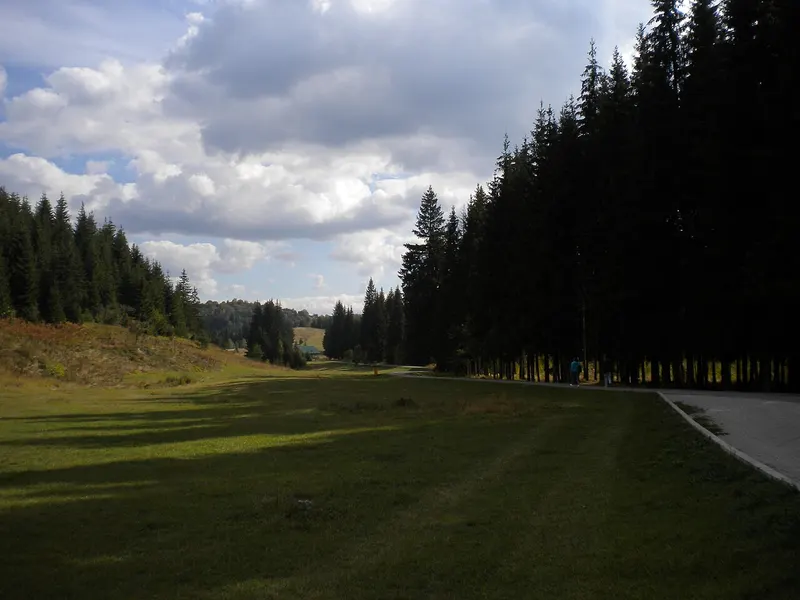
According to the 2017 description, no archaeological excavation had taken place. It called the state of the site unsatisfactory but the stones themselves relatively well preserved, apart from the spiral stone, whose broken piece lies 5 metres to the east. Three stones lean, two have sunk slightly, and moss and lichen are wearing them down. When the Institute for the Protection of Monuments of the Federal Ministry of Culture and Sport inspected the site on 22 July 2026, the fenced plot was overgrown with low to medium-height vegetation; rough gravel roads lead there.