Name, legend and beginnings
In the local dialect “mn” often becomes “vn”, which explains the form Lovnica. Since “lov” means hunt, the foundation legends revolve around hunters; one of them says the area was King Dragutin's hunting ground and that he founded the monastery. The present church, however, was probably built in the seventh or eighth decade of the 16th century.
The first written records are two notes in a typikon which, according to the first, was written at Lomnica on 6 November 1577/78, in the time of the hieromonk Arsenije. The monks Genadije and Akakije are painted in the narthex as founders, holding a model of the church between them. One of the two mother-of-pearl inlaid chanters' stands bears the year 1580, and a Gospel book was written here in 1592. Because Arsenije and Akakije are referred to as elders in those years, Lomnica was probably a dependency of Papraća Monastery at the time.
Longin and the frescoes
The iconostasis was painted by Longin, a monk tonsured at Peć who also wrote church poetry and copied books. One icon bears the year 1578; the iconostasis of 30 icons, two of them throne icons, dates from around then, and probably the older layer of wall painting as well. When Akakije died in 1579, Longin broke off the work and left the region.
A second group of painters worked here in 1608 and 1609. Their inscription above the door names four painters, two called Jovan plus Nikola and Georgije, and Abbot Prohor as the patron, and it complains of the fear of the Ottomans and the softas under which they worked. In the narthex six of the fourteen captions beside the portraits of monks are in Greek, and a rare Greek subject shows St Zosimas lamenting over the bier of Alexander the Great. Other details come from village life: at the Communion of the Apostles an ordinary bottle stands in place of a chalice. In terms of the area of surviving frescoes, only Dobrićevo and Zavala in Bosnia and Herzegovina can be compared with Lomnica.
Visitors, wars and renewal
In 1693 a record of the visit of Metropolitan Visarion of Dabar-Bosna was carved into the west wall of the nave. From 1705 the church served as a parish church, and throughout the 18th century visitors left their names on the walls; the last inscription by a monk dates from 1852. The church was re-roofed in 1823 and robbed in 1880.
The church escaped serious destruction in both world wars, although the roof of the konak burned in the Second World War. From September 1941 a Partisan hospital operated nearby, and in early 1943 it had a hundred beds in the monastery. The memorial cemetery for the fallen on the slope was laid out in 1961. After the restoration of the frescoes and the iconostasis, which began in 1952, a community of nuns gathered here in 1979 and monastic life was renewed.
Church, cave and spring
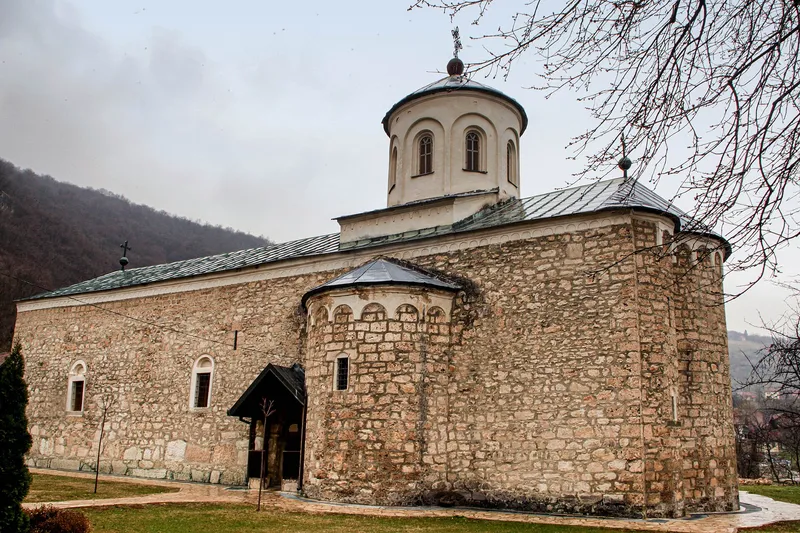
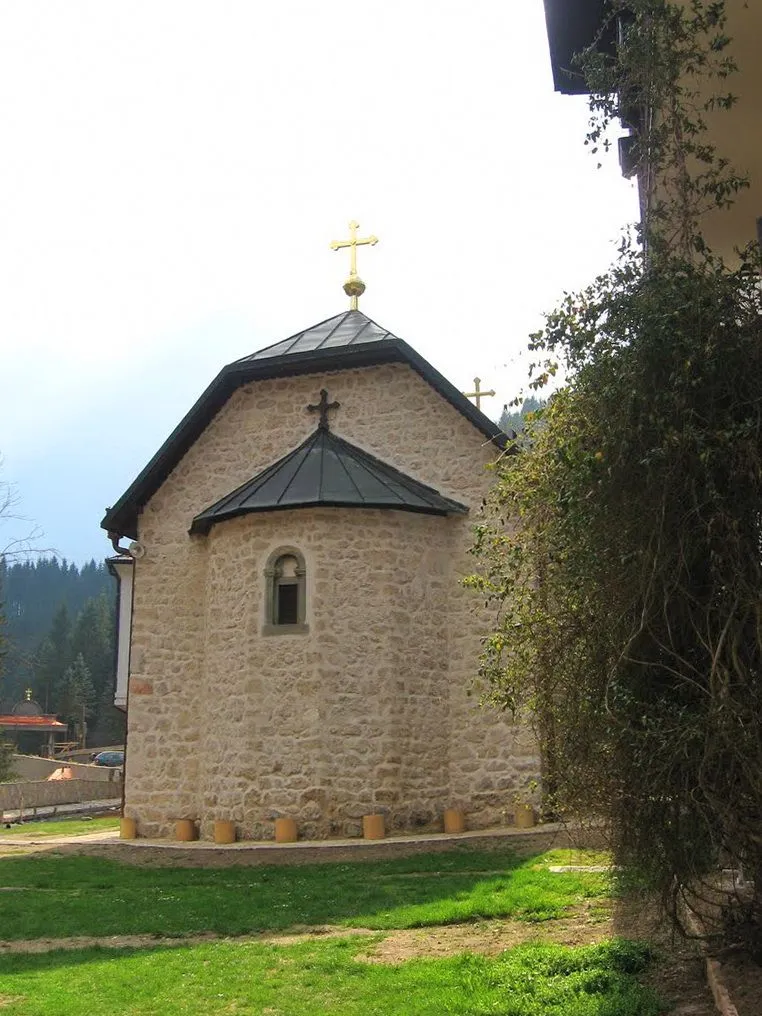
The single-nave church measures 15 by 7 metres on the outside. A blind dome sits over the central bay, its apex 7.90 metres above the floor. The walls of local limestone and sandstone are now unrendered, and the portals and window frames are carefully cut from a greenish local stone. Who built the church is unknown, but its builders were familiar with the coastal technique of attached arches. Because the slope slides towards the stream, retaining walls were built on the north and south sides.
The monastery stands at the southern foot of Borogovo on a narrow terrace above the stream. Above it opens Lovnica cave, whose entrance area covers about 30 square metres; it served as a hospital in the Second World War. The spring emerges beneath a rock face and forms a pool with a gentle waterfall, and some 800 metres further on the valley joins that of the Drinjača. Necropolises with stećak tombstones lie around the monastery, some carved with vine motifs.