Fortress and trading post
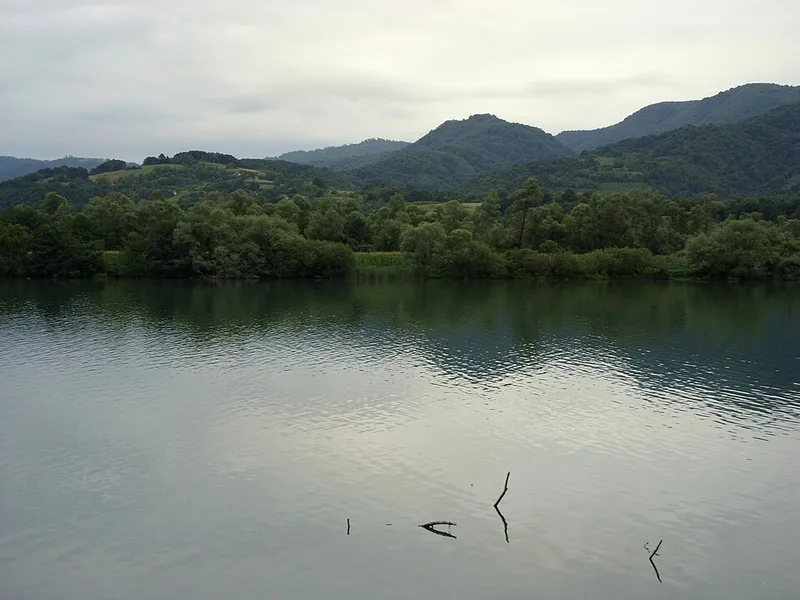
The fortress sits on an almost vertical rock about a hundred metres above the meeting point of the Jadar and the Drinjača, near the village of Pahljevići in Zvornik municipality. In the Middle Ages it belonged to the Bosnian royal domain in the Trebotić district. Its name probably comes from a family: a charter of the Bosnian King Stjepan Ostoja from 1417 names one Nikola Kušlatović as a witness.
Below the fortress lay the settlement of Podkučlat with its market square. Merchants from Dubrovnik settled here, and a customs post collected duties from traders on their goods. The settlement grew thanks to mining in the wider area, in the Jadar region and the districts of Birač and Ludmer. Podkučlat was also a junction for the Ragusan traders, with routes leading to Zvornik, to Olovo and Central Bosnia, to Srebrenica and across the Drina to Serbia.
Between Bosnia, Hungary and the Ottomans
During the 15th century Kušlat changed hands several times: besides Bosnian rulers, the fortress was also held by Hungarians, Serbs and Ottomans. From 1404 it belonged to the Bosnian Grand Duke Hrvoje Vukčić, and in 1410 it was handed over by agreement to the Hungarian King Sigismund of Luxembourg. In 1459 Kušlat fell to the Ottomans, who occupied the area immediately after conquering the Serbian Despotate and attached it to the Sanjak of Smederevo.
In the Ottoman period Kušlat formed a nahiye in the Sanjak of Zvornik and kept its military role. In 1804 it still housed 12 fortress guards and 15 armourers. As a result of the reforms, the fortress was abandoned before 1833.
The traveller Evliya Çelebi described Kušlat as a round stone town with solid bastions on a craggy rock, without a moat but surrounded by an infernal abyss. He reported a granary, an armoury, five cannons and a commander with a garrison of 28 men.
The mosque on the rock
According to the heritage institute of Tuzla Canton, the mosque beside the fortress was built between 1459 and 1463, before Sultan Mehmed II conquered the Bosnian kingdom. That places it among the few mosques in the country that are older than Ottoman rule over the whole of Bosnia. The institute counts it as traditional vernacular architecture from the period when the medieval Bosnian state came to an end: built of stone and wood, with a tall, steep timber roof and a wooden minaret.
The mosque was in use from the time it was built and was renovated several times, always in its original form. In 1993 Serb forces destroyed it; photographs survived, and the heritage institute had documented the building in 1989. By March 2013 the reconstruction was largely complete, with the roof and minaret renewed in wood.
The writer Ivo Andrić asked what kind of Bosnian you are if you have never heard of Kušlat, placing it on the old road from Zvornik to Central Bosnia.
What you see today
Remains of the fortress walls are visible, but its exact plan can no longer be determined. Together with the surrounding cliffs the site looks like a broken ellipse, which, in the view of historian Husref Redžić, is why Evliya Çelebi took it to be round. The only way up is a narrow forest path. Because parts of the fortress wall have collapsed, a landslip formed close to the mosque's west side, and the heritage institute considered it urgent to stabilise part of the original rampart.