Čava and Bužim in the Middle Ages
The sources know the castle by two names, Čava and Bužim. When it was built is unknown, though its construction points to the 14th century. From that period also comes a record of the parish of St Clement, part of the diocese of Zagreb, under the name Čava. In 1336 the castle passed to Grgur Galles, whose descendants sold their share to the heirs of the princes of Blagaj in 1425. At some point between 1429 and 1456 it came to the Counts of Celje; around 1456 it was granted to Dora Blagajska, wife of Martin Frankopan, and in 1479 it returned to the crown.
The king then gave Bužim to Juraj Mikuličić, who renewed it in the late 15th century. The outer ring of walls dates from that time, when Ottoman raids threatened the frontier and firearms were already common. In 1523 King Louis allowed Petar Keglević, captain of Jajce, to mine gold, silver and copper throughout the castle's lands for 25 years.
An Ottoman frontier fortress
In October 1530 Ottoman troops carried off prisoners and set the surrounding area alight. In 1564 the Bosnian sanjak-bey Mustafa-beg Sokolović occupied the castle but was pushed back; in 1576 the Ottomans under Ferhad-paša took Bužim. Grand Vizier Sokolović turned down a request to hand it back, arguing that mosques had already been built inside the forts. The Ottomans installed a garrison of 50 horsemen and 130 foot soldiers.
During the Great Turkish War Christian armies moved against Bužim in 1685, 1686 and 1688, and once more in 1737 during the siege of Banja Luka, without winning the fortress for good. The fortress was always kept in repair, for instance in 1626, and in 1833 it held 18 cannon. The mosque in the inner castle remained in use until the middle of the 19th century, after which a wooden mosque was built in the town below.
Inner castle and outer ring
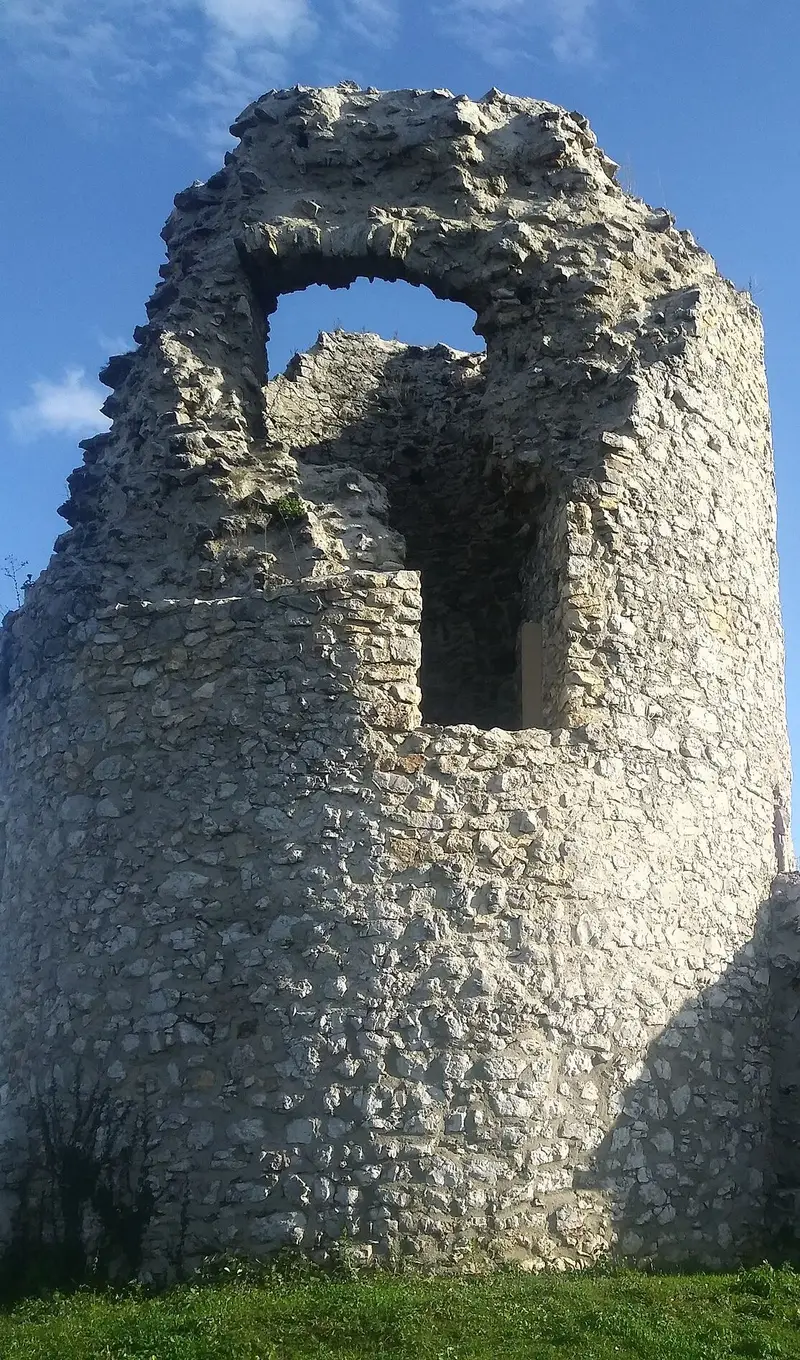
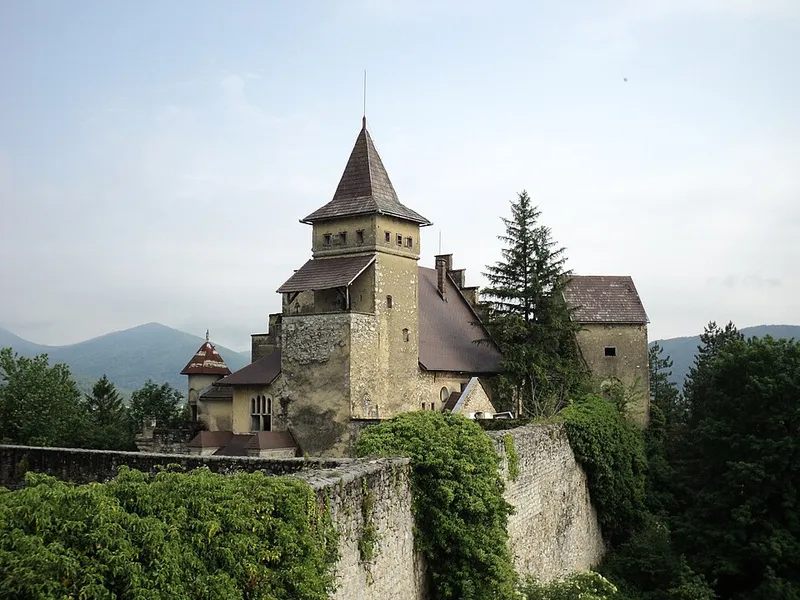
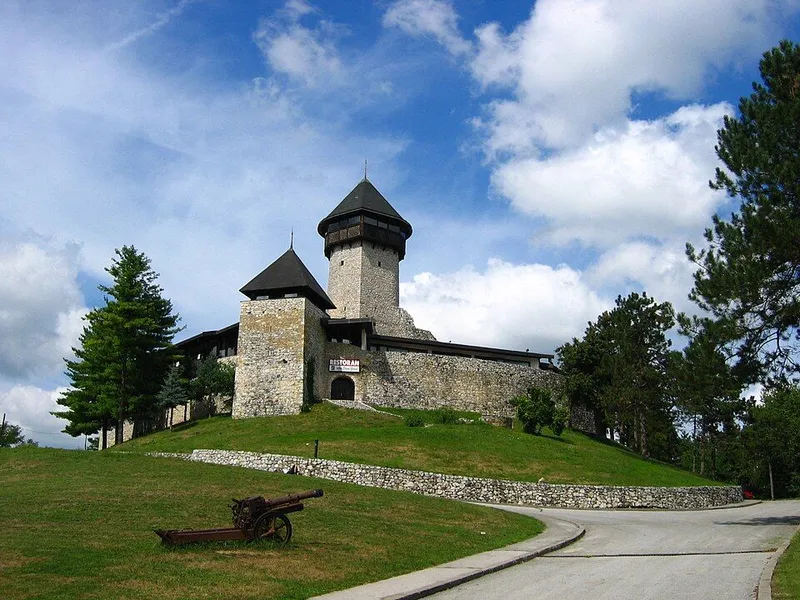
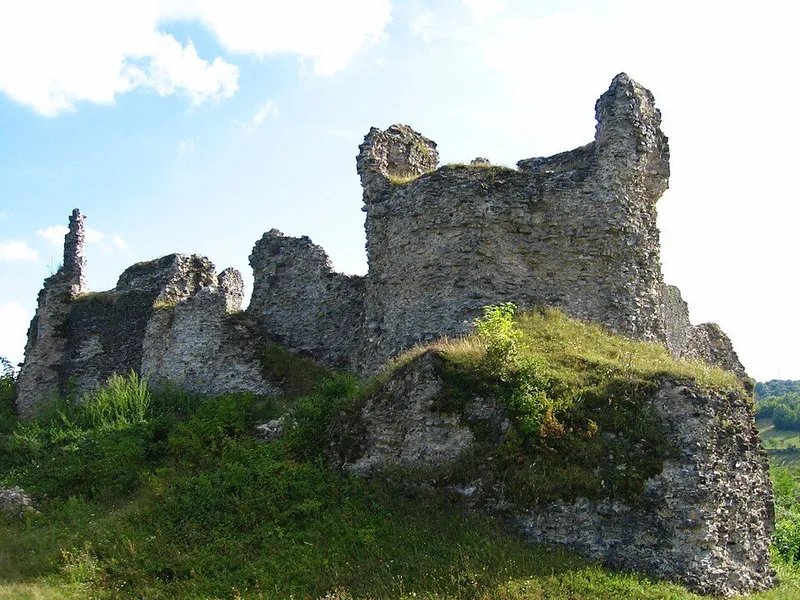
Bužim combines an older type of fortress from before the age of firearms with later walls and towers designed to withstand artillery. The inner castle is a fairly regular quadrangle of about 750 square metres with tall round towers at its corners. These had walls 2 to 2.8 metres thick, three storeys and a height of up to 20 metres. The south-east tower is well preserved, 9 metres across and 17.5 metres high; its outer skin is of hard dressed stone at the bottom and top, with finely cut tufa blocks in between. The stone mosque of the Ottoman period takes up more than a third of the courtyard, and traces of its mihrab remain on the east wall.
In the late 15th century the inner castle was enclosed by a trapezoid ring of lower walls and polygonal corner towers with gun platforms. This ring encloses about 4,500 square metres, its walls stand 5 to 8 metres high, and the west rampart alone runs for 77 metres.
The Glagolitic inscription
Above the arched gate of the outer ring sat a lintel of bihacite, a local stone, carrying a carefully written Glagolitic inscription. It opens by stating that the elect prince Juraj Mikuličić built this castle from its foundations, and goes on to praise him lavishly; it was probably carved only after his violent death. In 1876 an Austrian officer took the slab down and handed it to what was then the National Museum in Zagreb. It later passed into the stone collection of the Croatian History Museum.
Reliefs were carved on the side stones: on the left an armoured arm with a mace and battleaxe, on the right a soldier with a banner beneath a crescent moon and two stars. They are probably heraldic emblems of the castle's lords in the 15th and 16th centuries.