How the museum came about
The idea of a museum arose among the Franciscans of Herzegovina in the middle of the 19th century. Some of them had studied in Italy and Austria and seen museums there that occasionally held objects from their own homeland. A first major step was taken by the historian, writer and builder Fra Petar Bakula (1816–1873), who in 1867 published his Schematism, written in Latin, with notes on archaeology, history, ethnology and more.
The museum’s founder was Fra Anđeo Nuić (1850–1916) from Drinovci, an archaeologist, conservator and museum curator. He carried out early archaeological field surveys and discovered the Roman military camp at Gračine near Humac. He brought his finds to the friary, was given a room, had display cases made and opened the collection to the public in the spring of 1884, as the first museum institution in the country. In the same year he drew up a statute and began an accession register of the collected objects.
Closures and new beginnings
Only in 1969 did the permanent exhibition receive more suitable rooms in the east wing of the friary: three rooms for the prehistoric, ancient and medieval collections and a canopy in the atrium for the stone monuments. This display opened in 1973 but had to shut six years later because of building work. For the museum’s centenary in 1984 it reopened, now with one larger and three smaller halls, while the stone monuments moved to the cloister. In 1992 the war forced the exhibits into safekeeping again.
The present museum rooms were fitted out in 2002. The municipality of Ljubuški has since entrusted the public company JP Parkovi with running the museum, and excavations in the Ljubuški area in 2017 have helped to renew the holdings.
What you can see
The exhibition is arranged chronologically. The Old Stone Age is represented by a single object; far more items come from the Bronze and Iron Ages, mostly jewellery, tools and weapons from graves that survive as large stone mounds throughout Herzegovina. Among them are a small figurine of a goddess from Sovići, acquired somewhere in the Mediterranean, a helmet of the Greco-Illyrian type and vessels made on the potter’s wheel.
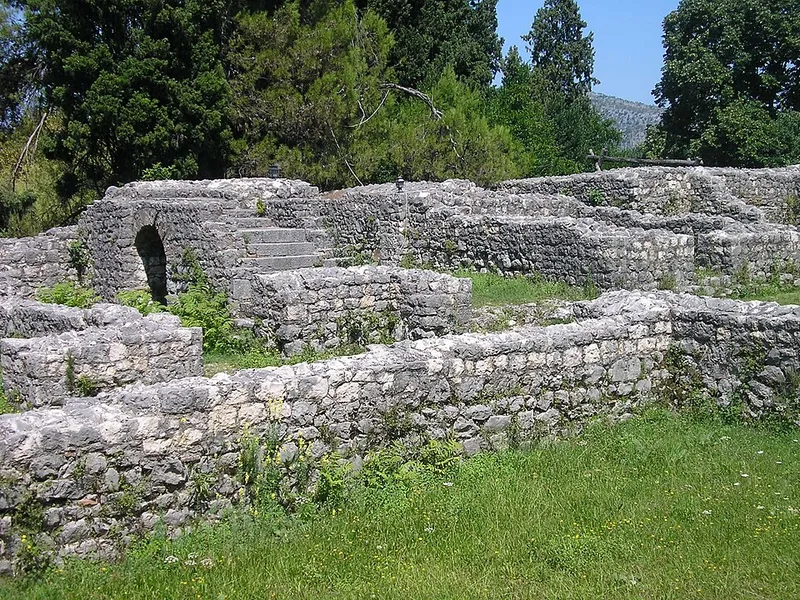
The Roman collection is particularly rich, as the Ljubuški area is known for its many Roman monuments. A large share of the finds comes from the nearby Roman camp at Gračine, which was investigated from 1977 to 1980. Inscriptions show that a large temple stood in Humac, perhaps even on the site of today’s friary; it was dedicated to Liber and Libera, the protectors of wine and viticulture.
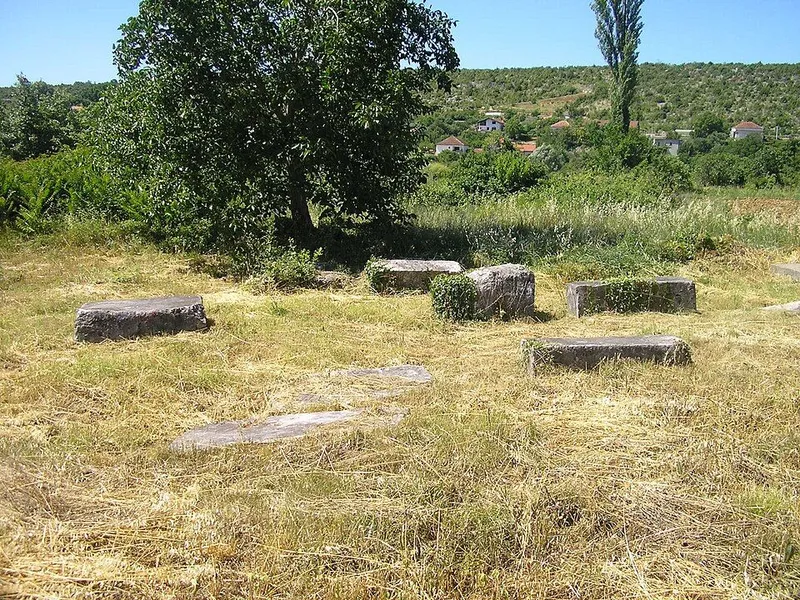
From the Middle Ages there are weapons, architectural decoration from churches, an original stećak and a cast of a particularly valuable stećak inscription. Also on display is the Humac tablet (Humačka ploča), which the museum dates to the period from the 10th to the 12th century. The museum describes it as the oldest surviving written record of the Croatian language in present-day Bosnia and Herzegovina, written in a mixture of Glagolitic script and Bosančica.
The friary and the “Majka” gallery
The friary itself dates from 1867: its foundation stone was blessed on 4 April 1867, and construction lasted about ten years. The friary library today holds more than 20,000 volumes, the oldest from the 16th century.
Since 2004 the friary has also housed the “Majka” (Mother) art collection. It comprises around 250 works, including almost 140 sculptures as well as paintings, drawings and prints. Some seventy Croatian artists of different generations are represented, and the collection as a whole is devoted to the theme of the mother.