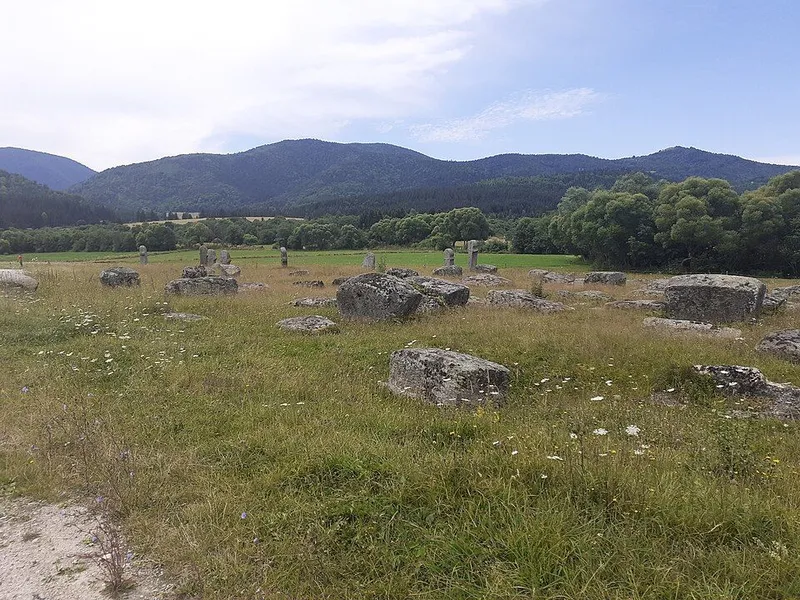
What you can see
A 1.5 km gravel track to the hamlet of Seona branches off the road and runs straight through the necropolis, dividing it in two. To the left of the track stand 94 stećci and 9 crosses, to the right 7 stećci and 7 crosses. The count gives 32 slabs, 52 chests and 11 gabled stones; another 6 have sunk so deep that their shape can no longer be identified. The main form is a chest set on a base.
The stones are of limestone, set out in rows and mostly aligned west to east or north to south. Only one stećak, number 1, is decorated, with a poorly preserved circle known as an apple. Chest number 20 stands out for its size of 214 x 177 x 32 cm, and number 82 belongs to a less common type: a chest on a base, the chest itself tapering towards the bottom. There are no inscriptions.
The cross-shaped tombstones
A special feature of Maculje is its 16 cross-shaped tombstones, known as krstače, which recall human figures. All but one are decorated, with crosses, including stylised and Greek ones, with circles and with crescent moons. Crosses of this kind occur around Travnik, Novi Travnik and Zenica but not in the other stećci regions, and they are seen as a distinct, still undeveloped form of the monumental cross.
The older pieces look more like oval slabs, wider at the top than at the bottom. Over time the upper part was shaped more and more clearly into shoulders, a hint of a neck and cross arms like outstretched human arms. Other necropolises with such crosses lie in the same municipality, near Orašac, at Kaurlaš near Zagrlj and at Sebešić, where burials continued over a long period beside a burial mound.
Roman road and the county of Lašva
Maculje lies on the course of an old Roman road between Skopljansko polje and the Lašva valley. Starting at Gornji Vakuf and Podgrađe, it followed the Bistrica valley, crossed Brezovača and Oštra Glavica and continued via Opare, Bistro and Duboko to Gornja Večerinska.
In the Middle Ages the area belonged to the county of Lašva, which covered today's municipalities of Busovača, Vitez, Novi Travnik and Travnik. It was ruled by the Bosnian bans and from 1377 by the kings, was probably well populated and lived mainly from farming. It first appears in writing in 1244, in a charter of the Hungarian king Béla IV. More than 50 necropolises with stećci from the 14th and 15th centuries are known in the area, along with the medieval forts of Toričan, Travnik, Bosnić or Škaf, and Vrbenac.
Legends, protection and condition
Legends cling to the stones. In one, a wedding party froze to death in the cold on its way and turned to stone. In the other, two young lovers were forbidden to marry by their parents; when the pair were halfway along the road with the wedding guests, the bride's mother cursed her daughter and the guests, who were then turned to stone.
In September 2007 the Commission to Preserve National Monuments declared the necropolis a national monument. In 2016 it was inscribed as one of 28 sites of the stećci World Heritage property; the inscribed area covers 0.6 hectares, the buffer zone 17.23 hectares. The 2017 description calls its condition satisfactory: the stones appear to stand where they were first placed, some of them were conserved in 2011, and the ground is kept clear of scrub. At the time no archaeological excavation had taken place.