From the župa of Lašva to the town of viziers
In the Middle Ages the area belonged to the župa (district) of Lašva, mentioned in 1244 in a charter of the Hungarian king Béla IV. The name of the town itself does not appear until the Ottomans conquered the Bosnian Kingdom: Sultan Mehmed II stopped here on his way to Jajce.
After Prince Eugene of Savoy had advanced into Bosnia, the vizier's seat was moved in 1699 from threatened Sarajevo to Travnik. With short interruptions, the town remained the seat of the viziers for some 150 years. In 1806 and 1807 France and Austria opened consulates; Ivo Andrić describes this period in his novel “Travnička hronika” (Bosnian Chronicle). In September 1903 a spark from a locomotive started a fire that destroyed most of the houses; the fortress was spared.
The fortress
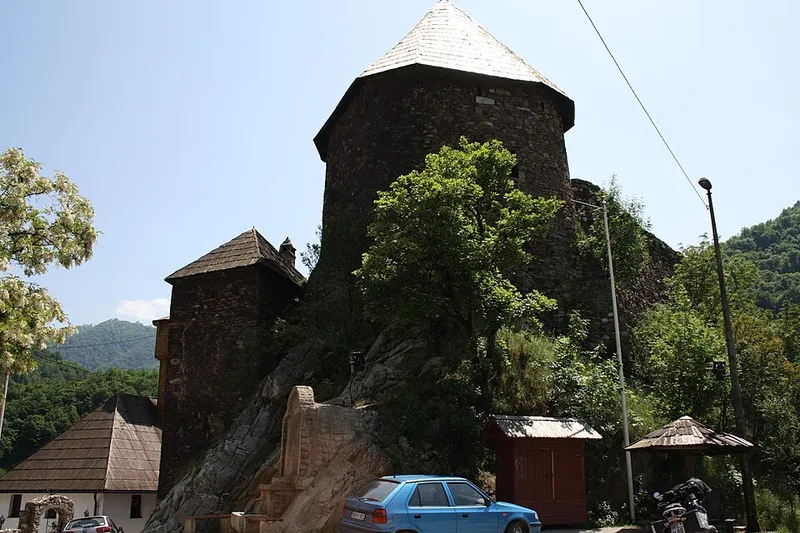
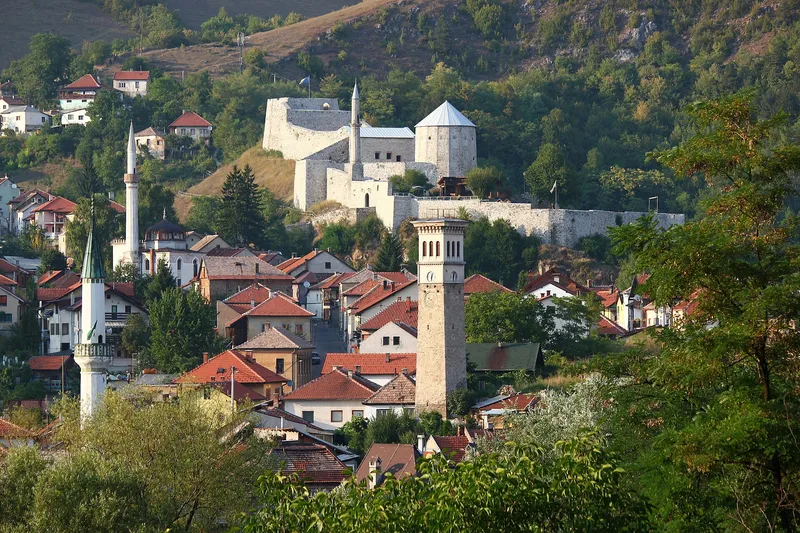
The fortress, known today as Stari grad (Old Town), rises on the town's eastern fringe, on a rocky Vlašić hillside between the Plava voda spring and the Hendek stream. It is shaped like an irregular pentagon, covers about 11,000 square metres and is entered from the west over a stone bridge. The site was once known as Garbun; the fortress served as an Ottoman garrison, a dungeon and, until after the Second World War, a military post.
Since 1953 the Travnik Regional Museum has looked after the site, with exhibitions in the tower and the powder house. Since 2005 the fortress has been a national monument of Bosnia and Herzegovina.
Mosques, clock towers and tombs
In the heart of the old bazaar stands the Šarena džamija, the Colourful Mosque, also called the Sulejmanija, known for its unusual wall decoration. According to tradition, it stands where Sultan Mehmed II stopped to pray. Other important buildings include the Jeni Mosque with the tomb of the vizier Abdulah-paša Defterdarija, the viziers' tombs, the stone bridge over the Lašva and the Hadži-Alibegova Mosque with its clock tower, fountain and a sundial on the mosque wall. A second clock tower stands on the Musala. Many of Travnik's religious buildings are national monuments.
Plava voda
Beneath Vlašić, just below the fortress and in the middle of the old town, rises the karst spring of Plava voda. Several strong springs were dammed for a small hydroelectric plant, and the place took its name, “Blue Water”, from the colour of the lake. Today Plava voda supplies the town with water. In 1906 Travnik got electric light after the Czech firm Križik built a hydroelectric plant here.
The Derventa coffee house at Plava voda is known from Andrić's “Travnička hronika” as Lutvina kahva. It is also called “Rudolfova” after Crown Prince Rudolf, who stopped here on his travels in 1887 and afterwards funded the restoration of the old building with a donation.
Ivo Andrić and his birthplace
Ivo Andrić, winner of the 1961 Nobel Prize in Literature, was born on 9 October 1892 in a small house in the old Bosnian style on Zenjak Street. The reconstructed house opened as a memorial museum in 1974. Upstairs visitors find a study with traditional furniture of Bosnian town families, a library of about 600 editions of his works and a room devoted to “Travnička hronika”, along with photographs of the Nobel Prize ceremony. Andrić was baptised in the Church of St John the Baptist.