Tombstones from two eras
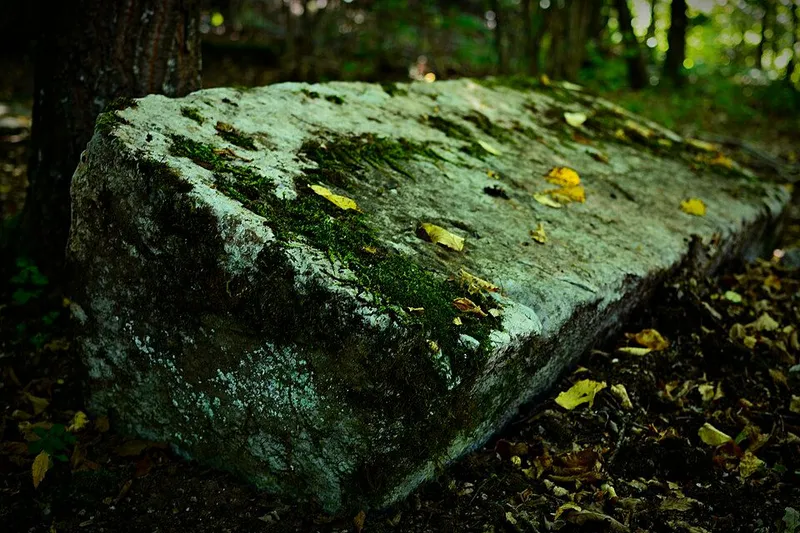
The stones lie on a hill covered with hornbeams, whose foot marks the edge of the protected area. According to the records of the Commission to Preserve National Monuments, 211 monuments were found here: 129 chests, 2 gabled stones, 2 medieval slabs and 74 stones of uncertain shape, plus 3 late antique grave slabs and a Roman altar. The heritage institute of Republika Srpska counted 238 stones and fragments in 2012.
22 stones are decorated, including the three late antique slabs. The motifs include friezes, small, stylised and human-shaped crosses, crescents, a staff, swords, a dagger, circles, a water mill, a hand, a rosette, and animals and people in relief. No inscriptions have been found on the stećci.
One of the late antique slabs, number 161, measures 168 x 73 x 24 cm. A semicircular recessed niche holds two busts: on the east side the lady of the house, holding a key in her right hand, on the west side a man. Two circles fill the corners, and beneath the busts runs a frieze of leafless tendrils. The inscription panel below is so badly damaged that no text survives.
From the Illyrians to the 20th century
The area around Borje, Kunovo, Potpeć and Velenići was already settled in prehistory. In 1889 several burial mounds were discovered whose bronze finds match those of the same period from Glasinačko polje. One mound held a box of fine river slate containing scattered, half-burnt skeletal remains on a bed of pebbles and slate, together with a fragment of a three-edged stone knife. In pre-Roman times the area belonged to the Illyrian tribal alliance of the Pirustae, who fought Rome to the end alongside the Daesitiates and were only defeated in the revolt of Bato in AD 6 to 9.
Excavations around the middle of the 20th century revealed several places in the area with remains of ancient and medieval religious buildings and their graveyards, among them five late antique tombstones. The field name Crkvina points to a church, but none has been found. Burials here continued beyond the Middle Ages into the 1930s.
Podrinje in the Middle Ages
In 1373 the area passed to Bosnia, when Tvrtko I, in agreement with Prince Lazar, defeated the Serbian nobleman Nikola Altomanović and divided his lands. Upper Podrinje was rich in forest and suited to stock-raising and beekeeping, and grain from its fertile basins was exported early to Dubrovnik. Important routes also crossed here: from Dubrovnik the road known in the sources as Via Drine or Via Choce ran through the area to Serbia and on to the road to Constantinople, and from Foča another route went via Goražde to Srebrenica and further north as far as Hungary. Foča itself was a market town of the Hranić-Kosača family and is first mentioned in 1368.
Protection and condition
In October 2010 the Commission to Preserve National Monuments declared the necropolis with stećci and late antique tombstones at Mramor (Crkvina) a national monument. In 2016 it became one of 28 sites of the stećci World Heritage property; the inscribed area covers 2.22 hectares, the buffer zone 2.79 hectares.
The 2017 description calls the condition good. Some stones are chipped, damaged, toppled or sunken, lichen and moss cover them to a greater or lesser extent, and because the whole site is wooded, some are becoming overgrown. After a second visit, soil was cleared from some of the stones but not from all, so the total count is regarded as provisional. In 2011 the site was surveyed and photographed stone by stone.