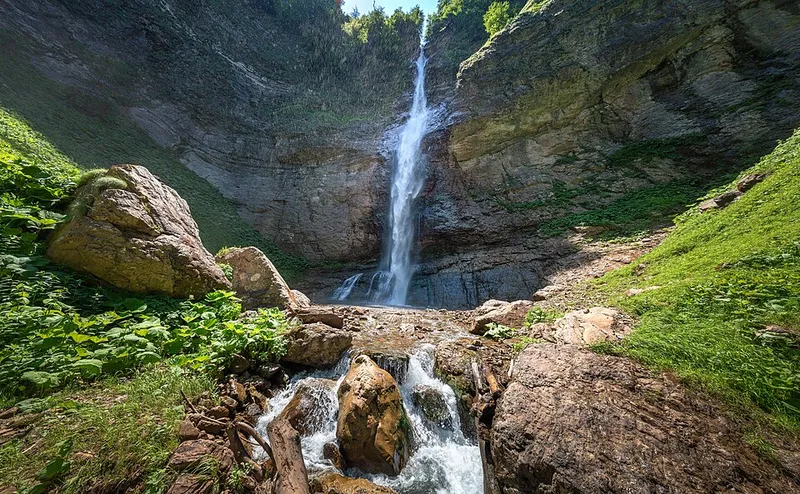
The waterfall
Skakavac means grasshopper. The Perućica stream flows through the forest of the same name and drops between two steep slopes of Maglić. About halfway along its course it falls vertically from an upper hanging valley over a karst limestone cliff into the lower valley; figures for the height of the drop range from 73 to 75 metres. A strong air current forms at the foot of the cliff, which makes the spot almost inaccessible, especially during the spring snowmelt. The stream then continues to the Tjentište valley, where it joins the Sutjeska.
The Perućica primeval forest
Perućica lies below 2,386-metre Maglić and is separated from the Zelengora range by the Sutjeska canyon. The reserve covers the entire catchment of the stream. It is about 6 kilometres long and extends from 668 metres at the confluence with the Sutjeska up to 1,648 metres at Prijevor. It is protected as a strict nature reserve.
Beech, spruce and fir grow here, reaching several centuries in age and 50 to 60 metres in height. Not even diseased trees or trees felled by avalanches, wind or lightning may be cut; new life grows on their remains. In places the forest is almost impenetrable. Walking in the primeval forest is only permitted when accompanied by a Sutjeska National Park guide.
Viewpoints
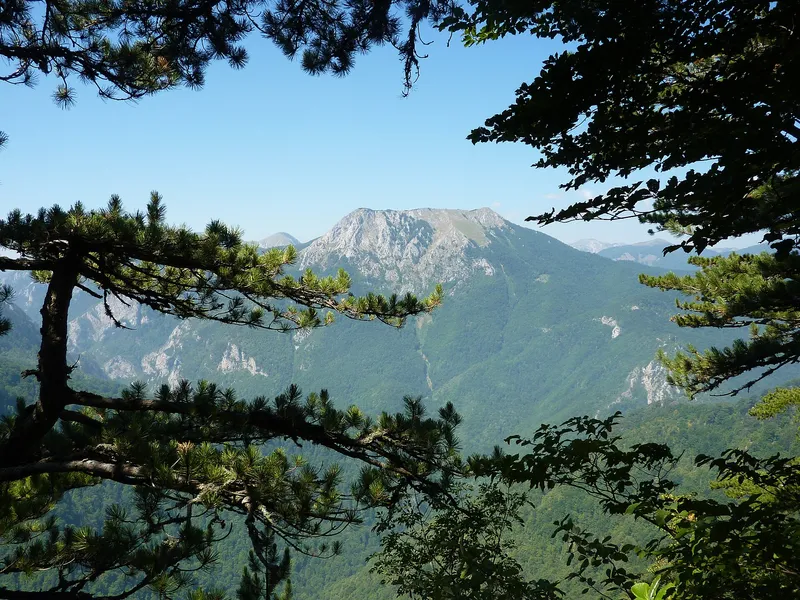
From Tjentište a decent gravel road climbs 10 kilometres to Dragoš sedlo. From the car park, a path about a hundred metres long leads to the viewpoint. Below it lies a deep, forested and almost inaccessible basin, in the middle of which Skakavac plunges into the depths. Opposite rise the rock walls of Volujak, with Maglić to the left and, to the right beyond the Sutjeska canyon, the peaks of Zelengora.
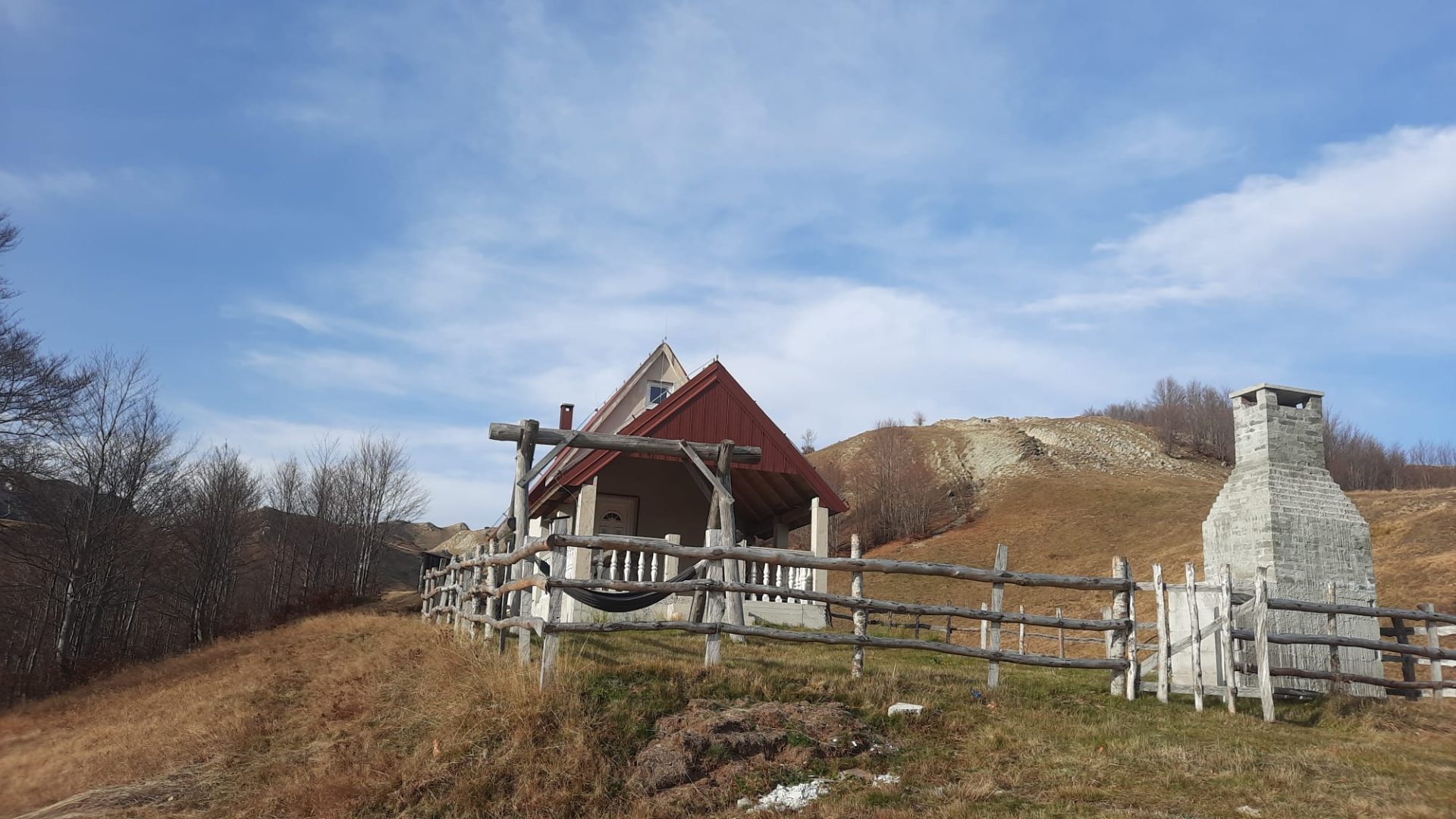
A few hundred metres before the car park, a hiking trail starts towards the Beškita viewpoint at 1,275 metres. Its two platforms, linked by a path, look out over Perućica and the Tjentište valley. Unlike the forest itself, both viewpoints can be visited without a guide, on foot or by car. At Prijevor below Maglić, katuns, the traditional summer shepherd settlements, are still in use, offering mountain cheese and kajmak.
Sutjeska National Park
The national park was designated in 1962 and, according to a new survey, covers 16,052 hectares; more than half of the area is forested. Over 2,600 species of vascular plants have been recorded, a significant share of them endemic or rare, along with 100 species of edible mushrooms and 114 bird species.
At Tjentište a memorial commemorates the Battle of the Sutjeska in the Second World War, and a memorial room decorated with wall frescoes is dedicated to the 1943 battle. The road to Dragoš sedlo starts here, so the memorial and the viewpoint are easy to combine.