Setting on Stražbenica
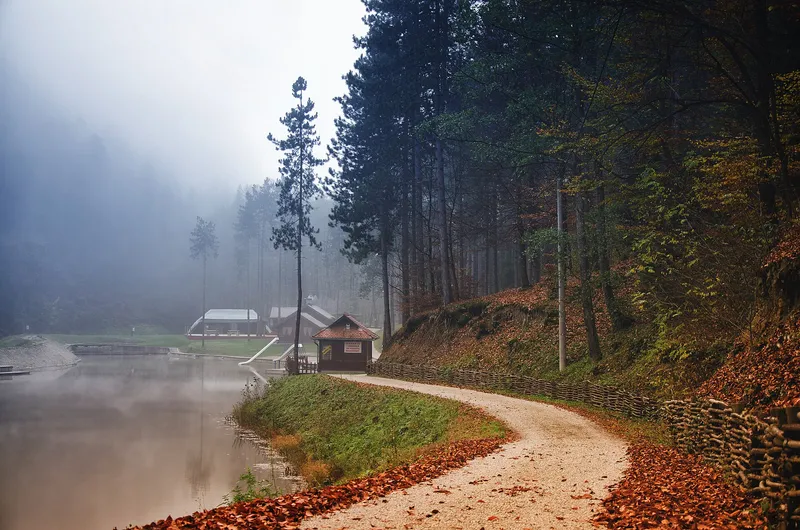
The stones lie in the hamlet of Brkića Potok, part of Vrućica, on the top of a small hill on the south-western slope of Stražbenica. The rise is covered by a small wood. The site is not protected by any heritage authority and is not maintained; even in Teslić many residents do not know the stones exist.
Legend and history
According to tradition, the three stones are the graves of Vojvoda Momčilo, his wife Vukosava and their child. Neither historical nor archaeological research, however, has shown that any duke or any ruler named Momčilo ever governed this area. The age and origin of the stones are also unresolved; there are several hypotheses, none of them scientifically confirmed or refuted. One assumption places the couple between the 13th and the 16th century. After the war a street in Vrućica was named after the duke.
The three stones
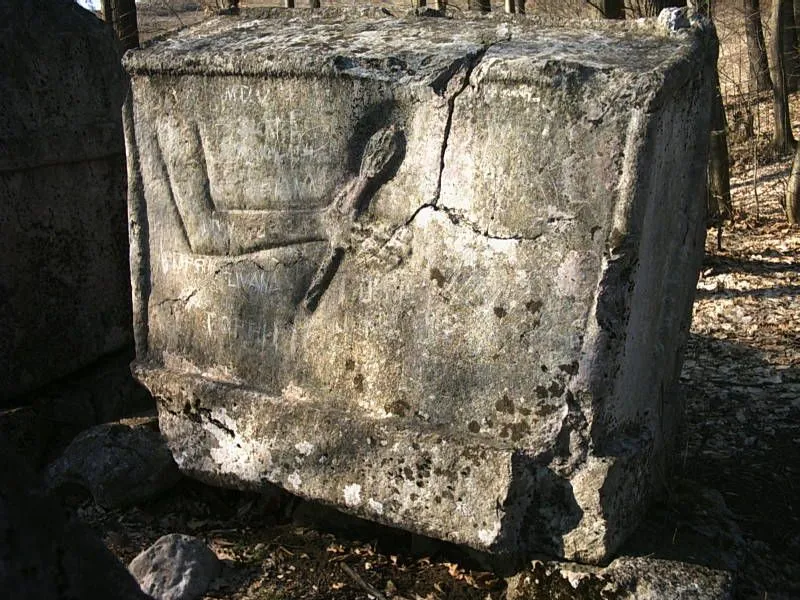
The largest stone of the group, regarded as the duke’s grave, rests on a prismatic base worked from a single piece; its upper part is shaped like a sarcophagus in the form of a house with a gabled roof. A rounded border 12 centimetres thick frames it, ending at the corners in stone balls. On the main face an arm is carved, bent at the elbow, its fist holding a mace or a torch; the head of the mace is elliptical with three rows of grooves. In the first half of the 20th century the stone lay toppled over for a long time.
The stone that tradition assigns to the wife stands right at the head end, is aligned north–south and measures 110 centimetres in length, 80 in width and, depending on the source, 170 or 180 centimetres in height. Above a band 14 centimetres wide it tapers into a dome with a ball at the top, from which grooves and 14 panels run down. The third stone, to the south and known as the “child’s grave”, is the smallest and plainest: each side of its roof is a trapezoid, an oval ball sits on top, the border is 10 centimetres thick, and there is no inscription.
Copies in the Doboj museum
Since 2012 copies of the three stones have stood in the lapidarium of the museum in Doboj; the first was set up on 6 October 2012. The sculptor Drago Handanović made them from reinforced fair-faced concrete together with museum specialists. For this they took 19 impressions with plaster negatives on site. Appearance, dimensions and arrangement match the originals.