Medieval beginnings
When the fortress was built is not known exactly. Excavations in the early 1960s found no continuous settlement from prehistory through Roman times to the fortress of the early 15th century. In the Middle Ages Maglaj belonged to the region of Usora, and it is thought that a župa stronghold stood here as early as the 13th century.
Maglaj is first reliably recorded in a charter that King Sigismund issued on 16 September 1408 “sub castro nostro Maglay”, below our castle of Maglaj, which suggests the Hungarians had taken it shortly before. As early as 1399 the Bosnian king Stjepan Ostoja had issued a charter for Dubrovnik with his army on the Lišnica, which joins the Bosna one kilometre upstream of Maglaj. Finds from the excavations also date from this period: six helmets of the Kesselhaube type from the 14th century, an iron vessel holding 2 kilograms of charred wheat, and a cast bombard from the early 15th century found beneath a loophole of the gate tower.
Under Ottoman rule
The Ottomans took Maglaj in 1476, ending the puppet kingdom they had set up in 1465 with Matija Radivojević as Bosnian king. Major building work followed as early as 1490, but the fortress was turned into an artillery stronghold only in the 17th century. Between 1683 and 1699 three strong casemates were built, and 150 coins struck in Sarajevo in 1690 were found in front of them.
On 7 October 1697 the garrison handed the fortress over to the troops of Eugene of Savoy without a fight; 200 soldiers were inside. At the end of October the Austrians blew it up on their way back from Sarajevo. After the Peace of Belgrade in 1739 the captaincy of Maglaj was founded; the descendants of one of its two captain families later bore the name Uzeirbegović. The fortress was thoroughly repaired in 1782, and in 1789 the Austrians briefly took Maglaj once more. A small garrison stayed until 1878, when the fortress was abandoned.
A walk through the fortress
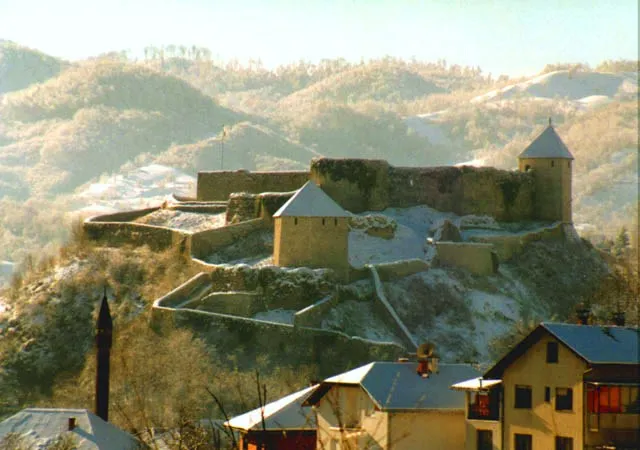
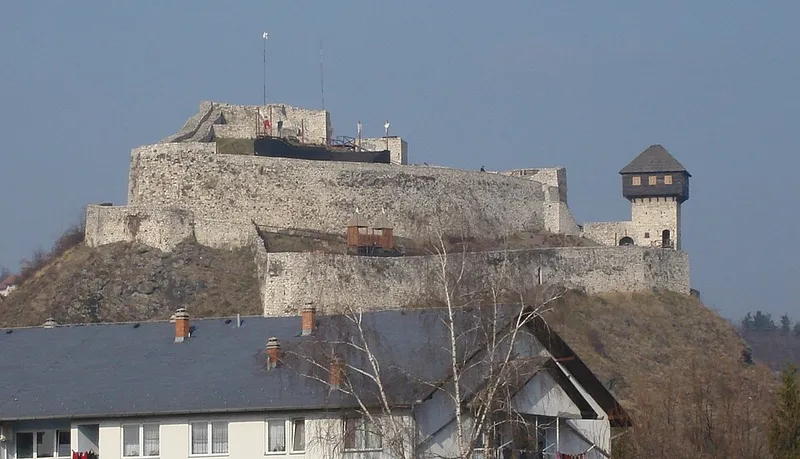
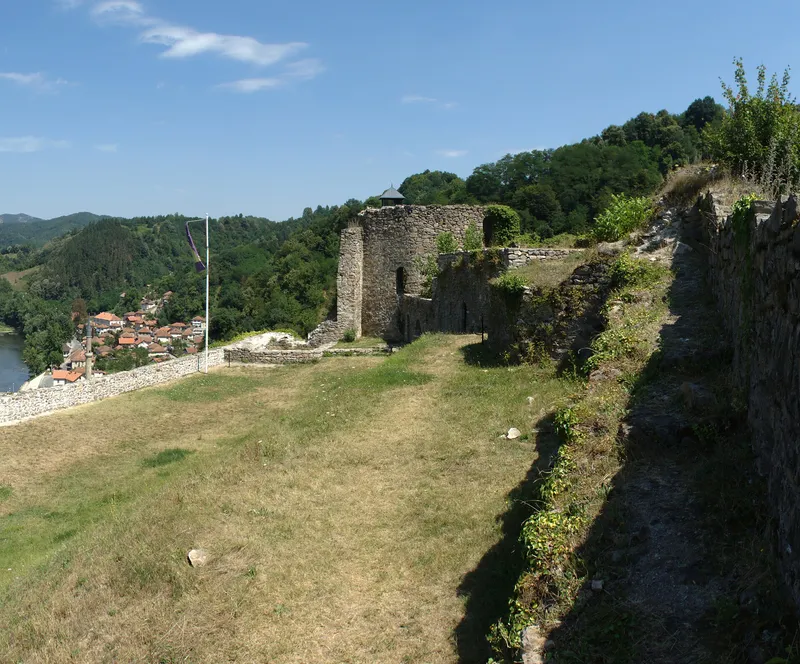
The fortress consists of a medieval core and two baileys added later, one of them with the clock tower on the northern upper plateau. It is reached by the old medieval path, today's Tvrđavska ulica, from the Zagrađe quarter to the south; the main entrance is at the north-east corner. The upper courtyard lies about 6 metres above the bailey and forecourt of the 18th century.
The core held the main tower, whose foundation walls are 3 metres thick and taper upwards so that shot would glance off. The larger part of its lower level was a dungeon, entered through an opening in the wooden ceiling. In the Ottoman period the tower became a gun bastion and its upper floors were taken down. In the north-east of the courtyard is a cistern sunk into the rock, built of tufa set in a thick layer of clay, like those at Vranduk, Doboj and Bobovac. In the 18th century a bailey about 30 metres long and 20 metres wide was added to the north, along with a forecourt on the west and north sides, 110 metres long and 7 to 11 metres wide.
Clock tower and protection
In the northern bailey stands the stone clock tower, square in plan with sides of 3.07 metres. Because it sits on rock, its north side is 17.1 metres high and its south side only 14.77 metres. After 1878 a clock was obtained from Vienna, and under the will of Vasvi-hanuma, wife of Mustaj-beg Uzeirbegović, a bell was bought at the fair in Zagreb in 1923.
The fortress was placed under state protection on 28 October 1950, and extensive excavations followed in 1962 and 1963. In 2005 the Commission to Preserve National Monuments declared it a national monument. Under the decision the site is to be cleared and opened to the public and may be used for education and culture.