The tombstones
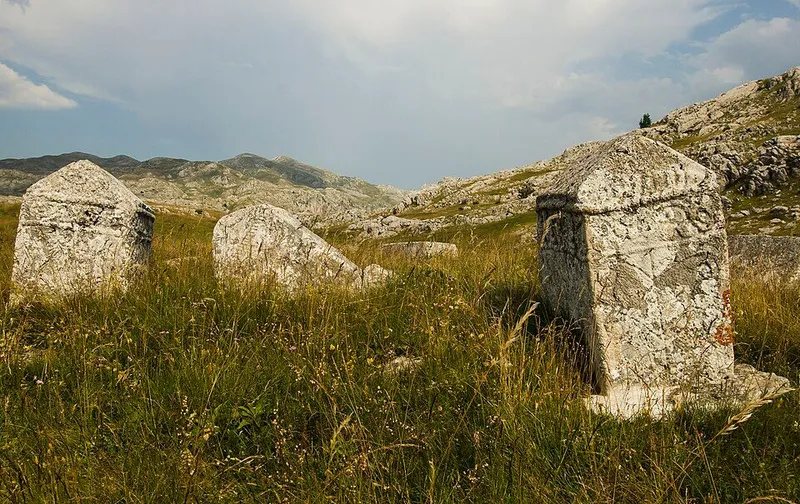
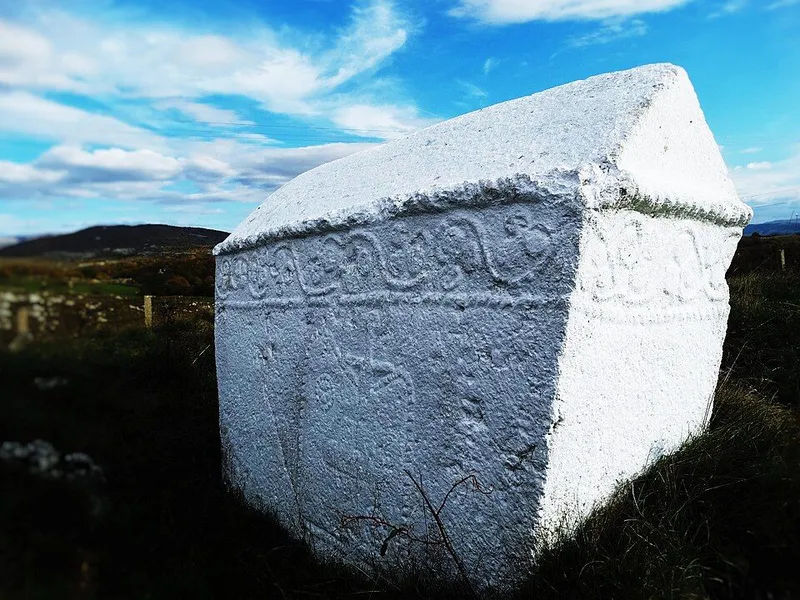
The necropolis lies east of a track that crossed the field from southeast to northwest as early as antiquity; a gravel road bounds it to the north and a private fence to the south. The stones mostly face west to east or, following the slope, northwest to southeast. According to Šefik Bešlagić's survey there are 462: 295 slabs, 150 chests, 3 gabled stones and 14 ancient spolia reused as grave markers. The heritage institute of Republika Srpska counted 464 in 2012, including 136 fragments.
44 stones are decorated. The range of motifs is small: sword, heraldic shield, sword with staff, rosette, crescent, half-sphere and crosses, plain, with a double crossbar, with anchor-shaped ends or in human form. Twisted wreaths and circles recur, and some stones have borders of twisted bands or vines with trefoils. One chest has Saracen arcades on its vertical sides, and two stones, numbers 13 and 41, show a man with shield and sword. There are no inscriptions.
Stone 43: hunt, joust and round dance
Chest number 43 is especially richly decorated. A frieze of vines with trefoils runs along three sides, and below it a deer hunt is incised, framed by a twisted band. The eastern end shows a large shield with a diagonal stripe and crescent, with a sword beneath. On the north side four knights ride in a tournament. The south side is split in two: above, a mixed round dance; below, two horsemen in a duel, with a woman between them holding the reins of both horses, and behind each knight a man with a lance.
Stones 43 and 44 were taken to the Military Museum in Belgrade in 1960, where they were kept as of 2017. No restoration or conservation work had been recorded by then.
Romans and medieval lords
Because the Neretva canyon between Konjic and Salakovac could not be passed, traffic between the Adriatic coast and the hinterland ran across Nevesinjsko polje from prehistory to the Middle Ages. At the Drenovik spring in Kifino Selo, routes from Gatačko polje, from Ulog and Kalinovik, and from Blagaj and Stolac converged, and a large Roman settlement grew up there. Roman remains also lie at the eastern edge of Kalufi: a cippus, seven grooved slabs, blocks with holes for clamps or lead, and slabs with a damaged moulding. Their precise workmanship and Roman units of measure reveal them as ancient.
The Chronicle of the Priest of Duklja names the county of Nevesinje as part of Podgorje in the land of Hum, later Herzegovina. In 1347 it came under Bosnian rule; the Sanković family held it until 1404, followed by Sandalj Hranić, who stayed in Nevesinje in 1404 and introduced customs duties at Konac polje. Nevesinje first appears as a town in the Dubrovnik records in 1429. The Ottomans conquered Nevesinje between 1465 and 1466.
Protection and condition
In March 2004 the Commission to Preserve National Monuments declared the Kalufi necropolis a national monument, and in 2016 it became one of 28 sites of the stećci World Heritage property. The inscribed area covers 1.99 hectares, the buffer zone 9.98 hectares.
The 2017 description calls the condition unsatisfactory. Many stones have sunk, several tall chests and gabled stones have toppled, and slabs and chests are chipped, cracked or broken. Moss and lichen are damaging the stones far more than in the 1960s, so that some of the carving can barely be made out.