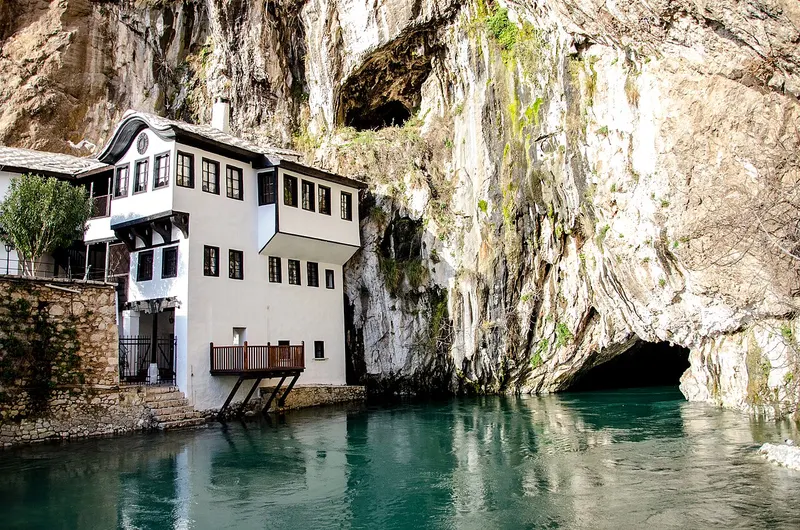
The source of the Buna
The Buna is a short left-bank tributary of the Neretva. It rises at Vrelo Bune, a powerful karst spring that emerges from a large cave beneath a high, vertical cliff. The spring delivers around 30 cubic metres per second of very cold, clear water.
The Buna is home to rare and endemic species, including the softmouth trout, the marble trout and the nase. According to the nomination as a national monument, the spring with its cliffs counts as a geomorphological natural monument and the spring itself as a hydrological one. The Ottoman traveller Evliya Çelebi described Blagaj as a place where eagles do not shun people.
History of the tekke
The tekke probably dates from shortly after the Ottomans took control of Herzegovina, by about 1520 at the latest. It is first mentioned in writing by Evliya Çelebi in 1664. At first it belonged to the Bektashi order; in the 18th century, after being renewed by the mufti of Mostar, it became a meeting place of the Halveti order.
Falling rock has damaged the complex several times. In 1851 Omer-paša Latas, at the request of Sheikh Ačik-paša, ordered the restoration of the tekke, turbe and musafirhana; thirty years later a rockfall destroyed the tekke. In 1952 the regional heritage institute restored the turbe and musafirhana. The tekke functioned as a dervish lodge until 1925, when its last sheikh, Sejdo Šehović, died. After the Second World War dervish activity was officially banned; in 1974 the Islamic Community took the complex over again. In 2003 the Commission to Preserve National Monuments declared the tekke a National Monument of Bosnia and Herzegovina.
What to see at the tekke
The musafirhana, or guest house, and the turbe, or mausoleum, are tucked against the rock and form a single whole with the spring and the mills; the cliff above the buildings is itself part of the sacred ensemble. The musafirhana has a cellar, a ground floor and an upper floor, with a wooden loggia projecting over the river. The roof and gable show the influence of Ottoman Baroque, and the ceiling of the guest room known as the ćošak is decorated with painted wood carving. The bath, or hammam, has a perforated stone dome whose openings were once set with coloured glass.
The turbe contains two graves with wooden grave markers. Who is buried here is not recorded; according to legend it is Ačik-paša, who became sheikh of the tekke in 1848. Near the spring, channels drove mills, one on each bank. Part of the right-bank mill is now a souvenir shop, and of the rest only the stone walls survive.
Blagaj: fortress, mosque and bridges
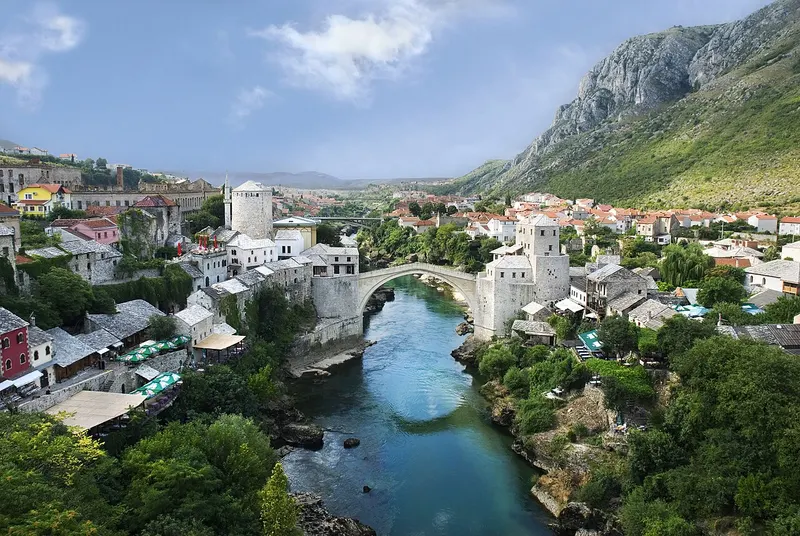
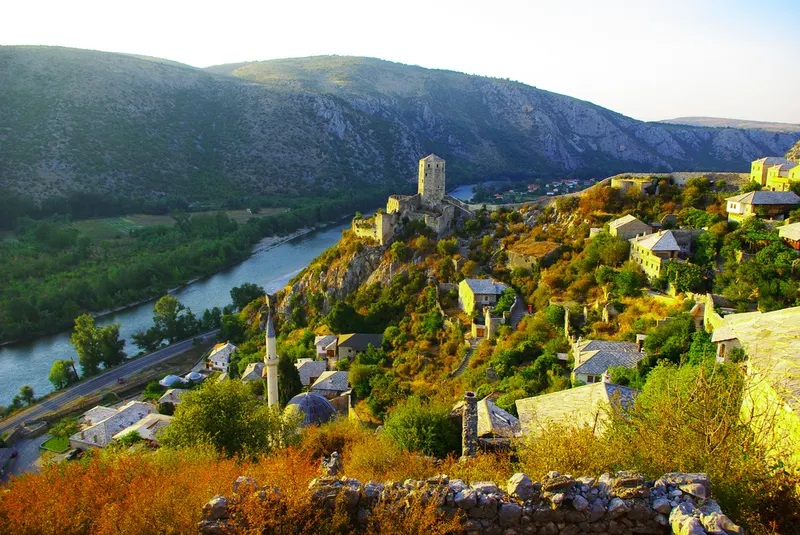
Above the town, on a plateau above steep cliffs, stands the medieval fortress of Stjepan grad, an irregular polygon with seven square towers. At its foot lay the settlement of Podblagaj, first mentioned in 1447. Blagaj became a small town, or kasaba, with the building of the Careva Mosque in 1520/21 close to the right bank of the Buna. The Karađoz-beg Bridge, with five arches, crosses the river; it was built before 1570 and is still in use.
The Velagić residential complex, built before 1776, with its interconnected courtyards paved with river pebbles, shows how people in Herzegovina lived in the past. Since 2007 the natural and architectural ensemble of Blagaj has been on Bosnia and Herzegovina's Tentative List for UNESCO World Heritage.