History
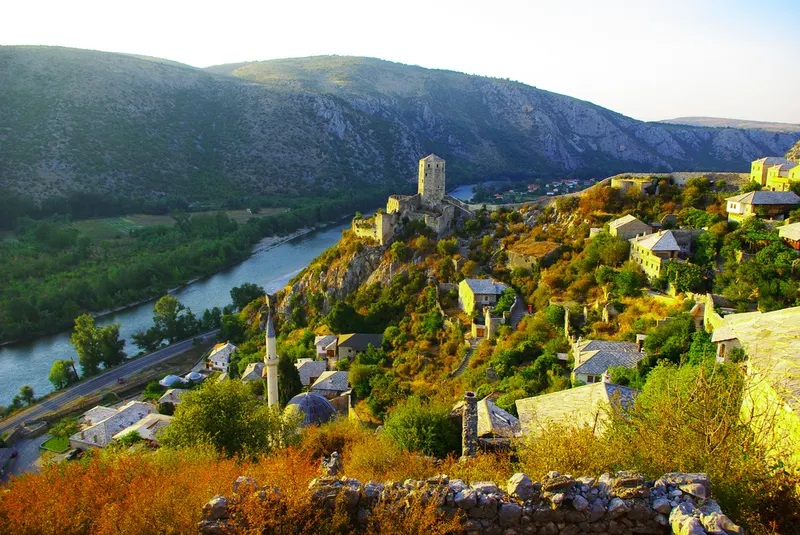
Počitelj lies on the road from Mostar to Metković, about 30 kilometres south of Mostar and 3 kilometres from the centre of Čapljina. The fortified town was probably founded in 1383 by the Bosnian king Stjepan Tvrtko I; in the Middle Ages it was the administrative seat of the Dubrava župa. The first documentary mention dates from 1444. From 1463 to 1471 a Hungarian garrison was stationed here, before the Ottomans took the town after a brief siege. It remained Ottoman until 1878, was the headquarters of the Počitelj military district from 1713 to 1835 and the seat of a kadiluk, a judicial district, from 1782 to 1879.
Under Austro-Hungarian rule from 1878, Počitelj lost its strategic importance and fell into decline, yet it was precisely this loss of its strategic role that preserved its original layout. During the Bosnian war the entire historic site was badly damaged. In 1996 Počitelj was included in the World Monuments Watch, a list of 100 particularly endangered heritage places worldwide. In 2000 the Government of the Federation of Bosnia and Herzegovina launched a programme for the permanent protection and rebuilding of the town.
Fortress and town layout
Počitelj belongs to the group of small medieval fortified towns on a rock with a single tower. Its core is the inner ward with a keep from the late 14th century, extended in the second half of the 15th century. Shortly before 1698 the fortress was considerably enlarged, with the Mehmed-paša and Delibaša bastions, the dizdar's house, a granary, a fortress mosque and a cistern.
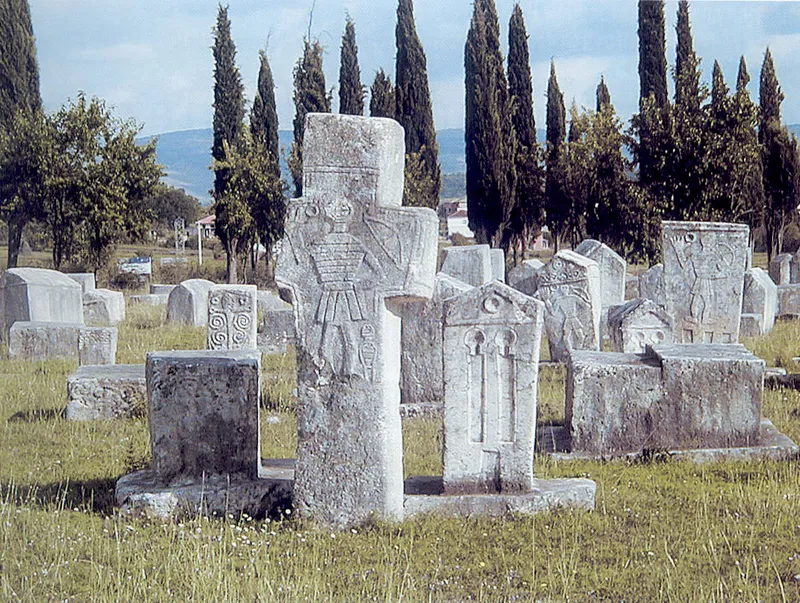
The town is laid out in zones. Down by the Neretva was the čaršija with its shops, han and hammam, behind it the madrasa and imaret, and above them the mosque. The houses climb the slope like an amphitheatre, while the minaret and clock tower provide the vertical accents. There are no graveyards inside the walls; the Great Harem lies outside on the hillside, and its headstone inscriptions go back to 1796.
Mosque, madrasa, hammam and clock tower
The mosque of Šišman Ibrahim-paša, also called Hadži Alija's mosque, was built in 1562/63 according to its chronogram and belongs to the classical Ottoman type of single-room domed mosque. It was blown up in 1993, bringing down the dome and minaret; it has since been restored and is again used as a mosque. The madrasa dates from before 1664; its five classrooms and lecture hall line two sides of an inner courtyard, the classrooms under small domes and the lecture hall under a large one. The hammam is also older than 1664 and was built by craftsmen from Istanbul. The clock tower is built of stone, ends in a stone pyramid and follows a type influenced by Mediterranean and Dalmatian architecture that is also found in Mostar and Stolac.
In 1961 work began on converting the Gavrankapetanović group of houses, dating from the 16th and 17th centuries, into an artists' colony. The complex burned in 1993; after rebuilding, it once again serves as an artists' colony.
Walking route and protection
The main path ties the town together: it climbs up from the river, reaches the walls, passes round the southern and western sides of the mosque, continues between the madrasa and the Gavrankapetanović house and then descends via the lower gate to the gardens of Donje polje. A side path connects the mosque, madrasa, imaret and hammam and leads through a small gateway into Gornje polje.
The walled core is a National Monument of Bosnia and Herzegovina and an open-air museum. Since 2007 the historic town has been on Bosnia and Herzegovina's Tentative List for UNESCO World Heritage.