History of the bridge
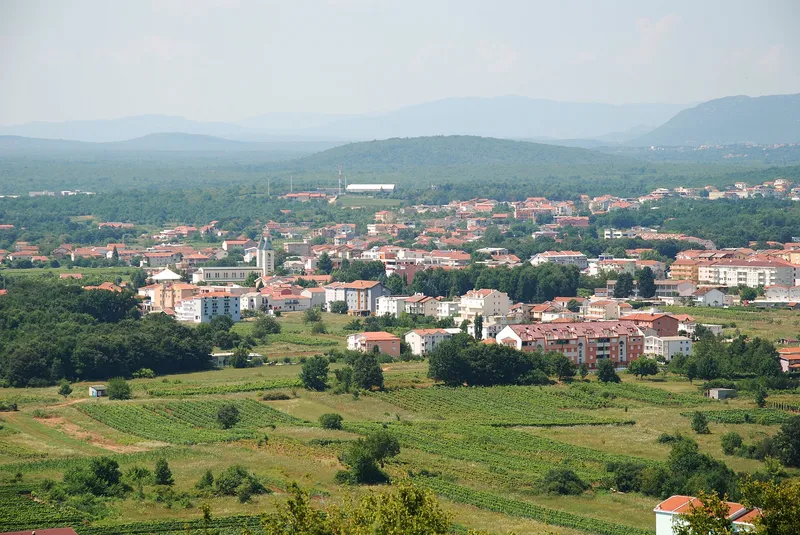
Mostar began in the 15th century as a small settlement where a land route crossed the Neretva, in the valley between Hum hill and the foot of Mount Velež. The name first appears in 1474 and comes from the 'mostari', the bridge keepers. In the 15th and 16th centuries the town grew as an Ottoman frontier town, and it continued to develop during the Austro-Hungarian period in the 19th and 20th centuries.
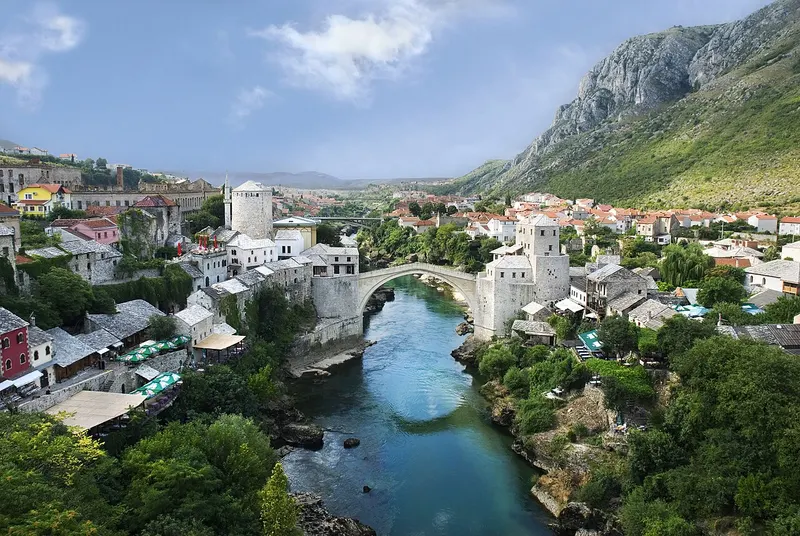
Before the stone bridge, wooden bridges crossed the river. On the orders of Sultan Suleiman the Magnificent, the single-arched stone bridge was built between 1557 and 1566. Its builder was Mimar Hajrudin, a pupil of the architect Mimar Sinan.
Destruction and reconstruction
In the conflict of the 1990s, much of the historic town was destroyed. The Old Bridge collapsed on 9 November 1993 after shelling.
In 1998 UNESCO appointed an international panel of experts to supervise the planning and rebuilding. The new bridge was to be as close to the original as possible, using the same techniques and materials. The builders used tenelija, a fine-grained limestone from local quarries. Divers recovered stones of the old bridge from the river, but most were too damaged to be reused. Work began on 7 June 2001, and the rebuilt bridge was inaugurated on 23 July 2004. Many buildings in the old town were also restored or rebuilt.
In 2005 UNESCO added the Old Bridge area to the World Heritage List. It sees the rebuilt bridge and old town as a symbol of reconciliation, international cooperation and the coexistence of different cultural, ethnic and religious communities.
What to see
The bridge is hump-backed, about 4 metres wide and roughly 30 metres long. Two fortified towers guard it, Halebija and Tara. In the Tara tower on the left bank of the Neretva, the Herzegovina Museum runs a department devoted to the bridge. It tells the story of the town's development and of the reconstruction. Excavations have confirmed that two earlier medieval wooden bridges existed, and the exhibition includes an archaeological site beneath the approach to the tower. From the top of the tower there is a view over the old town.
The World Heritage site is more than the bridge: it also includes the residential quarters known as mahalas, houses, the bazaar and religious buildings. Mosques, churches and synagogues stood side by side here. Not far away, the smaller Kriva Ćuprija spans the Radobolja, which joins the Neretva a little downstream of the Old Bridge.
Bridge diving and tips for your visit
Jumping from the bridge into the Neretva is a tradition among the town's young men. The river is very cold, so the dives are risky and call for skill and training. Once a year, in midsummer at the end of July, a traditional diving competition takes place.
For a view of the bridge and old town from above, use the observation deck in the Tara tower. If you want to understand how the bridge was built and rebuilt before exploring the old town, the museum there is a good place to start.