History of a state secret
Tito gave the order in 1953, as the Cold War was intensifying. In the event of nuclear war the complex was to serve as the centre of military command and to shelter the Supreme Command staff as well as Tito, his family and his close associates. The workers were carefully selected and had to sign a pledge of silence, and only four commanders knew of the project by virtue of their posts. After 26 years of construction the bunker was finished in 1979, having swallowed 4.6 billion US dollars. A detachment of 16 soldiers took over its maintenance.
Once Tito had died in 1980, the bunker was mothballed while being held on standby for war. In March 1992 the JNA general Milutin Kukanjac ordered it blown up so that it would not fall to the government of Bosnia and Herzegovina. Explosives had already been laid, but two soldiers cut the wires as they withdrew. The detachment later handed the bunker over to the Bosnian government, which used it as a supply depot during the war. ARK D-0 remained a state secret until the 1990s.
Inside the bunker
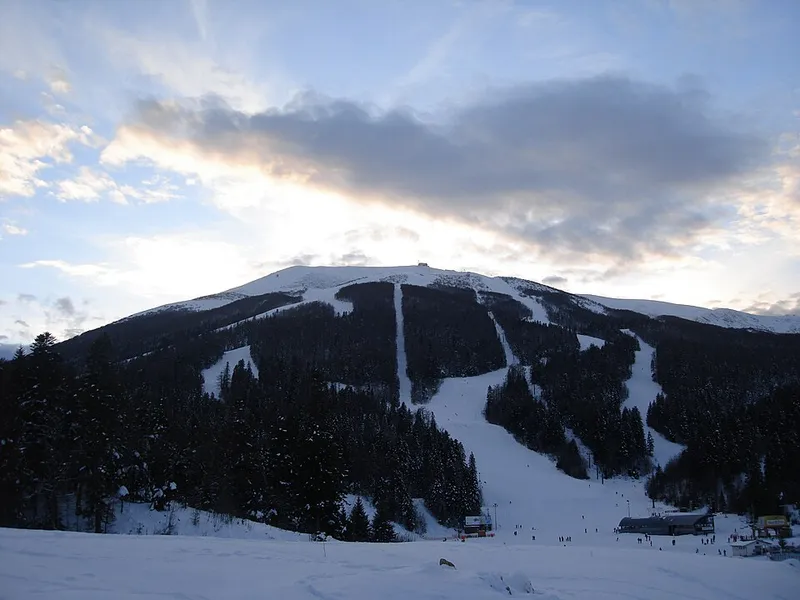
From outside, all you see are three inconspicuous houses that were never marked on any map. They hide the entrances: in the first house, three metal doors 1.2 metres thick guard the tunnel into the hill, a foothill of Bjelašnica. The horseshoe-shaped complex was built to withstand a 20-kiloton nuclear blast and is divided into 12 connected blocks. Its more than 6500 square metres hold over 100 rooms: dormitories, two large conference halls, five operations centres with direct telephone lines to the Presidency, two kitchens, a cryptography centre and a fully equipped operating theatre.
Tito's own quarters in Block 8 have five rooms, among them his office and his bedroom, from which a door led to the room of his wife Jovanka Broz. Up to 350 people were meant to be able to live here for as long as six months. For that there were tanks for 50 tonnes of oil, water tanks holding 170 cubic metres and water from natural springs in the mountain, and every system had a backup. The temperature stays between 21 and 23 degrees and humidity between 60 and 70 per cent, while some 6000 neon tubes light the whole complex.
Art in the bunker
Today the complex comes under the Ministry of Defence of Bosnia and Herzegovina and is managed by the army. It has survived largely unchanged, complete with the symbols of socialist Yugoslavia. In 2014 the Commission to Preserve National Monuments declared the bunker a national monument.
From 2011 the bunker hosted the D-0 ARK Underground biennial of contemporary art, whose first edition brought together 44 artists from 18 countries. Further editions followed every two years until the fifth and last in 2019. The project has turned the bunker into a hybrid of art museum and military museum: 159 works by 119 artists from 37 countries are on permanent display.